

 Blog Details

Introduction
The main reason metal fabrication firms rarely face a work shortage is that most are always busy. It is managing the interplay among production, purchasing, inventory, estimating, scheduling, customer orders, and job costing without resulting in delays and bottlenecks that they really struggle with. One fabrication job may involve purchasing raw materials, cutting, welding, finishing, quality checks, delivery, installation, and invoicing. When these operations are run through spreadsheets and disjointed applications, even the slightest data mistake might cause shortages of materials, production delays, or incorrect job costs.
That is why enterprise resource planning (ERP) has become very significant for fabrication shops. An up-to-date ERP system allows managers a centralized view of past sales, future production, materials availability, ordered items, and the performance of each job for costs. Instead of going back and forth among accounting, inventory, production, and customer management systems, manufacturers may link these through a unified interface. Companies that perform onsite equipment maintenance and installation, for example, need field service software that complements operational oversight by making it possible for office staff and field staff to manage work orders and scheduling; customer records and service history are all kept within one system.
This guide will compare six ERP systems that are most of all well-suited for metal fabrication shops in 2026; these include Fieldy, Jobboss², Global Shop Solutions, Epicor Kinetic, Odoo Manufacturing, and MrPeasy. The features, benefits, drawbacks, price models, industry-applicability, and scalability of each platform will be outlined to help you decide which one fits your manufacturing company best.
Quick Comparison – Best ERP Software for Metal Fabrication
Choosing the best ERP software for metal fabricating largely depends on how complicated your production process is. A small job shop business might look for software that is user-friendly and costs less; however, a bigger production business might require software that supports production scheduling, quality control, cost control, and logistics management.
| 💻 Software | 🎯 Best For | 🏭 Production | 📦 Inventory | 🛒 Purchasing | 👥 CRM | ⭐ Rating |
|---|---|---|---|---|---|---|
| Fieldy | Growing fabrication & service businesses | ✅ | ✅ | ✅ | ✅ | ⭐⭐⭐⭐⭐ |
| JobBOSS² | Small & mid-sized fabricators | ✅ | ✅ | ✅ | Limited | ⭐⭐⭐ |
| Global Shop Solutions | Large manufacturers | ✅ | ✅ | ✅ | ✅ | ⭐⭐⭐ |
| Epicor Kinetic | Enterprise manufacturing | ✅ | ✅ | ✅ | ✅ | ⭐⭐⭐ |
| Odoo Manufacturing | Flexible, budget-conscious businesses | ✅ | ✅ | ✅ | ✅ | ⭐⭐⭐ |
| MRPeasy | Growing manufacturing shops | ✅ | ✅ | Limited | ✅ | ⭐⭐⭐ |
What Is ERP Software for Metal Fabrication?
Enterprise resource planning (ERP) software for the metal fabrication industry is a unified business management system that links together activities such as finance, operations, production, stock, orders, deliveries, sales, etc., of a metal fabrication company.
Imagine that a metal fabrication job is a part of a commercial building. The customer contact is made through the sales team, the request is taken, and a quotation is prepared. Upon approval of the quote by the customer, there will need to be a review of the materials’ availability, purchase of steel or other components not in stock, planning the fabrication work, assigning tasks and other resources, job supervision, and cost-tracking; the end product shall go through several quality checks, and then finally the payment of the bill can be made to the customer. With no integrated system available at the business, the information can be lost or miscommunicated through emails, the accounts of the system in which the business is operated, and various production tools can carry the records.
An Enterprise Resource Planning (ERP) software system integrates and simplifies these activities into a single workflow. The system could keep track of customer details and job records, control the inventory, carry out purchasing tasks, set up the production schedule, and finally send the reports to management so that they can make an informed decision. This means that the manager knows every detail, from how a job ran to the entire company’s situation.
The distinction has to be made by metal fabrication enterprises between broad ERP software platforms for field service and the manufacturing management software modules. Generally, manufacturing ERP only deals with the company’s internal activities such as production, materials, purchasing, accounting, and supply chain. The field service management software features really shine when manufactured goods also involve service work on-site, like installation, inspection, repair, maintenance, or service.
Core ERP Modules for Fabrication
A capable fabrication ERP may include:
- Production planning
- Bill of materials (BOM) management
- Inventory management
- Purchasing and procurement
- Job costing
- Estimating
- Sales and CRM
- Scheduling
- Accounting
- Quality management
- Asset management
- Reporting and analytics
- Workforce management
Variation as vendor is quite obvious here! Before decision, fabrication companies are advised to map out their actual production process rather than being tempted only by Truth is, the package includes a lengthy set of features.
Features to Look for in Metal Fabrication ERP Software
A suitable ERP system for fabricators should be able to cover the entire lifecycle of a specific job from an initial customer inquiry up to purchasing, production, delivery, and payment. Most of the critical features of ERP systems are the ones that stop repeated data entry and, at the same time, allow managers to have timely information whenever they need to make decisions.
Production Planning
Through production planning, managers can find out the things that have to be produced, the timeline for completion, and the resources needed. With a very hectic fabrication workshop, it can minimize scheduling issues and highlight capacity bottlenecks easily.
BOM Management
A bill of materials represents a systematic listing of raw materials, parts required, and their respective amounts needed to manufacture an item or finish a task. Keeping a bill of materials error-free is highly crucial in cases where custom assemblies are being fabricated, and different requirements are specified by each customer.
Inventory Control
In the fabrication industry, the count of finished products is not the only data the factory is looking for. They might also be interested in tracing sheets, plates, tubes, bars, bolts, welding materials, and other things. Proper and effective inventory management prevents production from ceasing in case a critical part is missing.
Meanwhile, companies considering different ERP systems can take a look at our best inventory management software guide to help them better understand what particular inventory features they want to have.
Purchasing
An ERP should integrate material requirements with purchasing processes. At times when stock levels decrease or when a new order calls for materials not currently owned, the purchasing department could locate the needed purchase very efficiently and generate the purchase requisition documentation or the actual purchase.
Job Costing
Job costing is a tool that enables management to see the exact cost a project is taking as against what was first estimated. This is because it makes it possible to analyze labor, materials, subcontracting, overhead, and other charges by placing them side by side with revenue.
CRM and Sales
Customer details must be preserved when a quote changes into a production order. A CRM system gives companies a place for customers, opportunity tracking, and storage of correspondence, while also linking sales activities to ongoing jobs.
Scheduling
In a typical fabrication setup, the shop manager is constantly trying to manage the different priorities, dealing with the shortage of machines and the limited number of highly skilled staff. The use of a good scheduling tool can help them plan and allocate jobs properly, taking into account the resources available and the deadlines to be met.
Reporting and Analytics
Managers should be able to quickly answer questions such as:
- Which jobs are profitable?
- Which materials are being consumed fastest?
- Where are production delays occurring?
- How much inventory is currently available?
- Which customers generate the most revenue?
- Which jobs are approaching their budget limits?
Quality Control
When it comes to the production of structural parts, custom assemblies, or products complying with industry specifications, the quality control mechanisms become even more significant. Using ERP systems equipped with quality workflows allows inspections to be done in a standardized manner and ensures that all the results are properly recorded.
Mobile Access
These days, fabrication shops can be anywhere and not just on a desk. Supervisors and other staff, like technicians, installers, warehouse people, and even those working on-site, may need to have access to the job information in case they are away from the computer at their desk. Mobile work platforms allow them to easily change the work orders, see the customer details, track the work done for the job on the job site, or report the changes via email, for example.
Best ERP Software for Metal Fabrication in 2026
1. Fieldy – Best Overall ERP
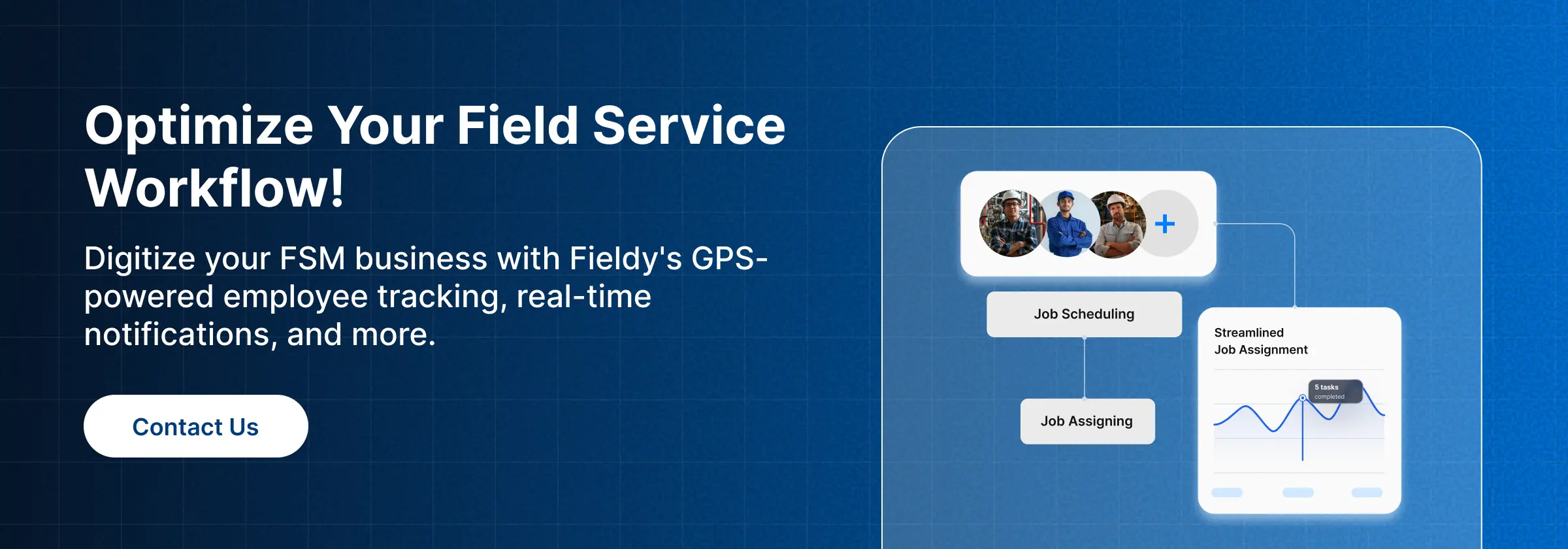
Fieldy is, of course, the very best we know when it comes to manufacturing businesses that want a modern operational solution that incorporates job management, stock buying, customer relations (CRM), time slots, making price lists and getting payments, and service features that happen at the place of the customer. In fact, it allows manufacturing businesses a way to integrate the different aspects of running their operations without making them separate from customer-related activities. This is very useful for a fabrication business that is constantly expanding because their activities also include manufacturing, delivery, installation, inspection, or even servicing a product. For example, a company may fabricate and send a unit to a customer, schedule a maintenance check-up of that unit, handle spare parts, and bill for those services. If the company has to make use of different software for each activity, the history of the customer and job data can easily get scattered. Fieldy brings together customers’ jobs, work orders, schedules, and other operational data so that the team members will have a more holistic picture of the service lifecycle.
From the point of view of top management, what they get is less about the variety of features for producing a manufacturing product and much more about the operational process linkage aspect. With Fieldy, a manufacturing company running in a small workshop can handle customer records, quotation jobs, inventory purchasing schedule, invoices, and field activity from one place only. Truth is, an application with Fieldy features that can be used on a mobile device opens a door for all the non-office personnel.
Small and medium-sized companies will find Fieldy a very good product since it not only covers the basic inventory functionality but also comes with features that large enterprise manufacturing suites only bring. The way the fabrication process is broken up between the office and the field work makes it a very suitable platform for fabrication companies dealing with installation, maintenance, repair, or recurring service. The integration of these functions under one platform helps to streamline the operations of fabrication companies while saving their time and money in using several specialized software packages separately.
Key Features
| ⚙️ Feature | 💡 Benefit |
|---|---|
| 📋 Job Management | Centralizes customer jobs and operational information |
| 📦 Inventory | Tracks parts and materials used across jobs |
| 🛒 Purchasing | Helps organize material purchasing and supplier activity |
| 👥 CRM | Maintains customer and sales information |
| 📅 Scheduling | Organizes jobs, appointments, and field activities |
| 📊 Reporting | Gives managers visibility into operational performance |
| 📱 Mobile App | Keeps field employees connected to job information |
Pros
- Combines job management and field operations
- CRM, quoting, invoicing, and scheduling in one platform
- Inventory and purchasing capabilities
- Mobile access for field teams
- Suitable for growing service-oriented businesses
- Reduces reliance on disconnected operational tools
Cons
- Businesses needing highly specialized heavy-manufacturing functionality may require a dedicated manufacturing ERP.
- Large enterprises may need deeper enterprise-specific production controls
Best For
Fieldy targets fabrication businesses best, for those that combine manufacturing with installation, repair on customers’ premises, or customer-facing service delivery.
Why Choose Fieldy?
Fieldy is a logical choice when a fabrication company desires to handle the wider customer and work lifecycle rather than focusing only on production at the factory.
Fieldy would probably be a good solution for a business that wants to integrate its quoting, client information, job tracking, stock purchasing, scheduling, billing, and mobile field data systems into one single software instead of continuing to run multiple separate applications. For fabrication companies that need to manage scheduling and coordination across departments other than the production floor, learning what field service job scheduling software is can help explain why having a complete scheduling system is important when employees, installers, and technicians are going to customer locations.
2. JobBOSS²
JobBOSS² was mainly customized for the operations and demands of shops and manufacturing facilities that produce custom items, make-to-order goods, or short-run production. Since a general-purpose ERP platform is not as relevant or a fit for these businesses, this system’s focus is much closer to the actual operations of a metal fabrication company. With the help of JobBOSS², shops will be able to handle everything related to managing quotes, estimating production, scheduling inventory procurement, job costing, and shop-floor activities in one system that is integrated.
Fabrication companies that specialize in producing custom brackets, frame assemblies, machined components, or even single customer orders should benefit the most from this specialized software. Because each fabrication order typically involves different types of materials needed, quantities of labor, steps of work, and a delivery date, the link between job estimates and the actual production and the cost of the job should be very clear. So, JobBOSS² is a good fit for manufacturing companies that have become too big for a spreadsheet-based approach but still do not see the need for the full-blown enterprise architecture offered by systems like Epicor.
On top of that, the shop-floor and ongoing jobs tracking capabilities of this platform help managers get insight into what work is currently running and identify where delays might be starting to appear. This manufacturing-focused feature of the platform is a big advantage for traditional shops engaged in fabrication. But firms with a significant part of their operations in the areas of installation, maintenance, dispatch, or mobile service may discover that a manufacturing-centered ERP is not sufficient to meet all their needs since they would require other functionalities as well.
Key Features
| ⚙️ Feature | 💡 Benefit |
|---|---|
| 💰 Quoting & Estimating | Helps calculate job costs before production |
| 🧮 Job Costing | Compares estimated and actual costs |
| 🏭 Production Management | Tracks manufacturing activity |
| 📅 Scheduling | Helps organize jobs and resources |
| 📦 Inventory | Monitors materials and stock |
| 🛒 Purchasing | Supports material procurement |
| 🏗️ Shop-Floor Management | Provides production visibility |
| 📊 Reporting | Supports operational and financial analysis |
Pros
- Strong focus on job-shop manufacturing
- Designed for custom and make-to-order production
- Strong estimating and job-costing capabilities
- Production and shop-floor functionality
- Inventory and purchasing support
- Suitable for small and mid-sized manufacturers
Cons
- More manufacturing-focused than field-service-focused
- May require additional tools for extensive mobile service operations
- Can be more complex than lightweight business management software
Best For
A great fit for small to medium manufacturing companies that make custom products and need a system that can assist them with stronger production, estimation, and job cost features is JobBOSS².
When Fieldy May Be Better
If your business is all about manufacturing, then it’s a good idea to go for JobBOSS². But if your fabrication business sends staff to customers’ premises for installations, repairs, inspections, or maintenance, a wider platform operational scope might give you a better result. Fieldy would be a smart move because it integrates job management, scheduling, CRM, inventory, purchasing, invoicing, and works done out of the office.
Another major factor to consider for businesses with installation or maintenance crews is first-time customer visit results. By analyzing the first-time-fix rate and the job and technician statistics, managers will be able to decide whether the employees in the field have the resources, components, and the proper preparations required to complete the task without the need to go back for the job several times.
3. Global Shop Solutions
Global Shop Solutions is an ERP platform that centers on the requirements of manufacturing and is mainly effective for those organizations that need a high level of control over production, material stock, purchasing quality, accounting, and shop-floor operations.
An advantage is its comprehensive manufacturing-related features integrated into the platform. The software is not designed to be just another production module attached to an accounting system; rather, it reflects the nature of a real manufacturing operation. Fabrication companies dealing with complex production workflows, multiple work centers, detailed job costing, inventory requirements, and quality processes can benefit from such systems.
The downside is that a platform tailored for complicated manufacturing operations may demand more planning and implementation than a simple one. Smaller fabricators may not need all the manufacturing capabilities and might find it unnecessary to have an extensive ERP. That is why businesses should decide if they require a comprehensive manufacturing control system before committing themselves to a system with such a wide functionality.
Key Features
| ⚙️ Feature | 💡 Benefit |
|---|---|
| 🏭 Manufacturing ERP | Connects core manufacturing processes |
| 📅 Production Scheduling | Improves production planning |
| 📦 Inventory Management | Tracks materials and stock |
| 🛒 Purchasing | Supports procurement processes |
| ✅ Quality Management | Helps standardize quality activities |
| 🧮 Job Costing | Measures job-level profitability |
| 💰 Accounting | Connects operational and financial data |
| 🏗️ Shop-Floor Control | Improves production visibility |
Pros
- Strong manufacturing functionality
- Broad ERP capabilities
- Production and inventory management
- Quality-management capabilities
- Detailed operational reporting
- Suitable for complex manufacturing environments
Cons
- May be excessive for smaller shops
- Implementation can require substantial planning
- Manufacturing orientation may not suit service-heavy businesses
Best For
Big old factories needing deep production inventory quality, money management controls.
When Fieldy May Be Better
Mega Shop system probably suits better in an environment where the main goal is factory floor control. Then again, fabrication service providers that operate with many customers could favor a system that will allow for job customer schedule, mobile workers, and field operations data to be equally prioritized and presented in one view.
If your company is involved across production and service locations in the maintenance of equipment and tangible assets, a digital asset management checklist in structured form can assist you in determining what kind of asset data you should capture and what to keep before you go for purchasing an ERP system.
4. Epicor Kinetic
Epicor Kinetic is a versatile ERP platform tailored first and foremost for manufacturers who require advanced control across production, supply chain, finance, inventory, planning, and other key business processes. The platform’s focus on the manufacturing industry makes it suitable for larger organizations engaged in metal fabrication with complex production environments and the need for an ERP system that can keep up with their growth.
Epicor Kinetic is most suitable for organizations where manufacturing is tightly tied to purchasing, supply chain management, financial operations, and operational reporting activities. For instance, a larger metal fabrication company might have to harmonize activities like raw-material purchasing, production schedules, managing inventory levels, customer orders, production costing, and financial performance across different departments. An integrated ERP solution can provide a shared data platform for these activities.
The wide coverage of an enterprise manufacturing ERP can create a need for more resources during implementation and training. A small metal fabrication unit with only a few staff members may not get enough value from this detailed feature set to compensate for the added complexity. Because of this, businesses with sufficiently complex processes and those anticipating continued complexity in their ERP requirements should be the main focus of a detailed evaluation of Epicor Kinetic.
Key Features
| ⚙️ Feature | 💡 Benefit |
|---|---|
| 🏭 Production Management | Controls manufacturing processes |
| 🔗 Supply Chain | Connects procurement and supply activities |
| 📦 Inventory | Provides material visibility |
| 💰 Financial Management | Links operations with finance |
| 📅 Scheduling | Supports production planning |
| ✅ Quality Management | Helps manage quality processes |
| 📊 Analytics | Provides business intelligence |
| 👥 CRM | Connects customer activity with operations |
Pros
- Comprehensive manufacturing ERP
- Strong supply-chain functionality
- Extensive production capabilities
- Suitable for complex organizations
- Broad reporting and analytics
- Scalable architecture
Cons
- Better suited to larger organizations
- Implementation can be complex
- Potentially more functionality than smaller shops require
Best For
Large manufacturing and supply-chain operations of production businesses.
When Fieldy May Be Better
Mid-sized or enterprise customers would be better off with Epicor Kinetic, a product that excels in delivering advanced manufacturing capabilities, as their main requirement will probably be a complex system that does multiple business functions. Though a smaller or rapidly growing fabrication business would probably prefer Fieldy because the system, with its operation-oriented design, offers a more basic and intuitive setup connecting customers, jobs, inventory, purchasing schedules, invoicing, and field teams.
This choice, of one system over the other, becomes more critical for the businesses that create something and then go on to install or service it. Here’s the idea: the best roofing software, or a solution catering in particular to an industry, might get a particular task done, but once the company has a vision to link customer interaction and field operations to broader job-management aspects, the integrated platform turns out to be a better option.
5. Odoo Manufacturing
Odoo’s method is to divide an ERP system into small parts or modules. This lets companies choose and combine apps for manufacturing, inventory, purchasing, CRM, accounting, sales, maintenance, and other functions, etc. Such versatility appeals to fabrication firms who like the idea of creating a bespoke ERP ecosystem tailored precisely to their needs instead of just going with one single rigid software package.
That’s something a rapidly expanding metal fabrication firm that tends to require ERP functionalities that may change over time might find appealing. For example, the company might first only get CRM, inventory control, and purchasing, followed by manufacturing, and then later accounting, maintenance, quality, or other apps. The component-style nature of Odoo makes it very simple for businesses to grow and get more out of their software as their own processes become more mature.
Determining how everything is put in place will overall determine the success of your ERP implementation.
Key Features
| ⚙️ Feature | 💡 Benefit |
|---|---|
| 🏭 Manufacturing | Manages production workflows |
| 📦 Inventory | Tracks materials and products |
| 🛒 Purchasing | Supports procurement |
| 👥 CRM | Manages customer relationships |
| 💰 Accounting | Connects financial processes |
| 🔧 Maintenance | Tracks equipment maintenance |
| ✅ Quality | Supports quality processes |
| 💼 Sales | Connects quotes and orders |
Pros
- Highly modular
- Broad range of business applications
- Flexible customization
- Manufacturing and inventory capabilities
- CRM and accounting available
- Can scale with business requirements
Cons
- Configuration can become complicated
- Customization may require technical expertise
- Total implementation cost depends heavily on scope
Best For
Growing manufacturing businesses that are looking for a flexible ERP platform and have enough resources to tailor the system to the way they work.
When Fieldy May Be Better
Odoo’s great flexibility is perfect for companies looking to build a big, configurable ERP system. If the main aim is to get an integrated operational system for jobs, CRM, inventory, purchasing, scheduling, quotation, invoicing, and field teams with the minimum number of modules to set up, Fieldy can be a better choice.
A fabricator company that has some sales opportunities and customer relationships running at different times could be interested in figuring out the main necessities from dedicated software platforms such as the ones described in guides on best roofing CRM software, mostly if the customers and field work constitute a large share of the business.
6. MRPeasy
MRPeasy is a manufacturing-based ERP system that has mainly been tailored for small and developing manufacturers. A small fabrication shop might in fact see this as a good fit. A company would probably have needs like production planning, inventory management, purchasing, BOMs, job tracking, and reporting, but very limited administrative staff. A system that is simple to implement and use would definitely lessen the strain on the employees who are currently doing several functions.
MRPeasy is probably the best choice for businesses whose main challenge is how to coordinate the production process without the support of a large organization. Truth is, it focuses on manufacture should be taken very seriously and maybe even ruled out by a business that regularly operates field-service teams, makes a lot of installations, or needs highly sophisticated dispatch and technician management.
Key Features
| ⚙️ Feature | 💡 Benefit |
|---|---|
| 📋 Production Planning | Organizes manufacturing activity |
| 🧩 BOM Management | Defines materials and components |
| 📦 Inventory | Tracks stock levels |
| 🛒 Purchasing | Helps manage material requirements |
| 🏭 Shop-Floor Management | Tracks production progress |
| 📊 Reporting | Provides operational visibility |
| 👥 CRM | Supports customer information |
| 💰 Cost Tracking | Helps monitor manufacturing costs |
Pros
- Designed for smaller manufacturers
- Manufacturing-focused functionality
- Inventory and production management
- More accessible than many enterprise platforms
- Cloud-based approach
- Useful for growing shops
Cons
- Less suited to complex enterprise environments
- Field-service functionality is not its primary focus
- Advanced requirements may require additional tools
Best For
If you’re a small to mid-sized manufacturing or fabrication company that needs core MRP capabilities without switching to a large enterprise ERP, the way is still clear to you.
When Fieldy May Be Better
Manufacturing companies should opt for MRPeasy when the only major requirement of the company is to plan and control production activities of the factory. Fieldy, though, might be more beneficial if it also helps schedule, connect work orders, purchasing, stock, invoicing, maintenance, and customer service tasks in a seamless way.
This choice is important for those fabricators who are not limited to the factory. If a business is typically responsible for the installation of the fabricated article beyond maintenance work, they tend to be better served by a platform that keeps track of and updates customer relationships throughout every stage of the job.

Benefits of ERP Software for Metal Fabricators
The greatest advantage of ERP software lies far beyond swapping out spreadsheets. It’s about putting in place a trustworthy system of data exchange that previously unrelated departments have been running separately now get a chance to share. When the sales, purchasing, inventory, production, accounting, and operations departments share the same data pool, managers will quickly spot issues, make informed decisions using up-to-date information, etc.
Better Production Planning
Enterprise Resource Planning (ERP) applications allow production managers to obtain an in-depth view of production activities, including orders received and materials required to meet those orders and other materials required, and an insight into how full the workforce is at a given point in time, plus information that enables the production workforce to know what their deadlines will be. This information makes it much faster and simpler for them to know which jobs they must prioritize, and what the constraints are on the capacity of resources (both machines and staff).
Faster Purchasing
Incorporating purchase orders with current stock and work in progress is an effective way procurement teams can be made aware not just “what” to buy but “why” to buy it. With this information, the buying departments are enabled to order the right goods and quantities at the right time as the company grows or changes and the demands of production get more specific.
Improved Inventory Visibility
In a manufacturing setting, having real-time inventory updates about all your stock is a very valuable thing, actually – raw materials and components will always be changing, in short supply, or being reserved for a certain order. Fabricators get to know their stock levels through their inventory system, i.e., what is available currently, what is allocated to the jobs that are currently in production, and what needs to be restocked.
Lower Waste
Through efficient planning and control, it is possible to prevent many types of unnecessary purchases resulting in savings; to avoid shortages of materials and, as a result, production stoppages; to stop reworks that are not required. These results can affect margins directly after some time passes.
More Accurate Costing
Connecting labor, material procurement, and job cost data allows businesses to identify variances between estimated and actual costs. The insights help management discover which jobs are really profitable.
Better Customer Communication
A well-integrated system will provide order, job schedule, and progress tracking to customer-facing staff in a more holistic fashion. As a result, employees will find themselves less reliant on production or warehouse staff when it comes to obtaining information about the status of goods.
However, ERP (enterprise resource planning) systems come in handy for fabrication businesses that also perform field service, installation, or maintenance tasks. The main idea is to figure out what field service technicians do by spending their working time doing; one has to think about the interconnectedness of job details, spare parts, customer records, service histories, and schedules that must be maintained when work is performed outside the factory.
ERP Software Examples in 2026
ERP Software Examples by Business Size
The best ERP system for a business hinges largely on its size, level of business complexity, no. of users, and the budget available. A small company generally will not require the sophisticated manufacturing, the extended supply chain, and financial controls that a huge global organization needs. A system which is overly sophisticated might lead to additional unnecessary costs for the implementation, whereas a system which is overly restrictive would make the business revert to the use of spreadsheets as well as disjointed software when it increases.
ERP Examples for Small Businesses
Small businesses often gain a lot from implementing ERP systems that are low-cost, easy to deploy, and have modular features. Some well-known examples to consider are Odoo, ERPNext, TallyPrime, QuickBooks Enterprise, and Zoho solutions. Such platforms can handle accounting, inventory, purchasing, sales, and customer info management all under one roof, without having the infrastructure of a large-scale enterprise in place.
For small businesses, having a CRM system is one of the must-have functions because typically their customer data lies next to their sales and service operations. The best CRM for small businesses will not only keep track of customers but will also help in generating new leads, organizing follow-ups, and integrating a sales plan with the rest of the company’s activities.
ERP Examples for Mid-Sized Businesses
Mid-sized companies often require more refined purchasing, inventory, production, financial reporting, and multi-location operation controls. Systems like Acumatica, Sage X3, Epicor, SYSPRO & Microsoft Dynamics provide mid-level businesses with solutions that are more comprehensive than basic accounting/inventory apps, yet not quite as comprehensive as a full multinational implementation. It is also the time when scalability becomes a key thing.
A rapidly scaling manufacturer, distributor, or service-based business usually goes by requiring new user locations, warehouses, workflows, integrations, and reporting capabilities over the years. So, the choice of an ERP should not only focus on the current needs but also on the future changes in the working setup of the business. The system will need to support operations at the size the business anticipates having three to five years from now.
ERP Examples for Large Enterprises
Large enterprise systems typically need an ERP solution that can support tons of financial structures, multinational operations, supply chain networks, manufacturing environments, and regulatory requirements; not to mention the large volumes of transactional data they process each day. SAP, Oracle NetSuite, Microsoft Dynamics, IFS, and Infor are all products that major companies regularly evaluate for their ERP systems. On top of handling business requirements like accounting and payroll, most enterprise-level ERP systems are also able to perform advanced features like production planning and material requirements planning (MRPII/MRP IV).
Larger companies’ ERP implementation projects may cover the company’s various business lines, currencies, national regulations, locations like warehouses and manufacturing units, as well as highly specialized production process workflows. The software alone can only provide a partial solution: the implementation method chosen by your team, data migration processes, integration strategy, end-user training, and IT security and support should all go a long way in ensuring that the results of the project match expectations.
ERP Examples by Industry
ERP requirements differ greatly between industries. A retailer mainly needs an ERP system that can handle inventory, purchasing, sales orders, and financial accounting. A manufacturer, then again, may require an effective production planning module, BOM (bill of materials), quality assurance, and shop floor visibility. Service industries typically still need traditional ERP modules like accounting, HR, etc. But also often need modules like appointment scheduling, work ticket/dispatching, CRM(customer relationship management), mobile capabilities, and technical staff workflows.
ERP Software for Manufacturing
Manufacturing ERP system software is the way to link production planning with all the operations related to materials and purchasing, inventory, costing and quality, and finance departments. Rather than letting production managers rely on their own Excel spreadsheets, and purchasing keep separate inventory records, an ERP integration can present a shared source of data.
The reason that metal fabrication businesses, for instance, can have such high demands comes from Truth is these operations may involve handling raw materials as well as managing cut lists and bills of materials, job costing, production scheduling, scrap purchasing, and inventory of finished products. Those companies that are contemplating the best ERP software for metal fabrication should that means focus only on manufacturing module capabilities and not base their decision solely on accounting or inventory features.
ERP Software for Field-Service Businesses
Field-service organizations operate very differently from the typical office-centric organizations. Although a customer request is the starting point for the work, it may include some front-end work of lead handling, scheduling, dispatching, assigning the technician traveling to work, invoicing, and follow-up, requiring that these functions are linked by an ERP or embedded operational platform instead of coming in their own silos. Scheduling becomes more complex when technicians are operating at multiple locations.
An effective field service scheduling tool can make assigning jobs from a dedicated field service scheduling software on customer locations, skills required vendors priority jobs, time-windows scheduling conflicts etc. Dispatching is focused on building the schedule by not only knowing what jobs are scheduled, but which employee is going to fulfill them, and then coordinating the message out to the field.
Field service dispatching software allows a business to schedule and communicate job details, locations, and status to technicians from one main system. Self-service becomes more useful when service volumes grow. Another feature of field service scheduling applications is that they allow customers to make appointments or order services easily, so they do not need to do manual tracking by the office staff, which can save time and promote customer-friendliness. Customer information is also another vital part of the process.
Integrating customer information into the service history, job communications, estimates, and other operating information of the field service CRM software enables office staff and technicians to be equipped with more context upon arrival at a specific job. Estimates are equally valuable to the contractor and service company, where the initial estimate can, more often than not, be the work order and invoice that will follow.
Field service quoting software can put together a professional-looking estimate, email the estimate for approval, and if approved, move that order into the next step in the service process. When the work has been finished, it must be billed for without delay and without error.
Field service invoicing software has the ability to link work done, labor hours used, parts utilized, and other charges to the invoice sent to the customer, minimizing manual input from the field to the accounting department. HVAC companies make a great case for industry-specific workflows.
It would be the exception if an HVAC contractor didn’t require customer management, preventive maintenance, equipment history, estimates technician routes, parts management, and billing in one application. HVAC field service management software can integrate those workflows and provide technicians with information on jobs.
ERP Software for Retail and E-Commerce
Retail and online stores rely on precise warehouse and ordering details to operate smoothly. Their internal system may have to handle product catalogs, warehouse purchasing, sales orders, customer records, finance, and online shops simultaneously on the same platform. Inventory management, in particular, makes a difference since selling products in greater quantities than are available results in order cancellations and frustrated customers, which in turn can negatively affect your image.
Besides that, having too much warehouse stock is a double expense for the company as it consumes physical space and capital. When they decide which software is recommended for inventory management, companies will be well informed if they check for features such as barcode support, the ability to track stock levels between different locations, purchase orders, reorder level setup, warehouse process modeling, detailed reporting, and connectivity with the sales channels.
ERP Software for Professional Services
Professional-services businesses usually don’t have as many physical inventory items; still, they have their lives and work closely tied to one-on-one or a small group of projects, their people and time, billing cycles, and resource allocation. An ERP or professional-service platform can, because of this, contain modules for project management, employee timekeeping, billing, resource allocation, customer and financial management, among other features.
To give you a real-life scenario, let’s say an engineering company uses the system for creating a project, assigning employees to the various parts of the project, monitoring billable hours, keeping track of project-related expenses, creating bills, and evaluating the actual performance of the project against the budget set earlier. The main advantage here is being able to connect these different functions without having multiple spreadsheets that need a manager doing reconciliation every time.
ERP Examples by Business Function
It is possible that different companies decide to use an ERP system mainly due to one specific operational requirement. Although a whole ERP system can cover many departments, it can be of great help to figure out only the truly needed modules if an ERP’s separate functional areas are considered.
ERP for Accounting and Billing
Financial management is often the key point around which everything else revolves when implementing an ERP solution. The basic accounting features could cover general ledger management, accounts payable, accounts receivable, invoicing, expense tracking, financial reporting, taxation, and payment reconciliation.
Businesses working in India will have accounting requirements that include local taxation and compliance processes. A company that is searching for the best billing software in India should not only look at invoice creation. They should also see if the software is integrated so that it can connect billing to customer payments, accounting records, inventory, and operational transactions.
ERP for Customer Relationship Management
Customer relationship management functions deal largely with the part of the business that involves interaction with customers and customer service. Common features of customer relationship management systems include capturing leads, keeping track of sales contacts, pipeline management, keeping communication history, scheduling follow-ups, recording opportunities, and managing customers through segmentation.
Customer relationship management integration is the reason why sales data shouldn’t be kept isolated within the sales department but should be integrated with other departments. When a customer is turned into a client, the information gathered during the sales process can be passed on to ordering and servicing, billing, and customer service.
So, companies researching the best CRM software in India are advised to look at sales features as well as integrations, automation, reporting, mobile access, and how seamlessly customer data can be connected with other business processes.
ERP for Inventory Management
Inventory management is about knowing what the company has, where those products are, how fast they are being consumed, and when you need to reorder more. A warehouse inventory system might manage the whole lifecycle of stocks, from physical handling of goods to the accounting of the same. For example, it would track how a business stores goods in a warehouse, manages the location of goods, handles batches and serial numbers, makes stock transfers among locations, determines points for the automatic reorder of goods, generates the purchase order, and manages inventory valuation through cost and selling price methods.
If the company operates several warehouses, or has a large catalog of products, being able to see the real-time movement of inventory is critical for avoiding both running out of stock and buying too much. Besides that, a robust system should synchronize the inventory movements with sales, purchasing, production, and accounting. That way, stock is treated as an important and interdependent business component, rather than a separate database.
ERP for Asset Management
Asset management covers all the equipment and other non-current business assets during their complete lifecycle. From purchase and implementation to maintenance, inspection, repair, warranty, depreciation, and replacement, it is all included in asset management.
When dealing with large-scale enterprises, figuring out what enterprise asset management software is a significant step, as it not only maintains a catalog of machines but also allows you to keep your equipment well-maintained, increase its lifespan, minimize breakdowns, and understand the overall costs and performance.
ERP for Contract Management
Many contracts, in different forms, carry substantial business and operational obligations like pricing, service levels, renewal dates, sign-off requirements, and compliance conditions. Managing contracts through a single platform reduces the chance of a big deadline slipping through the cracks and also helps to avoid duplication of efforts or conflicting actions. It is one of the benefits of contract management.
Companies that have a large contract portfolio will probably assess the best contract lifecycle management software options when they need to handle creation, negotiation, sign-off, storage, renewal, and compliance through one structured lifecycle instead of a chaotic network of folders and files (which was common practice before).
ERP for Asset and Maintenance Service
In maintenance-oriented businesses, the key is knowing what equipment needs servicing, when scheduled maintenance should be, what jobs were previously done, and what agreements are still in force. Regular maintenance schedules and repeated service contracts can help a business progress from only fixing things after they break down to regular preventative service.
An enterprise dealing with annual maintenance contracts (AMCs) can benefit from AMC management software, which automates things like recurring schedules, contract renewals, customer notifications, technician scheduling, and service records.
ERP for Field Assets
The biggest issue with field assets concerns tracking equipment, as these may not all be at one particular site since some can be at the customer’s place, in trucks, warehouses, or even technicians’ premises. So, the company has to have an accurate idea of where the asset was, what service it has experienced in the past, the parts that were used, the warranty situation, and maintenance needs.
An integrated field service asset management software can link the machinery records with customer accounts and service work. This allows the repair tech to access the asset’s record before fixing the machine so that he/ she is not dependent on the documents or the customer to narrate the previous issues and repairs.
ERP for Employee and Field-Team Management
Businesses that have mobile workers not only want to be sure who has been assigned to a particular task but also where their workers are and if the assigned task has already been done. An effective workforce management system can link together scheduling, job assignment, attendance, productivity, field activity, among other features.
The use of an employee GPS tracking app can greatly enhance the understanding and coordination of mobile workers in your organization if it is used for the right purpose: the collection of employee field activity information. When it is properly used, data on employees’ whereabouts can help management to optimize working-hours planning and determine the most efficient transportation methods for different customers.
For those companies employing a large number of mobile workers, a field staff tracking app could offer a more detailed picture by, for instance, linking employee records with specific tasks or their location. But the intention behind the use and collection of location data should be to create an environment where better coordination and quality of service are achieved rather than focusing only on collecting location data.
How Do ERP Systems Work? A Simple Example
A plumbing contractor who gets a service request from a business client is a good example. The first step may be to record customer details in the CRM. The software automatically initiates a service request or order and performs a check to see if the necessary parts are in stock.
If the part is readily available, the service will be scheduled. But if inventory is running low, the company’s procurement team may place an order for the missing items. Upon finishing their work, the technicians pass their notes to billing, whereas top-level executives get the latest reports on company finances and operations.
We should highlight here that the system allows staff to work with one data entry instead of entering the same data again in different programs. The information collected by one department will be provided to the next department, thereby creating a seamless flow of information within organizations.
Such an idea will prove to be even more beneficial when the business starts expanding its scale of operations. A process well-suited for 20 customers and three staff members can easily get out of control manually if the company has numerous customers, several branches, many personnel, and millions of transactions.
What Are the Main ERP Modules?
Selling the whole ERP system in one go is not the way most providers do it these days. They break their software into modules like software Lego, enabling clients to pick and buy only those functions that are needed and in tune with their business operations.
Financial operations
Includes the handling of a company’s financial functions such as accounting (both internal and external), accounts payable and receivable, budgeting, financial statements, preparation and submission of tax, reconciliation of transactions to identify errors in payments, etc.
Crm and Marketing
Broadly speaking, this module handles all customer-related activities from capturing leads and identifying prospects, to recording detailed customer information, tracking opportunities, managing sales pipelines, handling communications with customers, and doing follow-ups.
Stock Control
Records are kept of the company’s stocks, raw materials, warehouse products, stock movements, reorder levels, serial numbers, and inventory valuation.
Supplier Acquisition
Dealing with suppliers is part of this module. It covers managing and identifying potential suppliers, processing purchase requests, issuing purchase orders, receiving authorization, and managing the overall purchasing procedures.
Talent Management
Maintains staff information, prepares payroll, tracks attendance and leaves, manages recruitment of human resources, and executes other staff-related activities of the company.
Hiring and scheduling of Jobs
This module keeps a watch on projects being executed, tasks involved, personnel allocated, money budgeted and used, time limits, costs associated, project returns, and other aspects relevant for a successful project.
Production
Aids the planning of the production cycle, materials list for each product (bills of materials), work orders, materials, shop-floor activities, quality assurance, and cost accounting.
Logistics and the Movement of Goods
Integrates and synchronizes the purchasing and supply processes with suppliers, managing stock, organizing transport, handling warehouses, processing orders, and distribution among all parties involved.
Equipment Lifecycle Management
Keeps a record of assets like machines, plans maintenance work, reminds of warranties, maintains logs on services given to the equipment, and handles the information on the life cycle of the asset.
On-site customer support
This feature is for processing customer service requests and planning, organizing, and sending out the technicians to the job sites, issuing service tickets, documenting the service performed, and carrying out all the activities related to the work on the customer site.
Data Visualization
Integrates various modules’ data, which are then consolidated into visualizations showing the performance indicators (KPIs), the finance-related reports, the operating-level reports, and other high-level insights for senior management.
What Are the Benefits of ERP Software?
ERP systems not only unify business data but also provide other benefits. In effect, a good implementation gives a company a shared platform, meaning that each department will make use of the same data, carry out their activities per the company’s standard procedures, among many other things.
Centralized Business Data
Centralized data is among the significant benefits that you will get from ERP software, as it will help you do away with the problem of scattered data. Rather than managing customer details in a CRM, purchasing data in a spreadsheet, inventory records in another program, and financial data in accounting software respectively, an ERP can unify these different data sets.
This way, data entry is done only once, and it is much easier for employees to access up-to-date information. Salespeople are enabled to get details about their customers, an inventory manager is able to know the availability of products, and finance people can get hold of transactional records without the need for every department to have its separate fact base.
Better Inventory Visibility
ERP solutions can help businesses better understand their inventory across various warehouses, locations, and divisions. By using these systems, employees can track what they have in stock, what has been reserved, what is going to be delivered, and how much has been used historically.
This ability becomes essential in manufacturing environments or supply businesses because inventories constitute their major capital assets. Having a more complete picture of where the inventory is can help companies avoid urgent purchasing and overstocking and, because of that, prevent production downtimes and losing orders from customers.
Reduced Manual Work
Automation also offers another significant benefit. By implementing an ERP system, employees won’t have to do the transfer data manually. Instead, ERP can automatically perform actions in response to certain business events.
Let’s say a sales order has been authorized. Then, the inventory system will be automatically updated, the procurement process will be initiated if the quantity of goods is below the required level, and the accounting team will automatically get the necessary details for billing. The sequence in a workflow might be different based on the platform; still, the core stays unchanged: to get rid of redundant administrative tasks anytime, anywhere possible.
Improved Collaboration
ERP software enables different departments to get access to information that might have been a departmental secret before. For instance, sales will be able to see the status of orders, procurement will have the ability to see the upcoming needs, the operations department will know the customer’s commitments, and finance can monitor the financial impact.
Such transparency may help close the loopholes of poor communication that commonly come up when teams depend on email, spreadsheets, and disconnected apps.
Faster Reporting
Preparation of management reports could involve gathering information from various departments, and then the effort of manually matching it would be required. ERP allows reporting much faster because the operational data and financial information are stored together in an already connected environment.
Managers will be able to analyze sales figures, purchase inventory, production spending, profitability, and other metrics without waiting for departments to provide their separate spreadsheets.
Better Customer Service
By providing employees with faster, efficient access to accurate information, ERP software might be helpful in indirectly enhancing customer service. For instance, the employee can locate the information about a customer without contacting several departments.
For service organizations, the advantage will probably be much bigger because customer data could be integrated with appointments, work orders, technicians’ equipment, invoices, as well as service history.
Automated Processes
One of the many tasks that can benefit from automation through ERP systems is approvals, purchasing notifications, inventory replenishment, billing, reporting, and other routine procedures.
The idea is definitely not to replace all decision-making with machines. Rather, businesses are able to automate the administrative steps that are repetitive in nature so they can dedicate their employees’ time and energy to solving issues and handling situations and decisions involving some sort of human touch that cannot be handled by machines.
Improved Decision-Making
Better decisions are a result of having high-level information. With the ability to view sales, inventory, costs, production activities, customers’ activities, and financial performance at the same time, one gets an overall picture which enables detection of patterns and identification of problems much more easily.
If a manufacturer, for example, finds out that a product has always had low margins owing to the material costs and inefficient production, then integrating the data is the way to go. If a company only has access to the separate databases that are siloed, it may be difficult, if not impossible, for them to uncover the root causes and the underlying issues of such inefficiencies in the production or sourcing process.
Greater Scalability
An ERP, if well-chosen, lays the foundation for the company’s expansion. The system is capable of introducing a single workflow throughout the company that is based on one information base, regardless of whether the company grows in employees, customer numbers, number of product lines, number of storage facilities, number of locations, or even new production processes.
But, it would be wrong to equate the word scalability with merely adding up the number of users. It is imperative for the business that the ERP system being implemented is up to the level of the company’s transaction volume, presence in the geographical areas, various integrations with outside systems or data formats, types and frequency of reports produced, and the industry-specific processes that their company engages in.
How to Choose an ERP System
Better to start with what your company does, i.e, the business processes, than with software features. This is one common mistake that firms make: choosing modules based on their appeal and only realizing later if the chosen modules really help in solving their day-to-day problems.
Step 1: Identify Your Business Processes
Document how work currently moves through the organization. Understanding the workflows makes it easier to identify where the existing process breaks down and which ERP capabilities are genuinely required.
Step 2: Determine Which Modules You Actually Need
Do not automatically purchase every available module. Identify the functions that are essential to your business.
A manufacturer might prioritize:
- Production planning
- BOM management
- Inventory
- Purchasing
- Quality
- Job costing
- Accounting
A field-service company may prioritize:
- CRM
- Scheduling
- Dispatch
- Work orders
- Mobile access
- Quoting
- Invoicing
- Asset management
The right ERP is the one that supports the processes that matter most, not necessarily the one with the longest feature list.
Step 3: Decide Between Cloud and On-Premise ERP
With cloud ERP, the user is generally required to connect via the web, and the solution is managed by the third-party vendor who supplies the software. The use of such cloud solutions is known to alleviate quite a bit of the effort that companies would otherwise need to put in maintaining their in-house IT facilities. Most cloud ERP solutions are self-updating.
The on-premises ERP is the type that the company hosts on its own infrastructure in-house, and the system is maintained on it. While this kind of ERP may give more hands-on control of the technical aspect, the company is responsible not only for maintaining but also for the security, upgrades, and the backup of the software system. These aspects are to be handled by a much larger internal IT team.
There is no single or right answer. The option one chooses would be a function of several of the factors that the user has at their disposal, like data security needs, IT staff skills, compliance regulations, capital budget, and preferred business ways, among others.
Step 4: Evaluate Integrations
Most companies have already adopted other software. So, your ERP system must be able to interact with and get along well with other systems that run your business.
Check integrations for:
- Accounting
- CRM
- E-commerce
- Payments
- Banking
- Payroll
- Shipping
- Inventory
- Manufacturing
- Field service
- Reporting
The risk of introducing another data island instead of removing the current one could come about if the ERP system being considered cannot link to the essential systems.
Step 5: Check Industry-Specific Features
Generic Enterprise Resource Planning (ERP) systems can be really strong tools, but they might not fully grasp or be able to customize themselves to the workflows of a specific industry.
For instance, a metal fabrication business would probably depend heavily on BOMs, production routing, material requirements planning/scrap tracking, and job costing. Then again, a contractor might focus more on estimates, scheduling work orders, technicians’ tracking, and managing client communications. As a result, it makes sense that the industry fit should be one of the first things you consider when you’re comparing the platform options of ERP solutions.
Step 6: Compare Ease of Use
It is of no or minimal value for an ERP system to be highly advanced technically to employees who have a very hard time using it.
When they demonstrate, ask them to perform the real-world use of the system, not by showing all the different features. Assign your team to carry out the most common tasks such as initiating a purchase order, checking stock availability, managing work order schedules, creating invoices, and reports, respectively.
Eventually, whether the software will deliver value or not will mainly depend on how well the user community gets familiar with it. So, it is a wise choice to get software whose user-friendliness is well tested and established.
Step 7: Review Security and Permissions
Business management software, i.e., Enterprise Resource Planning (ERP) systems, is capable of managing and organizing data related to the company’s finances, customers, employees, suppliers, and day-to-day operations. So, reviewing what a user can do with the system, what means of verification he uses, whether actions of the user are traceable, how the data is backed up, the methods of access control, and the overall security procedures becomes a top priority at each point to avoid any loss of sensitive information to unauthorised users.
Different employees may naturally have different levels of access to certain parts of the ERP software. That is why implementing a role-based permission model is a secure way to determine the areas of the system an employee can use that align with their job tasks.
Step 8: Calculate Total Cost
The software subscription is only one component of ERP cost.
Consider:
- Licensing
- Implementation
- Data migration
- Training
- Customization
- Integrations
- Hardware, where applicable
- Ongoing support
- Internal administration
A low-priced platform is sometimes misleading since, if there are major demands for implementation and customizations, it could end up costing a lot more.
When comparing the best ERP software for the business, apart from the subscription cost, businesses should also consider the overall expenses for ownership and not only rely on the monthly or annual subscription advertised.
Step 9: Test the Platform With Real Workflows
A trial account might superficially look very attractive, yet be totally unsuitable for actual work and miss many important processes needed for day-to-day work.
Develop a real-life testing situation by using your own data and workflows. A good example is that a manufacturer can simulate the entire customer order process: from quotation until purchasing, production, inventory depletion, delivery, and invoicing.
Such an approach reveals shortcomings in workflow long before a product demo can demonstrate such defects.
Step 10: Consider Long-Term Scalability
One of the last steps is to evaluate the future directions of the business. An ERP system will need to scale with the growth of users, locations, customers, products, transactions, and operational complexity.
The idea is not to purchase the largest system in the market but to find a platform that will support the business well enough that there is no need for a costly system replacement shortly after its installation.
ERP Software vs. Other Business Software
ERP software overlaps with many other categories of business applications, but the primary difference is the scope of integration.
ERP vs. CRM
A CRM is mainly concerned with customer-related activities like managing leads, opportunities, contacts, sales pipelines, and communication. Then again, an ERP system is generally used for supporting various core business operations like finance, purchasing, inventory management, production, and operations.
In cases where the CRM system of a company offers advanced sales features and the ERP deals with operational aspects like production, finance, sales, etc., a company can choose to have both systems. For example, a CRM can provide a very sophisticated front-office sales and customer care environment with a powerful set of features, whereas an ERP system covers lots of internal operations or functions of the business with a less flashy but comprehensive interface to help the user to manage various business operations at once. A company may have both systems at the same time if its CRM has highly functional sales features, but the ERP handles the back-office operations.
ERP vs. Inventory Management Software
Inventory management software centers largely, if not entirely, around stock, warehouses, purchasing, products, and inventory movements.
In comparison, an enterprise resource planning system, or ERP, might offer inventory management services and go the extra mile to integrate inventory with accounting, sales, purchasing, manufacturing, projects, and other areas of business operations.
A small retail store might require only inventory management. Though, for a manufacturer with production, finance, purchasing, and supply-chain demands, it would be more favorable to have a complete ERP system.
ERP vs. Accounting Software
Software for accounting handles mainly financial transactions and reporting. ERP system, however, goes further to include other business activities and processes besides finance.
The illustration below could help you understand it better: accounting software will basically record that the company has purchased raw materials, but the ERP system will tie that purchase to the supplier, purchase order, receipt of raw materials, demand for production, a customer order, and finally a financial transaction.
ERP vs. Field Service Management Software
Even though ERP systems can handle some field-service features, they’re still not as good at it as a field-service solution, which focuses on technicians and mobile operations.
In the field service environment, real-time scheduling and dispatch, GPS visibility, mobile work orders, technician communication, service history, and customer appointment management may be a necessity.
If so, a service company should check if its existing ERP is capable of such a level of work and otherwise decide to introduce a field-specific platform that works best together for operations.
ERP vs. Asset Management Software
Asset management involves keeping track of items like machinery, equipment, and other physically tangible properties by maintaining records about their condition, service warranties, and lifecycle.
An Enterprise Resource Planning (ERP) system might have the ability to handle some asset management functions. However, enterprises with large equipment fleets or complex maintenance operations often necessitate deeper asset features.
ERP vs. Contract Lifecycle Management Software
Contract lifecycle management deals in particular with contracts from the earliest phases, like creation and negotiation, all the way to approval, execution, renewal, and expiration stages.
It is common for one of the core systems, like ERP, to house customer and supplier contracts only. Still, it is organizations with complex or extensive contractual requirements that can really profit from specialized and comprehensive Contract Lifecycle Management solutions.
The most significant issue here is not whether the ERP system in question is physically capable of carrying out a particular action. What matters is if the ERP is so in-depth in depth with performing a certain action that the organization’s needs and expectations are fulfilled.
ERP Integration Examples
Integrations allow businesses to keep specialized applications while connecting their information to the central ERP environment.
CRM Integrations
In addition, sales teams should get a chance to be one with other departments, e.g., finance and operations, by making sure their customer information is the same through CRM integrations.
And, when these integrations are done properly, it results in sales and non-sales departments relying on the same set of customer information, eliminating the problems that come with operating based on different customer data versions.
Accounting Integrations
To keep it efficient, accounting integration would be extremely helpful if the financial system of choice isn’t provided through an ERP. Transactions like invoices, payments, expenses, and balances with customers may have to be transferred between different platforms.
Inventory Integrations
Inventory integrations can act as a link between ERP systems, warehouse platforms, e-commerce stores, POS, and inventory management systems for a particular product line or service.
Such a system enables companies to keep inventory records up to date and consistent at all times across various sales and operations streams or channels.
Payment Integrations
Payment system integration enables invoices to be linked with payment processors or gateways. Upon receipt of payment, the respective transaction will also impact the customer records and the accounting records.
E-Commerce Integrations
Businesses that sell in shops and on the internet usually require integration of their ERP system with online storefront management systems as well. Sales orders enter the ERP system while the changes in stock and fulfillment data go to the external customer-facing systems.
Field-Service Integrations
Sometimes service businesses may connect ERP platforms to field service specialized software to manage appointment booking, staff allocation, mobile job tickets, tech GPS monitoring, and customer support.
Pretty much when ERP is well-versed in accounting, material sourcing, or goods handling, it makes sense to go for such integrations, in particular in those departments that deal with onsite work. After all, not all businesses want to spend a fortune developing custom software from scratch.
Asset Management Integrations
Integrations between asset management systems make it possible to synchronize equipment records, maintenance events, service history, and replacement data between operational and enterprise systems through a process of data sharing with the help of automated software interfaces.
A major goal of the integrations is to ensure that vital asset information remains accessible and is not locked up or isolated in a dedicated software application.
How Much Does ERP Software Cost?
Here are some common ways that pricing is done:
Subscription Pricing
Cloud ERP systems are usually paid via monthly or yearly subscriptions. The cost can depend on the user package, module, or feature level.
Per-User Pricing
In some cases, the platform will mainly use user count and type to estimate licensing. So it’s up to companies to decide if all staff require regular licenses or if the software vendor offers different roles for users.
Module-Based Pricing
Certain ERP systems offer businesses the option of choosing individual modules only. Such a feature can be mostly enticing when a company’s requirements are very limited to certain functions, but paradoxically, it may become very costly when the company gets additional modules.
Enterprise Pricing
Major ERP vendors usually prepare tailored price offerings to reflect the size of the organization, the extent of its needs, the scope of implementation, and the type of contract entered into by the parties.
How Long Does ERP Implementation Take?
It is a matter of time. Sometimes months, sometimes only days.
An easygoing small business deployment might be completed in weeks, but if the company mostly does the same work processes, the time needed may extend to some months.
A medium-sized rollout, in particular when it includes data migration, a number of departments, integrations, and a revamp of processes, may take several months.
A large-scale enterprise rollout can span months or even a year, mainly when such a rollout spans different locations, departments, countries, legacy systems, etc., and the work also includes setting up custom workflows, extensive integrations, and other such work.
What matters most is not the software installation time, because before the system is actually used in operation, companies need to spend time on data cleansing, workflow configuration, employee training, process testing, problem-solving, etc.
Final Verdict
No single ERP system is the ultimate solution for all businesses. The different ERP systems used in the guide are clear proof of this, as it highlights the wide range of functionalities that vary with company sizes, industries, and ways of operating. The manufacturers may put all their efforts into production and the supply chain; the retailers may want inventory and e-commerce integration, and service businesses may need scheduling, dispatch, CRM (customer relationship management), quoting, invoicing, and mobile workforce management.
Fieldy can be the perfect choice for companies in services that want a system with a wider scope than just accounting, inventory, or CRM software because its feature set, including customer management, scheduling, dispatching, quoting, invoicing, work orders, inventory, asset workflows, and field operations, is tailor-made for companies where employees typically spend quite a lot of time away from the office.
If companies opt for a Fieldy integrated workflow instead of combining customer relationship software jobs schedules technicians, inventory, and billing programs separately, then they can see if it will complement the way they run their business. For HVAC, plumbing, electrical, cleaning, roofing, pest control, and other services, it’s possible the connection in business operations could be even more important than installing an ERP mainly built for large manufacturing or finance operations.
If you’re a company that’s planning for an all-in-one solution to handle customers and field workforce alongside inventory, scheduling, pricing, and billing, look no further than Fieldy.