

 Blog Details

Introduction
From restoring air conditioning in a blazing summer heatwave to bringing back internet connectivity for businesses, field service technicians are essential for maintaining the functioning of households, commercial establishments, and critical infrastructure. These individuals are the embodiment of a service company for the customers, solving problems on-site, combining their technical background with a friendly demeanor.
Due to industry integration and rising consumer requirements, apart from repairing, technicians also undertake an array of other duties. A modern-day field technician is the one who carries out repairs, installs new systems, performs preventive maintenance works, does the inspection of the installed facilities, keeps the work log, gives customer assistance, and ensures adherence to safety regulations, all these while traveling between a large number of sites.
Technological innovations have changed field workforce dynamics. The paper-based tools like schedules and forms got replaced by technological gadgets like mobile apps, GPS tracking, digital work orders, and software tools like online databases and cloud-based management systems. Technicians now, with real-time access to customer info and job updates, can be more effective while also delivering an even better customer experience.
No matter if a person repairs air conditioning, plumbing issues, is a qualified electrician, or deals with telecom services, medical equipment, pest control, utilities, and household appliance repairs, expert field service personnel remain one of the top assets for service-related enterprises. Gaining insight about their roles, the skills required, and the equipment they regularly use helps a company to grasp the fact that they are a vital part of current-day field service operations.
What is a Field Service Technician?
A field service technician is a qualified professional who provides on-site repair services at customers’ homes or workplaces following an agreement. The difference with ordinary employees in office jobs is that these people deliver goods or services while standing outside or entering the clients’ property.
They do different roles in different industries, but their goal is to make sure that machines and equipment run properly without malfunctioning and that customer needs and inquiries are promptly responded to.
Maintenance technicians usually face situations alone, and they have to make instant decisions in a very practical and technical working environment where knowledge of the subject and creative thinking skills complement each other.
Industries That Employ Field Service Technicians
Field workers find jobs in many different areas where mobile service teams are needed. Here’s the list of such departments:
- HVAC and refrigeration
- Plumbing
- Electrical services
- Telecommunications
- Medical equipment servicing
- Utility companies
- Pest control
- Appliance repair
- Fire protection systems
- Security system installation
- Elevator maintenance
- Landscaping equipment servicing
Although requirements vary across fields, one major thing that all industries have in common is relying on professional field workers to ensure that devices are working safely and effectively.
People are commonly asking, “What are field service companies, and how do they differ from other kinds of businesses?” Field service companies do not require their customers to be present at the place of service. Instead, a team of mobile workers, who travel with the company, offers their services. They are responsible for performing installations, making minor and major repairs, conducting inspections, and providing emergency services, etc.
Field-Based vs Office-Based Roles
In addition to office staff, field technicians play their part in successful service delivery, and yet their duties are vastly different.
| 🏢 Office-Based Employees | 🛠️ Field Service Technicians |
|---|---|
| 📅 Schedule appointments | 🔧 Complete on-site work |
| 🚚 Coordinate dispatching | 🩺 Diagnose equipment issues |
| 📞 Manage customer calls | 🛠️ Perform repairs |
| 🧾 Process invoices | ⚙️ Install equipment |
| 🗂️ Handle administration | 🔍 Conduct inspections |
| 📦 Track inventory | 🎓 Educate customers |
They both team up closely to complete a job as quickly as possible and also deliver services in the minimum time to the customers.
What Do Field Service Technicians Do?
A field service technician’s responsibilities are far more varied than just fixing machines. They need to make good impressions for the business and also make sure that the service they provide each and every customer is safe, reliable, and of the highest quality.
Every technician’s days vary a little from one day to the next, but they mainly perform a set range of tasks, as outlined below.
Customer Visits
Every job starts with an expert technician being dispatched and going to the customer’s location. These service experts may travel by ground or air to:
- Residential homes
- Office buildings
- Manufacturing facilities
- Retail stores
- Hospitals
- Schools
- Construction sites
Cutting to the moment they arrive, they inspect the scene, go through any customer worries they raised, and finally, they proceed to inspect the gear or outfit that the customer needs help with. It is during these face-offs that a good service ethic is displayed, which helps a customer believe in you and the service.
Equipment Installation
Many technicians install new equipment as part of their daily responsibilities. Examples include:
- Air conditioning units
- Boilers
- Plumbing fixtures
- Electrical panels
- Network hardware
- Medical devices
- Security systems
- Commercial appliances
Proper installation ensures equipment operates safely while minimizing future maintenance requirements.
Repairs and Maintenance
Repair work accounts for one of the largest segments of a technician’s workload. Standard activities consist of:
- Replacing worn components
- Repairing damaged systems
- Conducting preventive maintenance
- Testing equipment performance
- Calibrating instruments
- Cleaning mechanical components
Scheduling preventive maintenance can sometimes save a lot of money for the client or even the business by spotting minor concerns that are easy to fix instead of dealing with an unexpected breakdown that could cost a fortune.
Troubleshooting Technical Problems
A field technician is a professional problem solver. They use a combination of knowledge and skills to identify, diagnose, and repair any kind of mechanical problem without the need to make unnecessary part replacements. In their diagnostic work, one of the best methods is to use advanced diagnostic devices coupled with the manufacturer’s technical guide. A well-organized and effective troubleshooting technique will definitely shorten the repair period and really increase the ratio of first fixes made on-site.
Documentation
Modern service organizations rely on accurate digital documentation. Technicians typically record:
- Work completed
- Parts used
- Labor hours
- Equipment readings
- Inspection results
- Customer signatures
- Site photographs
Accurate documentation supports future maintenance, warranty claims, compliance requirements, and customer communication.
Safety Compliance
Safety remains one of the technician’s highest priorities. Depending on the industry, technicians may follow procedures related to:
- Electrical safety
- Lockout/tagout
- Working at heights
- Hazardous materials
- Personal protective equipment (PPE)
- Environmental regulations
Following established safety standards protects both technicians and customers.
Customer Communication
The possession of technical know-how in isolation is inadequate. The best technicians not only solve the problem but at the same time give the customer the whole picture, i.e., a thorough explanation; they engage the customer by explaining all possible avenues, they answer the customers’ questions, and last but not least, they offer maintenance advice that goes with the territory and in the long run results in the equipment’s longer life. Good communication with your customers brings your business more orders and more positive comments.
A Typical Day in the Life of a Field Service Technician
Although every workday differs depending on the industry and service requests, most technicians follow a structured workflow that balances customer service with operational efficiency.
Before Leaving for the First Job
The day usually begins by reviewing scheduled appointments. Technicians check:
- Daily routes
- Customer information
- Work orders
- Required tools
- Replacement parts
- Safety equipment
- Vehicle inventory
Preparing thoroughly before departure reduces delays throughout the day.
During Customer Visits
At each location, technicians:
- Greet the customer
- Confirm reported issues
- Inspect equipment
- Diagnose faults
- Perform repairs or installations
- Test completed work
- Explain results
Maintaining professionalism throughout the visit contributes significantly to customer satisfaction.
Completing Work Orders
When the technicians are done with their tasks, they finish up the digital work orders and then leave the site. Usually, this entails :
- Recording completed tasks
- Updating equipment history
- Logging parts used
- Capturing customer signatures
- Uploading photographs
- Generating invoices when appropriate
Standardizing the field service management workflow will allow a seamless flow of information between your technicians and office colleagues, minimizing paperwork backlog for the administrative staff.
End-of-Day Reporting
Before finishing the workday, technicians typically:
- Review completed jobs
- Submit outstanding documentation
- Report inventory usage
- Restock vehicle inventory
- Confirm next day’s appointments
- Communicate unresolved issues
These activities help prepare both technicians and dispatchers for the following day’s schedule.
Essential Skills Every Field Service Technician Needs
Knowing technical matters is the first step in building a strong career as a technician, but that is not enough to guarantee success. The best in the field are those who bring in their communication skills, being organized, and the ability to quickly switch from one situation to another.
Technical Skills
Every technician must understand the equipment they service. This includes:
- Equipment diagnostics
- Mechanical systems
- Electrical systems
- Manufacturer specifications
- Installation procedures
- Repair techniques
- Preventive maintenance
Continuous learning is essential because technology evolves rapidly.
Communication Skills
Technicians regularly interact with customers, dispatchers, suppliers, and colleagues. Strong communication helps:
- Explain technical issues clearly
- Build customer trust
- Prevent misunderstandings
- Improve teamwork
- Resolve problems efficiently
Excellent communication is often what separates good technicians from exceptional ones.
Problem-Solving
Difficulties come about in most work situations. Technicians have to be capable of analyzing circumstances swiftly, determining the causes behind the problems, and proposing solutions that actually work, despite the limits of time constraints they are under. The skill of making good judgments through critical thinking is an indispensable component of this job.
Time Management
Organizing a schedule for several appointments in different places requires some detailed thinking. Efficient technicians sort out the most urgent tasks they are handling first, travel as little as possible, do their jobs rapidly, but maintain a good service level.
Customer Service
Miscellaneous tasks performed by field service technicians are not only technical matters, but they also act as an extension of the company. Customer experience, which is influenced by elements like timely arrival and manner of conduct, is a direct consequence of this representation.
Safety Awareness
Safety regulations in each industry should be second nature to every technician as they work on-site. Safe behaviors are among the top accident prevention methods and, at the same time, safeguard customers, staff, and the business premises, etc.
Digital Literacy
Modern-day technicians work on various portable devices like mobile phones or tablets and cloud computing platforms. A good grasp and usage of digital technologies are nowadays comparable to having technical skills in many service sectors.
Tools Every Field Service Technician Uses
Cutting-edge tools empower the technicians to get the job done efficiently with top-notch professional standards. Besides being different from one industry to another, the tools used by the technicians for their work can be clustered into a few main groups, which are very common across various field service jobs.
Hand Tools
Most technicians carry a core toolkit containing items such as:
- Screwdrivers
- Adjustable wrenches
- Socket sets
- Pipe cutters
- Pliers
- Wire strippers
- Utility knives
- Hammers
- Tape measures
These tools support routine installations, maintenance, and repairs.
Diagnostic Equipment
Technicians use specialized instruments to identify equipment problems accurately. Examples include:
- Digital multimeters
- Pressure gauges
- Leak detectors
- Thermal cameras
- Refrigerant analyzers
- Network testing devices
- Voltage testers
Accurate diagnostics reduce repair time and improve first-time fix rates.
Personal Protective Equipment (PPE)
Safety equipment commonly includes:
- Safety glasses
- Gloves
- Hard hats
- Steel-toe boots
- High-visibility clothing
- Respirators
- Hearing protection
PPE requirements vary depending on the work environment and applicable regulations.
Mobile Devices
Handheld devices of the modern generation are very well suited to serve the purposes of technicians. A well-designed field service app for technicians will help staff members access schedules, customer data, work orders, directions, and historical service records without going back to the office.
A field service app for technicians that features lots of functionalities goes far beyond scheduling – it gives the possibility of doing digital inspections, attaching pictures, getting signatures from customers, changing job statuses, a real-time communicator with dispatchers, etc.
There are times when businesses rely on the features of field service management apps for technicians like user-friendliness, availability to get along online and offline, ability to generate reports, GPS capabilities, among others, to evaluate which apps would enable their technicians to work at their best throughout the day.
The Importance of Field Service Management Software
Trying to manage a mobile workforce without the help of digital tools is one of the easiest ways for a company to become a chaotic mess. While the volume of service requests and the demands of the customers both go hand-in- hand, you have to have a system that is central and connects office personnel, service technicians, customers, and business information in real-time.
To streamline field service operations, modern FSM software combines scheduling, dispatching, work orders, customer service, data analytics, and invoicing into a single solution. There is no need anymore to use paper forms and spreadsheets, and to make a lot of calls, as technicians will get all the necessary information directly on their mobile devices.
Smart Scheduling
Good scheduling leads technicians to provide more services to customers in a day and minimizes idle time. Using modern field service scheduling software can help you save even more time by efficiently allocating appointments, respecting available technicians’ time slots, reducing scheduling errors, and overall allowing your business to keep your technicians fully occupied during the workday.
The benefit of this is that you are not only becoming more productive, but you will also be able to serve customers much more quickly.
Intelligent Dispatching
Dispatcher work is quite challenging since the emergency service is usually the priority for them, plus their current appointments.
Field service dispatch software gives managers the ability to find the closest technician qualified for the work, assign a job instantly, determine optimal routing, and quickly deal with an unforeseen service case. Real-time dispatch allows you to handle your business more efficiently and, at the same time, cut down on unnecessary driving.
Customer Relationship Management
Technicians provide better service if they know the customer’s history before coming to the customer’s place.
An integrated field service CRM software platform combines all customer info: contact details, past repairs, equipment records, warranties, maintenance agreements, and history of contact. Having everything in one place lets the field technicians provide speedier & bespoke services.
Faster Estimates
The preparation of professional estimates on-site helps customer confidence and, at the same time, speeds up the closing of a deal.
Thanks to the field service quoting software, a technician can produce his/her quote that fits one of the company templates, send it to the customer’s email, and get approval instantly. Then, there would be no more paperwork, and the work could be started right away. This kind of digital quoting also helps maintain the same pricing standards across the company.
Automated Invoicing
In fact, a company should start billing right at the end of a job, which is before several more days. A top field service invoicing software offers a feature where a technician is able to bill for all the work, get digital signatures as proof of completion, and allow payment through the customer premises to enable a business to have faster collection of receivables and minimize arrears.
Asset Tracking
A lot of organizations invest in complex equipment, which is kept by their customers for several years. Through a field service asset management software, the company keeps track of the installation date, the maintenance done for the machinery, the history of inspections, warranty details, and the machinery’s performance. This data can help reduce the amount of time required for service visits and also provide information that can make them much better.
Managing Recurring Maintenance
Automating preventive maintenance contracts is beneficial for service businesses, among other business ventures. Trustworthy and easy-to-use AMC software can simplify and eliminate hassle in these aspects: scheduling regular visits, managing contract renewals, sending out maintenance reminders, and other customer notifications, as well as service history management, can be handled automatically. This results in lower administrative work and, at the same time, leads to customers feeling more valued, and in this way, they will be retained.
KPIs That Measure Field Service Technician Performance
Performance indicators that the field service team can measure are crucial for the company’s success, not just their own assumptions. By closely observing technician output, leaders can easily determine each individual’s unique capabilities, pinpoint areas for improvement, and take more effective actions overall.
Audit-worthy field service KPI metrics will drive innovation to perfection by not only helping you improve processes continuously, but also paving the way for growth on a larger scale.
Important Technician KPIs
Some of the most valuable metrics include:
- First-Time Fix Rate (FTFR)
- Average Response Time
- Mean Time to Repair (MTTR)
- Jobs Completed Per Day
- Customer Satisfaction (CSAT)
- Technician Utilization
- Revenue Per Technician
- Repeat Visit Rate
Rather than focusing on a single number, businesses should evaluate multiple KPIs together to gain a complete understanding of operational performance.
KPI Summary Table
| 📊 KPI | 💡 Why It Matters | 🎯 Target Goal |
|---|---|---|
| ✅ First-Time Fix Rate | Fewer repeat visits | 80–90%+ |
| ⚡ Response Time | Faster customer service | As low as possible |
| 🛠️ Mean Time to Repair | Efficient repairs | Continuous improvement |
| 📅 Jobs Completed Per Day | Technician productivity | Industry dependent |
| ⭐ Customer Satisfaction | Service quality | 4.5/5 or higher |
| 👷 Technician Utilization | Workforce efficiency | 70–85% |
| 💰 Revenue Per Technician | Financial performance | Increasing trend |
| 🔄 Repeat Visits | Repair quality | Continuous reduction |

Regular KPI reviews help managers identify training opportunities, optimize scheduling, and improve customer experiences.
Common Challenges Field Service Technicians Face
With all the technological advancements that have made many elements of field services much easier, field technicians still have a few stones left unturned when it comes to improving service delivery. Several factors could hamper them, thereby lowering their productivity and resulting in a deterioration of service quality.
Traffic and Travel Time
Extended distances to the customers’ homes make it hard for technicians to visit and complete as many jobs as they would when it comes to a short distance is shorter. That’s why fewer visits per day. Poor planning of the way to the clients leads to the technicians driving longer distances, resulting in more fuel consumption, but also fewer tasks finished as a result.
Scheduling Conflicts
Unscheduled job cancellation or a sudden job at a location not included in the route, plus a time delay at the point of service delivery, are all major ways to mess up an already perfect arrangement on a technician’s schedule. That means using a feature like scheduling flexibility can be very effective in preventing such disruptions to the workflow.
Missing Parts
If you arrive without the correct substitute part, it is most likely that you will have to come back for yet another visit. Keeping an exact record of stock helps you get the job done the first time, which results in fewer repeat visits.
Communication Gaps
Cheeky misunderstandings between the administrative team and the technical staff lead to late work, wrong job allocations, or incomplete work orders. A single source of communication between the members of the organization will ensure that relevant people are getting the right information promptly and sharing it effectively.
Rising Customer Expectations
Today’s customers expect:
- Fast appointments
- Accurate arrival windows
- Digital communication
- Professional service
- Immediate invoicing
Meeting these expectations consistently requires efficient operational processes.
Administrative Paperwork
Paperwork consumes invaluable technician time that could have been used for the customers. Electronic forms greatly cut down the work of administration.
Emergency Service Requests
Unscheduled breakdowns need to be handled immediately, but while planned jobs are going on. Ensuring emergency response at the same time as fulfilling planned work is perhaps the biggest challenge in field service management and an issue that many expanding service companies are struggling with on a regular basis.
How Route Optimization Improves Technician Productivity
Travel is frequently one of the biggest expense items from an operational point of view for field service companies. Less driving means more jobs completed, but also big savings in fuel and reduced vehicle depreciation.
Getting to the nub of what route optimization is can start with identifying the role of route optimization software to decide which is the most efficient way for your field agents to move between multiple job locations. Without going for paper-based route planning, route planning software allows businesses to spend more time on their core business activities and less time driving.
Field service optimization with efficiency is a mix of route planning, schedule setting, technician availability, traffic situation, and customer priorities so that throughout the day the productivity can get the maximum.
Benefits include:
- Reduced fuel costs
- Shorter travel times
- More completed jobs
- Lower overtime expenses
- Improved customer satisfaction
- Better technician utilization
Field Service Operations and Workflow Explained
Any effective field service business relies on a clearly defined operational process that smoothly leads a task through the stages from a customer’s initial call to the payment of an invoice. Having clearly outlined field service operations makes work flow the same way every time while cutting the number of delays and errors in the administration work. Among the main stages of the process are:
- The customer contacts the business.
- A service request is created.
- Appointment is scheduled
- The technician is dispatched
- The work order is completed
- Repair or installation is performed
- Customer approves completed work
- The invoice is generated
- Payment is collected
- The job is closed
- Customer follow-up is completed
A standardized field service management process ensures every department—from customer service to dispatching, field technicians, accounting, and management—works together efficiently using the same operational framework.
Field Service Engineer vs Field Service Technician
Though similar job titles are usually interchangeable, the jobs involved may still mean different sets of duties and educational requirements. A lot of specialists wondering about career options are curious about what exactly a field service engineer does. Field service engineers usually deal with complex technical products, their installation, troubleshooting, and diagnostic tools, as well as engineering support, whereas technicians carry out maintenance, repairs, inspections, and routine service work.
Comparison Table
| 📋 Category | 🛠️ Field Service Technician | ⚙️ Field Service Engineer |
|---|---|---|
| 🎯 Primary Focus | Maintenance & Repairs | Complex Technical Systems |
| 🎓 Education | Technical Diploma / Certification | Engineering Degree (often preferred) |
| 📅 Daily Tasks | Service, Maintenance, Installation | Diagnostics, Commissioning, System Optimization |
| 🔧 Technical Complexity | Moderate to High | High |
| 🤝 Customer Interaction | Frequent | Frequent |
| 📈 Career Growth | Supervisor, Service Manager | Engineering Management, Technical Specialist |

Both roles remain essential to successful field service organizations.
Trends Shaping the Future of Field Service
Technology is constantly changing the way technicians do their jobs. There are several trends in the industry that we will see during 2026 and beyond.
AI-Assisted Scheduling
Artificial intelligence enables companies to allocate their technicians better, besides avoiding the problem of conflictual schedules and unnecessary travelling for them.
Mobile-First Operations
Nowadays, it is the case that technicians complete each piece of their job using smartphones and tablets instead of documents on paper.
Predictive Maintenance
Equipment that is connected via the Internet informs organizations of failures in advance, so technicians can do preventive maintenance.
Internet of Things (IoT)
Smart sensors keep a lookout on equipment performance all the time. These sensors are an excellent way to get operational data without actually opening things up, so preventive maintenance can be carried out smoothly.
Digital Inspections
By using digital process automation for field service, technicians are given a powerful tool to not only do the standard checkup but also to photograph and report for approval through the chain of command automatically, all with more precision and uniformity.
Growing Market Demand
The growth in the field service management market worldwide is due to a change in how businesses approach technology use. Organizations are now shifting from a purely digital platform to something more like a blended environment in which humans and machines coexist seamlessly while performing different field service functions.
Smarter Software Capabilities
Today, modern field service management software features a whole lot to businesses apart from basic scheduling. AI scheduling, predictive analytics, GPS optimization, customer portals, automated reports, mobile apps, and workflow automation have increasingly become major parts of the software features.
Make sure to work with service-related businesses to have an understanding of what field service management is. Field service management as a term has now broadened in meaning to represent not only a scheduling tool but also a full-fledged business Operational strategy.
Why Fieldy Is the Ideal Solution for Field Service Teams
When job responsibilities for technicians evolve towards something more complicated, a business must resort to a software application that gets the job done without creating additional paperwork. Fieldy is an awesome all-in-one solution that ties together the main parties, such as technicians, dispatchers, office staff, and customers, with a single cloud-based platform.
Key Benefits
- Mobile technician app
- Smart scheduling
- AI-assisted dispatching
- Customer relationship management
- Digital work orders
- Asset management
- Quotes and estimates
- Digital invoicing
- GPS tracking
- Inventory management
- Reporting dashboards
- Workflow automation
- Customer communication
Technicians will quickly become the ones to see and work with all necessary documents and information before going to a client’s house, and at the same time, bosses will not just see the big picture.
Fieldy Pros & Cons
| 👍 Pros | 👎 Cons |
|---|---|
| 📚 Easy to learn | May have fewer enterprise-specific customizations than some large enterprise platforms |
| 📱 Mobile-first design | Advanced integrations may vary depending on business requirements |
| 🤖 AI-assisted scheduling | — |
| 🚚 Smart dispatching | — |
| 👥 Integrated CRM | — |
| 📊 Excellent reporting | — |
| 💰 Affordable pricing | — |
| 📈 Built for growing service businesses | — |
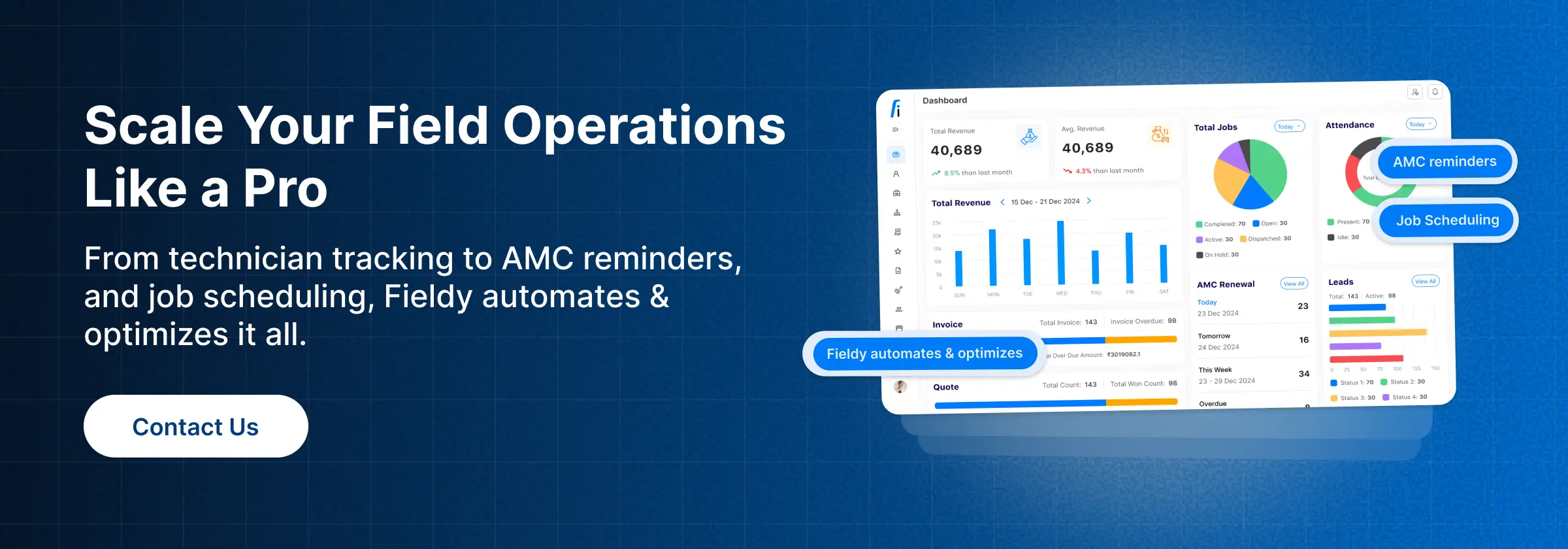
For businesses looking to improve technician productivity without increasing administrative workload, Fieldy offers an excellent balance of usability, automation, and scalability.
Conclusion
Field service technicians make up a vital part of many service industries as they help make sure important equipment, machines, and public systems keep functioning. Their job descriptions go well beyond just fixing things to include tasks like setting up machinery, keeping machines well maintained by doing regular upkeep, finding the problems and getting them fixed, keeping records, communicating with customers, and following safety rules without fail.
To do well in this position the right blend of skills, knowledge, and qualities like good technical knowledge, excellent interpersonal skills, ability to find the solutions quickly, good time management, knowledge of the latest digital technologies, and a deep desire to serve customers outstandingly are necessary apart from tools they use that play equal role from testing machines and safety devices to mobile apps and cloud computing systems.
With the transformation and digitalization of the field service sector in general, technology today has become a very necessary tool for field servicing. Features like digital appointment management, smart dispatching, automatic work orders, GPS tracking, customer satisfaction and performance analysis reporting, and early fault detection will help field service providers work better and also help the business owners gain loyal customers and make money.
Fieldy brings all these features and more in one platform. Besides making the workday routines easy, Fieldy empowers technicians to access any important information at any time and from any place through their mobile device, and gives full-time oversight to the managers over the business operations. Fieldy’s platform will help you service providers to work faster, delight customers, and even plan for the upcoming changes in field service management effectively.
Whether you plan on putting together a new and different type of field service team or just want to upgrade your current system, it will always be a wise choice for you to adopt the right set of tools and technologies and provide these to your field service technicians.