 Blog Details

Introduction
The field service sector has seen a major transformation in recent years. With faster service, businesses can be expected to be up-to-date with communication with customers at the very moment, besides carrying out a higher degree of operations smoothly without compromising quality by 2026. Besides that, conventional means of regulating field operations have been steadily going down the effectiveness scale. Things like manually creating the schedule, ordering products on paper, filling out receipts manually, and the system comprising various pieces of software being used separately can very often cause situations like not being able to show up, multiple bookings, delayed payments, and overall bad customer experiences.
Thereupon, buying the right FSM software has been a decision made as part of the company’s strategy, not merely one about a technology upgrade. A modern integrated platform assists companies in having at hand all the necessary aspects from planning schedules, sending out teams, keeping track of what customers they have, talking to techies, billing supplies, and reports – in the same system. There’s no longer a necessity to be flipping switches between different devices; owners of businesses and managers will have their entire operations under their control at once, with a clear view of things happening on that day. Still, not every software package brings the same set of tools.
Deciding on inappropriate software may further complicate things, you run up some big expenses, and your development potential is also capped. This article will give you an insight into the top five features that are a must-have for any field service business and the ones they should not compromise on when purchasing software in 2026. In addition, we’ll teach you about what kind of questions to raise to get the most out of your software vendor, which functionalities will pay off handsomely, and most importantly, why opting for software with an eye on long-term value beats selecting based on price any day of the week.
What Is Field Service Software?
Field service software is a platform that assists companies in effectively managing their workforce, which typically goes out to service their clients rather than staying at the central office. This single system will handle booking customer appointments, sending out field service crews, setting up work tickets, storing customer profiles, inventory control, invoicing generation, and monitoring company performance as a one-window solution.
Instead of using spreadsheets, whiteboards, phone calls, or paper, field service software is the tool of choice as it automatically carries out daily tasks and enhances the collaboration among office colleagues and field workers.
When one company has a lot of technicians at different sites to work, that’s when this solution becomes the heartbeat of running a business.
How Field Service Software Supports Mobile Workforces
While office workers typically spend their day at desks, field technicians, most of the time, are just traveling from one customer to another. These staff need to be able to quickly obtain schedules, job details, service history, equipment records, customer notes, and invoices during visits without going back to the office. Today’s software can enable all this by the use of cloud platforms and mobile software. Technicians can:
- View daily schedules
- Receive real-time job updates
- Access customer history
- Upload photos from job sites
- Complete digital inspection forms
- Capture customer signatures
- Generate invoices
- Process payments
- Update job status instantly
In parallel, office personnel see into the activities of the teams at a detailed level, which, for one thing, makes the whole scheduling operation less stressful, for another thing, allows monitoring of the development of a field technician, and last but not least, enables faster reaction to sudden circumstances.
Industries That Use Field Service Software
Field service software is typically perceived as a tool that mainly serves household-related services, but in fact, these kinds of software are utilized for work that is done outside the office for various businesses that rely on mobile teams. Among the top users of such software are:
- HVAC contractors
- Plumbing companies
- Electrical contractors
- Cleaning businesses
- Landscaping services
- Pest control companies
- Appliance repair businesses
- Telecommunications providers
- Property maintenance companies
- Security system installers
- Fire protection contractors
- Solar installation companies
- Handyman businesses
Despite a unique workflow for each business sector, industries generally face the same set of challenges in their operations, e.g., managing when technicians are available or not, communicating with customers, managing orders and tasks, tracking what materials or goods are currently held in their stock, and finally, how they charge customers for services or products via a bill or invoice.
Understanding the Role of Modern FSM Platforms
A lot of business entrepreneurs are wondering what field service management software is and how it compares to regular scheduling software. Integration basically makes the difference. A scheduling app might be just giving a technician a certain appointment. Conversely, a powerful field service management solution not only covers all service management functions but also integrates them into one system, namely:
- Scheduling
- Dispatching
- Customer relationship management (CRM)
- Work orders
- Inventory
- Estimates
- Invoices
- GPS tracking
- Reporting
- Mobile workforce management
- Customer communication
These integrated functionalities let companies do away with manual record keeping, cut down on time spent on administrative jobs, and boost productivity.
Key Benefits of Field Service Software
Adopting modern field service software is a significant change for many businesses, and they almost immediately see the results throughout various aspects of their operations. Some major gains companies may experience are:
Enhancing Organization and Efficiency
All information about customers, work orders, estimates, invoices, and service history is kept together in one place. That saves time searching for the right documents so employees can focus on working with customers.
More Efficient Technicians
Technicians now get job schedules, updates on the job, and customer details right on the mobile device they use. Paperwork is kept to a minimum and, as a result, technicians spend more time on the job than on documentation.
Speedy Customer Response
Automatic scheduling and smart dispatching help them get to customer requests fast, in particular when it’s urgent. The faster the reply, the more likely the customer will be satisfied, and the stronger the reviews will be of the business online.
Better Understanding of Your Business
Managers with instant access via location of all your employees, the status of all jobs, inventory numbers, and performance of the business overall. That means it’s no longer about trying to fix problems only when and if they show up. You get ahead by making proactive decisions.
Better Cash Flow
Invoices and estimates sent through the cloud and customer payments made online have cut down on billing errors and time taken for payment collection. Many businesses find their cash flow much better after switching from handwritten billings.
Why Choosing the Right Field Service Software Matters
Field service software purchase is not merely about finding a replacement business application for the existing one. It’s a major investment that can boost productivity, satisfaction, profitability, and lead to the long-term success of a company. A well-suited software can enable the company to manage its operations efficiently while also enhancing the experience of both employees and customers.
A mismatch of the software, then again, may cause unnecessary complications and workload, reduce the efficiency of management, and hinder further business expansion.
Better Productivity
One of the most immediate benefits of modern field service software is a significant boost in workforce productivity. With field service software, managers don’t spend valuable hours creating schedules and going through paperwork, but can easily monitor field personnel and update schedules with the click of a few keys. Most such software comes with a work order feature, which helps technicians to record their findings, tasks, and work in progress. Technicians also benefit from:
- Mobile work orders
- GPS navigation
- Digital checklists
- Instant customer information
- Real-time communication
A major advantage of using field service software is that time-consuming administrative tasks are automated, thereby freeing up the workforce to attend to the main revenue-generating operations of the organization.
Higher Customer Satisfaction
Customer expectations continue to evolve. Today’s customers expect:
- Quick appointment scheduling
- Accurate arrival times
- Real-time updates
- Digital estimates
- Electronic invoices
- Professional communication
Businesses that continuously provide these experiences are often more fortunate in terms of customer loyalty, referrals, and good reviews online. Customer satisfaction is turning out to be a very strong competitive advantage for the field service industry.
Lower Operational Costs
Manual processes create hidden expenses that many businesses overlook. These costs include:
- Excessive travel
- Duplicate appointments
- Paperwork delays
- Administrative labour
- Fuel consumption
- Repeat site visits
Automating workflows helps reduce these expenses while improving overall efficiency.
Faster Job Completion
Technicians equipped with mobile software have immediate access to everything they need before arriving on-site. This includes:
- Customer history
- Equipment details
- Previous repairs
- Required parts
- Job instructions
Having complete information readily available reduces delays and improves first-time fix rates.
Improved Technician Accountability
Managers often struggle to monitor field operations without accurate, real-time information. Modern software improves accountability through:
- GPS tracking
- Digital time stamps
- Job status updates
- Performance dashboards
- Mobile reporting
These features help businesses identify inefficiencies while supporting continuous improvement.
Increased Profitability
Every operational improvement contributes to stronger financial performance. Businesses often increase profitability by:
- Completing more jobs each day
- Reducing fuel costs
- Improving technician utilization
- Minimizing administrative work
- Accelerating payment collection
- Increasing customer retention
Rather than relying solely on higher sales, many businesses improve margins by operating more efficiently.
Real-World Example
Consider a plumbing company that is currently expanding and operating around 15 service engineers at different locations, where different plumbing problems are addressed.
Before the company switched to using the field service application, it used phone calls and spreadsheets as a means to send jobs to field technicians. Technicians came back to the office ultimately to submit forms, while invoices were sometimes sent many days after the service job had already been completed.
Having selected an integrated software solution, they transformed the scheduling, work orders, billing, and communication with technicians into a digital format. Soon, managers observed that there were no scheduling conflicts anymore, there was faster billing, productivity of technicians had improved, and there was a very significant increase in customer satisfaction attributed to better communication and timely responses.
Although every business is unique, such an example illustrates that it is likely that if a company makes some improvements in the level of its operations, it will also get results expressed in numbers.
The ROI of Digital Transformation
Industry research has it that organizations that invest in digital field service technology get advantages out of it, like this:
- Higher technician utilization
- Faster response times
- Improved first-time fix rates
- Lower operating costs
- Better customer retention
- Increased recurring revenue through maintenance programs
Beyond those advantages, in reality, such benefits build up or multiply over time, which means over time the software may become one of the best things that a field service business could ever do with the money it has.
Questions to Ask Before Choosing Field Service Software
Deciding on field service software is a big choice that you will rarely change. The software you will buy today will directly impact the productivity of your team, the retention of your customers, and the growth of your business for years to come.
Several companies decide on the software purely by comparing the price or listing the available features. Of course, these are important points, but they might not really be enough factors to tell you whether that software is going to be suitable for what your business is all about. Formulating some good questions for yourself before purchasing the software will help you to prevent yourself from making expensive mistakes and also will give you the right platform to support your business operations effectively.
1. Is the Software Built for My Industry?
Businesses that offer field services have different workflows. Here’s one way:
- HVAC contractors deal with preventive maintenance plans and manage the seasonal demand.
- A plumbing business has to take care of sudden call-outs and quickly send out the technicians.
- Electrical contractors are usually required to have compliance documents and inspection reports ready.
- Cleaning companies have to plan the clients’ locations so that they can be visited on a schedule.
- Landscaping businesses have to plan work so that they avoid weather disruptions.
- Pest control businesses depend mostly on recurring service contracts for their work.
An industry-specific field service platform will allow better handling of these field service requirements, which are industry-specific in nature, compared to a more general project management tool.
Expert Tip
Find out from the vendors whether their software includes workflows that match your industry. If such is available, then the implementation time can be cut down, and users’ acceptance will be improved.
2. Is It Mobile-Friendly?
Most of the time, field service workers aren’t going to have work sitting at their home base. While they are moving from one customer site to another, they need to have all job information handy. An updated mobile application should enable field workers to:
- View schedules
- Accept new jobs
- Access customer information
- Complete work orders
- Upload photos
- Capture customer signatures
- Generate invoices
- Record payments
- Work offline when internet connectivity is limited
Inability to use the mobile software well can quickly lead to field workers’ use of paper records in place of the software, which was supposed to be the main way.
3. Can the Software Scale With My Business?
The requirements of a small business operating with five technicians should be quite different from those of a big company running fifty or more. Think of the areas where you can count on the platform to work for you:
- Additional technicians
- Multiple office locations
- Increased customer volume
- Recurring maintenance contracts
- New service divisions
- Expanded reporting requirements
Cutting-edge scalable software is the only way to go for reducing the risk of platform change when expanding business operations.
4. Does It Integrate With Existing Business Tools?
Possibly, the business already uses software for things like accounting, payroll payments, and customer communication. Do consider whether the platform integrates with:
- Accounting systems
- Payment gateways
- Email services
- Calendar applications
- Communication tools
- Document storage solutions
The most thoughtful integrations do away with the need for repeated data input and enhance the smoothness of the business processes.
5. How Easy Is the Onboarding Process?
Even the most advanced software provides little value if employees struggle to learn it. Look for vendors that provide:
- Guided onboarding
- Training resources
- Video tutorials
- Knowledge bases
- Live implementation support
- Dedicated account managers
Simple onboarding encourages faster adoption and reduces disruption during implementation.
6. Does It Offer Advanced Reporting?
Business owners need more than scheduling tools. They need insights that help improve operations. Quality reporting should include:
- Revenue trends
- Technician productivity
- Job completion rates
- Customer satisfaction
- Response times
- Profitability
- Repeat business
- Maintenance contract performance
These reports support informed decision-making and long-term planning.
7. Is Customer Support Reliable?
Technical issues can occur at any time, particularly during implementation. Evaluate the vendor’s support by considering:
- Support hours
- Live chat availability
- Phone support
- Email response times
- Product documentation
- Software update frequency
Reliable customer support often becomes one of the most valuable aspects of any software partnership.
Decision Checklist Before Buying
Use the following checklist to evaluate any field service software before making your final decision.
| ❓ Question | ✅ Yes | ❌ No |
|---|---|---|
| 🛠️ Built specifically for field service businesses? | ☐ | ☐ |
| 📱 Mobile app available for technicians? | ☐ | ☐ |
| 📅 Easy scheduling and dispatching? | ☐ | ☐ |
| 👥 CRM included? | ☐ | ☐ |
| 📋 Digital work orders? | ☐ | ☐ |
| 📝 Quoting and invoicing included? | ☐ | ☐ |
| 📦 Is inventory management available? | ☐ | ☐ |
| 📍 GPS tracking included? | ☐ | ☐ |
| 📊 Reporting dashboards? | ☐ | ☐ |
| 📈 Easy to scale? | ☐ | ☐ |
| 🔗 Integrates with existing systems? | ☐ | ☐ |
| 🎧 Reliable customer support? | ☐ | ☐ |
The more boxes you can confidently check, the more likely the software will support your business over the long term.
The 5 Must-Have Features of Field Service Management Software
No software vendor is able to provide the same list every time they present their features and functionalities, but in the end, not all functionalities provide equal benefits. Some functions make your productivity, profitability, and customer satisfaction rise directly, whereas other functionalities are only extra nice-to-have.
The five functions listed below should be regarded as necessary for every field service company assessing software in 2026.
1. Smart Scheduling & Dispatching
The act of scheduling has traditionally been the operational heartbeat of every field service business. In the absence of a solid scheduling system, one of the top technicians might get stuck with delays, no-show jobs, or double appointment situations, resulting in a longer travel route and That’s why lower productivity. New generation scheduling solutions replace paper calendars and Excel sheets with smart software applications that automate planning and increase a technician’s efficiency.
Why Scheduling Matters
Each service job will have an impact beyond your field teams. The effects may ripple through many areas of your business.
A bad day in your business schedule might cause:
- Double bookings
- Late arrivals
- Increased fuel costs
- Technician idle time
- Customer complaints
- Lost revenue
On the flip side, good planning and scheduling allow business operators to do more jobs without hiring more people.
Features to Look For
Scheduling software that helps leading organizations includes:
- Drag-and-drop calendar management
- Technician availability tracking
- Skills-based assignments
- Route optimization
- Emergency job scheduling
- Automatic conflict detection
- Color-coded calendars
- Real-time updates
Field service software like that mentioned above can cut down quite a bit on the amount of paperwork required at the administrative level; at the same time, it can increase the amount of information available about the field operations. Besides a specific field service scheduling software system should also provide the capability of handling maintenance appointments which have to be done regularly, seasonal demand forecasting, and real-time changes to the schedule to make way for cancellations or emergency service requests.
Benefits of Smart Scheduling
Businesses implementing intelligent scheduling often experience:
- Higher technician utilization
- Reduced travel time
- Faster emergency response
- More completed jobs per day
- Better customer satisfaction
- Lower operational costs
Small improvements in scheduling efficiency often generate substantial gains across the business.
Common Scheduling Mistakes
Many companies unknowingly reduce productivity by relying on outdated scheduling methods. Common mistakes include:
- Manual calendar management
- Assigning technicians without considering location
- Ignoring technician skill sets
- Overbooking schedules
- Failing to account for travel time
- Not planning for emergency work
These practices frequently result in delays, employee frustration, and dissatisfied customers.
Best Practices
To improve scheduling efficiency:
- Plan technician routes geographically.
- Balance workloads evenly.
- Build flexibility into daily schedules.
- Prioritize recurring customers.
- Review schedules throughout the day.
- Use real-time updates to respond to unexpected changes.
Consistent scheduling practices improve both technician productivity and customer satisfaction.
2. CRM & Customer Management
Outstanding customer service starts with correct information. Customer relationship management software enables companies to store thorough customer data, thereby allowing office workers and technicians to immediately view the required details at the time of every service call. Instead of going through emails or paper files, company staff can get full customer histories in seconds.
What a CRM Should Store
A comprehensive CRM typically includes:
- Customer contact details
- Service history
- Equipment information
- Warranty records
- Maintenance agreements
- Quotes
- Invoices
- Communication logs
- Technician notes
- Site photographs
By having all relevant info in one place, the work is done much quicker, and the administrative task is much lighter. Field service CRM software nowadays ought to, among other things, keep track of all customer communications so that the mechanics see what repairs have taken place before, what issues repeat themselves, and, based on that, can offer a tailor-made service.
Why CRM Improves Customer Retention
Getting repeat visits means remembering your client’s history, both professional and personal. When the technicians come, already being knowledgeable of things like the customer’s system, service record, and former complaints, allows them to work out problems faster, and trust develops naturally. Besides the satisfaction of the customer from the personal approach in the services offered, there are also advantages:
- Higher customer satisfaction
- Increased repeat business
- More maintenance contract renewals
- Stronger online reviews
- Greater referral opportunities
Keeping existing customers is, on average, less expensive than finding and converting new customers all the time. That is why CRM is often considered the highest-value component in a field service platform.
Best Practices for Customer Management
To maximize the value of your CRM:
- Keep customer records updated after every visit.
- Record equipment details accurately.
- Store photos and inspection reports digitally.
- Document customer preferences.
- Track recurring maintenance schedules.
- Review customer history before every appointment.
These habits create a smoother customer experience while helping technicians deliver more informed and efficient service.
3. Digital Quotes & Invoicing
Estimating, getting sign-off, and collecting cash should be easy and quick. But many service companies use paper forms, spreadsheets, or separate accounting systems for these tasks, which, of course, cause delays in the entire sales process and also make things look disorganized.
Good service technicians who are well-informed through modern field service software can easily create estimates while on-call, get quick customer sign-offs, and prepare invoices right after the job is finished. This leads to better customer satisfaction and naturally to a healthier cash flow.
Why Digital Estimates Matter
Nowadays, more and more customers expect a quick turnaround when asking for service quotes. They would rather get a detailed and professional proposal, even if they had already scheduled the technician’s visit and departure.
The main advantage of electronic quotes to a business is:
- Respond faster
- Improve professionalism
- Reduce calculation errors
- Standardize pricing
- Increase customer confidence
Rapid quotation decreases the likelihood that your client will turn to a competitor for a price check. A good field service quoting software lets technicians prepare precise quotations with pricing templates, labor rate references, and parts inventory, all the while maintaining uniformity across every job.
Best Practices for Creating Estimates
To improve quote acceptance rates:
- Use standardized pricing templates.
- Clearly describe the proposed work.
- Break down labor and material costs.
- Include warranty information where applicable.
- Offer digital approval options.
- Deliver estimates before leaving the job site.
Professional, transparent estimates help customers make informed decisions more quickly.
The Importance of Digital Invoicing
Invoicing as soon as the work is done cuts down on the customer’s time and effort to pay, thereby speeding up payment. On the traditional invoicing front, the technician has to hand over the paperwork to the office, where an accountant will have to prepare the invoice and then deliver it. This may result in the time period from invoice preparation to invoice receipt being much lengthened, which in turn may delay the payment cycle.
Digitally based billing can eliminate all such delays, as invoices can simply be made ready and sent via the mobile phone or email without having to get approval from other departments. A fully integrated field service invoicing software enables business owners to automatically create billing statements using completed jobs. This not only lessens paper and administrative work but also improves the accuracy and reliability of invoicing.
Benefits of Automated Invoicing
Businesses using digital invoicing often experience:
- Faster payment collection
- Improved cash flow
- Fewer billing disputes
- Reduced paperwork
- Better financial reporting
- Lower administrative costs
Many platforms also support online payment options, making it easier for customers to pay immediately.
Workflow Diagram (To Be Designed Later)
The following workflow can be converted into a visual diagram during content design:
Customer Inquiry > Schedule Appointment > Technician Visit > Digital Estimate Created > Customer Approval > Service Completed > Invoice Generated > Online Payment Received > Job Closed & Customer Follow-Up
4. Mobile Workforce Management
Lots of time is usually spent out in the field by field service technicians, i.e., most of the job takes place away from the office. This means it must be very important for these field workers to be able to access their schedules, customer data, work orders, and other communication methods at any time they require them, so their productivity remains high.
The software for field service nowadays consists of mobile apps that enable the technicians to stay connected with the office personnel in an instant. Technicians will not need to carry around their paperwork or contact dispatch to update details. They will just be able to finish each element of the task with their tablets or smartphones.
Essential Mobile Features
A high-quality technician app should include:
- Daily schedules
- Work order access
- GPS navigation
- Customer information
- Photo uploads
- Digital inspection forms
- Customer signatures
- Time tracking
- Invoice generation
- Payment collection
These capabilities reduce administrative work while improving communication across the organization.
GPS Tracking and Real-Time Visibility
GPS tracking benefits both managers and technicians. Dispatchers can:
- Locate nearby technicians
- Monitor travel routes
- Respond to emergencies
- Improve scheduling decisions
Meanwhile, technicians receive optimized routes that reduce unnecessary travel time and fuel consumption.
Offline Functionality
Field employees don’t always have reliable internet access. The best mobile applications continue functioning offline, allowing technicians to:
- Complete work orders
- Record notes
- Capture photos
- Collect signatures
Once connectivity is restored, data automatically synchronizes with the central system.
Digital Documentation
Certain that digital documentation takes the place of paper records, not only reduces the possibility of human errors but also enhances accountability. And, technicians may:
- Upload before-and-after photos
- Complete checklists
- Record equipment readings
- Capture customer approvals
- Document completed work
Dig into their records, locate the warranty of the equipment, and, if appropriate, even request its activation. It is quite natural that a well-maintained database with a complete service history would cut down a lot of time spent finding paper documents at every maintenance visit. The solution to improve employee productivity in a field service environment starts by equipping the workers with suitable mobile equipment and tools. Field workers can access a job record, update the status of a job, and finish the administrative tasks without returning to the office. In doing so, one can get more hours dedicated to providing services while the other one will spend on handling paperwork will have a decrease.
Best Practices for Mobile Workforce Management
Successful businesses typically:
- Equip every technician with a mobile device.
- Standardize digital forms.
- Train technicians on mobile workflows.
- Encourage real-time job updates.
- Monitor technician utilization regularly.
These practices improve efficiency while strengthening communication between field teams and office staff.
5. Reporting, Automation & Business Intelligence
Data is now one of the most precious commodities for field service businesses of the present time. Instead of relying on gut feeling, the well-off firms make use of reporting tools and business intelligence to keep track of performance, spot trends, and make decisions based on what’s happened operationally. When integrated reports are used properly, all of those daily running numbers can be converted into decisions.
Key Performance Indicators (KPIs)
Every business should monitor metrics that directly impact profitability and customer satisfaction.
Common KPIs include:
- Jobs completed per day
- First-time fix rate
- Technician utilization
- Average response time
- Customer satisfaction score
- Revenue per technician
- Invoice collection time
- Maintenance agreement renewals
- Repeat customer percentage
Tracking these metrics helps managers identify opportunities for improvement.
Technician Performance Reports
Performance reporting allows managers to evaluate:
- Job completion times
- Travel efficiency
- Customer feedback
- Revenue generated
- Productivity trends
These insights support coaching, recognition, and workforce planning.
Financial Reporting
Financial dashboards help businesses understand:
- Revenue growth
- Operating expenses
- Profit margins
- Outstanding invoices
- Sales performance
- Cash flow trends
Having access to real-time financial data enables faster and more informed decision-making.
Customer Satisfaction Reporting
Customer experience plays a significant role in business growth.
Reporting tools can monitor:
- Review ratings
- Survey responses
- Repeat business
- Referral rates
- Service quality trends
Businesses that actively measure customer satisfaction are better positioned to improve retention and reputation.
AI Recommendations
Artificial intelligence is increasingly enhancing field service operations. Modern platforms can analyze historical data to recommend:
- Better technician assignments
- Improved scheduling
- Inventory optimization
- Maintenance forecasting
- Resource allocation
These recommendations help businesses make smarter operational decisions with less manual effort.
Workflow Automation
Automation reduces repetitive administrative tasks and improves consistency across the organization. Examples include:
- Appointment reminders
- Technician notifications
- Quote approvals
- Invoice generation
- Maintenance reminders
- Customer follow-ups
- Contract renewal alerts
By automating routine processes, office staff can focus on higher-value activities such as customer service and business development.
Forecasting and Business Planning
Advanced reporting tools also support long-term planning by helping businesses forecast:
- Seasonal demand
- Staffing requirements
- Inventory needs
- Revenue trends
- Equipment replacement cycles
Forecasting enables proactive decision-making rather than reactive problem-solving.
Additional Features Worth Having
In addition to the five major points, there are quite a few more elements that can help you operate your company more effectively and even provide a growth plan for the long-run. These extra features are probably not going to be a priority for your business at this stage, but chances are, they will gradually turn out to be really helpful once you grow bigger.
Inventory Management
Proper inventory management means technicians can get their hands on parts immediately for jobs they are about to do. Most growing firms will eventually purchase best inventory management software so that they can track stock levels, replenishment can be automated, and emergency purchases, which are not very affordable, will be reduced. Efficient inventory results in quicker repair work without having to make multiple calls, and at the same time, carrying costs are reduced.
Purchase Order Management
Purchasing becomes more complex as companies expand. Understanding how to manage purchase orders helps organizations streamline purchasing procedures, maintain supplier relations, and increase inventory accuracy. Integrated purchase order processes also save you time by cutting back on the manual paperwork and the delays during pre-approval stages.
Asset Management
Customer equipment is managed with end-to-end asset service management solutions, recording its history of installation, warranty service, inspections, and equipment longevity. This information can be used in preventive maintenance and can enhance customer service over the lifetime of the equipment.
AMC Management
Recurring maintenance contracts give an assured income, as well as a more loyal customer base. Robust AMC management software enables companies to automate contract renewal, repeat scheduling, maintenance reminders and service history management, reducing administration and increasing customer loyalty.
Work Order Management
Track each service request from inception to resolution. Recognizing what work order management is reveals why companies should focus on standardised procedures, digital documentation, technician accountability and visibility of work in progress. A good work order system minimizes delays and clarifies communications, and increases the accuracy of service records.

Customer Experience Tools
Customer service excellence goes beyond the repair itself. Understanding the foundation of an exceptional customer experience is achieved through communication, openness, professionalism, and a trusted delivery of service along the customer experience journey.
What makes a great customer experience in FSM is having all these elements, such as scheduling, technician communications, digital documentation, and follow-up work, in perfect harmony and detail, providing the customer with all the knowledge they need during every step of the process.
Understanding why customer experience is important in FSM is crucial, as happy customers will share good reviews, renew maintenance contracts, recommend your company, and remain loyal customers.
Learning how to measure digital customer experience, such as tracking customer satisfaction surveys, review response times, first-time fix rates, on-time schedules, and customer communication efficacy, to find ways to improve.
Industry-Specific Features to Look For
Every field service business is different. Yes, scheduling, dispatching, CRM, and invoicing might be common industry terminologies, but the processes, compliance, and customers might have vastly different requirements.
For instance, a heating/ventilation/air conditioning contractor may concentrate on working on fixed-term maintenance contracts and seasonal demand, whereas a plumbing firm may give priority to emergency work.
Cleaning companies work on regular cycles, and painting contractors require extremely accurate estimating tools. Select software that has domain-specific features suited for your business; this will keep your investment relevant to your normal business processes, unlike tailoring your operations to fit generic tasks.
HVAC Businesses
HVAC companies are responsible for some of the most difficult tasks in the field service industry today. Technicians often incorporate emergency breakdowns, seasonal maintenance, equipment installations, warranty claims, and long-term maintenance contracts, all at the same time.
Utilizing HVAC field service management software allows contractors to coordinate these workflows in one unified platform while increasing customer communication and technician productivity.
Features HVAC Companies Should Prioritize
Look for software that includes:
- Preventive maintenance scheduling
- Equipment history
- Warranty tracking
- Technician certification records
- Inventory management
- Mobile inspection checklists
- Emergency dispatching
- Maintenance contract management
These capabilities help reduce administrative work while improving service consistency.
Maintenance Education Creates Customer Value
Customer education creates trust and promotes subsequent maintenance. Basics like how often to replace the HVAC filters at prescribed intervals enable customers to optimize performance while preventing unnecessary failures.
- Standard filters: every 1–3 months
- Homes with pets: every 1–2 months
- Allergy-sensitive households: monthly
- Vacation homes: every 3 months
As a rule of thumb, offering maintenance reminders brings additional occasions to cultivate enduring customer relations.
Plumbing Businesses
In the plumbing industry, the pace can be quick, and response time is almost critical to the overall satisfaction of the customer. Emergency leaks, burst pipes, blocked drains, and water heater failures often require immediate technician reservation scheduling.
When selecting plumbing field service software, a company can balance all of those tasks–coordinating technicians, estimating, tracking, inventory, and billing–in a single system.
Features Plumbing Companies Need
The ideal solution should provide:
- Emergency dispatching
- GPS technician tracking
- Inventory visibility
- Digital work orders
- Mobile invoicing
- Customer service history
- Photo documentation
These features reduce delays while helping technicians resolve problems on the first visit.
Managing Multiple Service Categories
A comprehensive plumbing services list often includes:
- Leak detection
- Pipe repair
- Drain cleaning
- Sewer inspections
- Water heater installation
- Water heater repair
- Faucet replacement
- Fixture installation
- Toilet repair
- Sump pump installation
- Commercial plumbing maintenance
Software should allow businesses to organize each service category efficiently while maintaining accurate customer records.
Pest Control Businesses
Unlike many service companies, pest control companies have a higher-than-average volume of repeat business from long-term maintenance contracts. Their technicians tend to come back monthly, quarterly, or annually rather than being a one-time visit. This is another area where pest control management software is being used to automate repeat scheduling and contracts.
Important Features
Look for:
- Recurring scheduling
- Treatment history
- Compliance documentation
- Technician routing
- Customer reminders
- Digital inspection reports
Automation helps businesses improve customer retention while reducing administrative effort.
Cleaning Companies
It is not unusual for a cleaning company to have dozens or maybe even hundreds of recurring jobs on both residential and commercial properties. Efficiency in scheduling holds particular significance as technicians call at different sites every day.
Emerging companies are learning which is the best cleaning business software to run everything from scheduling and customer information to giving contracts on a regular repeat schedule and billing.
Recurring scheduling is another major productivity driver for cleaning companies, and this is the reason why lots of businesses have opted to purchase the best scheduling software for cleaning businesses that will allow them to maximize coverage of technicians and cut down on drives.
Commercial cleaning companies will have needs like inspection reports, quality audits, multi-site support, and contract tracking. Accessing the best commercial cleaning software can standardize those processes and increase consistency.
Customer relationships are vital in the cleaning industry. The best cleaning CRM software will allow businesses to control all customer communications, regular service choices, quotations, invoices, and service records from one system.
Painting Contractors
Every painting project differs, so estimating for painting contractors is difficult, with factors like labor needs, prepping costs of materials, and the size of the property involved all affecting quotes. While a good quote will lead to profitability, it will also help cut back on arguments over prices.
Using the best estimating software for painting contractors, contractors can produce professional estimates in less time and with greater price consistency. Using digital estimating software is another time-saving tool that increases business by providing a faster quote response and an increased conversion rate.
Handyman Businesses
Handyman companies generally provide many different types of services during one workday. For example, one of their technicians might fix a drywall in the morning, put together some furniture in the early afternoon, and install a light ceiling fan before sunset.
This need for adaptability presents software with the challenge of managing different types of jobs without becoming overly administrative.
Typical Services
A standard handyman services list may include:
- Furniture assembly
- Door repairs
- Drywall repair
- Window maintenance
- Fence repairs
- Deck maintenance
- Pressure washing
- Minor plumbing
- Minor electrical work
- Painting touch-ups
- General home maintenance
Scheduling systems should accommodate varying job durations while allowing technicians to update work orders from the field.
Common Challenges Businesses Face When Choosing Software
Choosing a field service software is a costly investment, and yet often companies make errors when evaluating their field service management software, and as a result, do not get the best value out of their solutions.
Buying Based Only on Price
The cheapest platform isn’t necessarily the most economical. Cheaper software can lack automation, reporting integrations, or scalability, which can make for more costly operations. Make the decision based on the larger picture, not where the licensing cost is lowest.
Ignoring Scalability
Most shops purchase software that is dictated by the current nature of the operation. As the number of technicians, customers, and service areas grows, these systems can become bottlenecks. Select software that is flexible enough to grow into, so you don’t have to migrate to new software entirely.
Choosing Generic Business Software
Common project management applications do not generally offer particular field service features like dispatch, work orders, GPS or mobile tracking, scheduled maintenance reproduction, recurring operations, or technician workflows, for example. Industry-specific platforms offer much more.
No Mobile Application
Disconnected software creates duplicate data entry and additional administration work. Weigh integration potential very carefully when considering a purchase.
Weak Integrations
Without detailed reporting, managers are hindered in identifying productivity trends, profitability problems, or potential customer service issues.
Limited Reporting
Strong reporting gives administrators a foundation of continuous improvement and analytics to make sound decisions.
Most of these purchasing blunders arise from an inadequate understanding of the broader challenges in field service management, including resource coordination, communication, scheduling, inventory management, and customer demands.
Comparison Table — Essential FSM Features
The following table summarizes the core features every field service business should evaluate before selecting software.
| ⚙️ Feature | 💡 Why It Matters | ✅ Must Have? |
|---|---|---|
| 📅 Scheduling | Efficient job planning | Yes |
| 🚚 Dispatch | Faster technician response | Yes |
| 👥 CRM | Better customer retention | Yes |
| 📝 Quoting | Faster estimates and higher conversions | Yes |
| 🧾 Invoicing | Improved cash flow | Yes |
| 📦 Inventory Management | Better stock control | Recommended |
| 📱 Mobile App | Higher technician productivity | Yes |
| 📍 GPS Tracking | Improved accountability | Recommended |
| 📊 Reporting | Better business decisions | Yes |
| ⚡ Automation | Reduced administrative work | Recommended |
While every feature contributes to operational efficiency, scheduling, CRM, quoting, invoicing, reporting, and mobile functionality should be considered essential for businesses seeking long-term growth.
Why Fieldy Is the Best Field Service Software in 2026
The importance of a single powerful but intuitive platform will be that much more crucial for our digital services field service business in the future.
Today’s best solutions, like Fieldy, are separated from other product packages by offering an operating package instead of a patchwork.
Rather than needing a business to buy 3 distinct pieces of software for scheduling, client management, invoicing, reporting, and communication with technicians, Fieldy integrates each of these key components into one system.
Smart Scheduling
Fieldy makes scheduling easy with smart calendars, tech availability tracking, recurring maintenance scheduling, and drag-and-drop appointment management. Managers save time coordinating schedules; technicians get more work done.
AI-Assisted Dispatching
Real-time dispatching gives businesses the ability to outsource and dispatch the most proximate, qualified technician based on skill, availability, and location. This cuts down on travel time, enhances emergency response, and maximizes technician utilization.
Integrated CRM
Every customer interaction is stored within a centralized database, including:
- Contact information
- Equipment records
- Service history
- Quotes
- Invoices
- Maintenance agreements
This information helps technicians deliver faster, more personalized service.
Digital Quotes & Invoicing
In addition, Fieldy offers technicians the ability to prepare estimates, get approvals, create invoices, and record payments in the field. This will not only increase the speed of billing but will also be more customer-friendly.
Inventory Management
Tracks warehouse inventory, technician vehicle stock levels and usage, purchase orders, and can even log the parts used, assisting the business to minimize repeat visits and maximize first fix success.
Mobile Technician App
Technicians can:
- View schedules
- Complete work orders
- Capture signatures
- Upload photos
- Record notes
- Navigate to customer locations
- Update job status in real time
The mobile-first experience reduces paperwork while improving operational efficiency.
GPS Tracking
Managers can quickly pinpoint technicians’ locations, which helps them with efficient task allocation and improves technician accountability at the same time.
Customer Portal
Customers can check their scheduled appointments, look at their service history, get quotes approved, and take possession of invoices from a simple customer help interface.
Automation
Routine administrative tasks—including appointment reminders, follow-ups, recurring maintenance scheduling, and invoice generation—are automated to reduce manual work.
Reporting & Analytics
Comprehensive dashboards provide insights into:
- Revenue
- Technician productivity
- Job completion
- Customer satisfaction
- Profitability
- Maintenance agreements
These reports support smarter business decisions.
Integrations
Fieldy is compatible with common enterprise software, minimizing the need for redundant data input and optimizing business processes department-wide.
Ease of Use
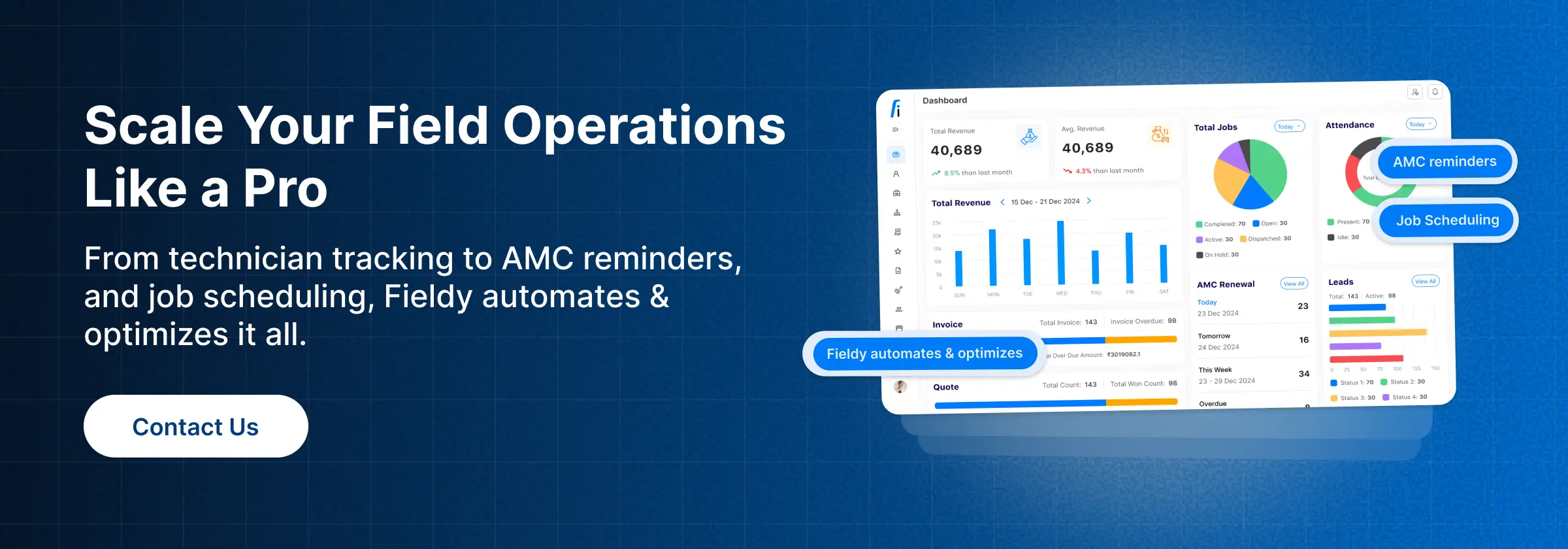
Fieldy is not only user-friendly but also easy on the eye, with clear interfaces, informative dashboards, and little need for training. This should result in quicker field staff and office worker onboarding, as well.
Flexible Pricing & Scalability
The number of your staff at Fieldy can be anything from five to a bunch. No matter how many there will be, it won’t matter because Fieldy will grow with your company while still keeping prices for small and mid-sized ones low and competitive.
Fieldy Pros & Cons
| 👍 Pros | 👎 Cons |
|---|---|
| 🚀 Easy onboarding | May offer fewer enterprise-specific customizations than some large platforms |
| 📱 Excellent mobile app | Advanced enterprise implementations may require additional configuration |
| ⚡ Powerful automation | — |
| 💰 Affordable pricing | — |
| 🏢 Built for multiple industries | — |
| 🎧 Strong customer support | — |
| 👥 Integrated CRM | — |
| 🤖 AI-assisted scheduling | — |
| 🚚 Smart dispatching | — |
| 📊 Comprehensive reporting | — |
Best For
Fieldy is an excellent choice for:
- HVAC contractors
- Plumbing businesses
- Cleaning companies
- Landscaping businesses
- Pest control providers
- Electrical contractors
- Handyman services
- Appliance repair companies
- Property maintenance businesses
- Growing multi-service organizations
This package of automation, user-friendliness, ability to grow, and low price of Fieldy will make it an ideal choice for companies that want a good field service management solution but don’t want to break the bank.
Other Popular Field Service Software
Indeed, countless field service management platforms are out there, but the buyers are only shortlisting those few that not only have good functionalities but also have a strong market presence and are widely accepted by the customers.
The comparison of features provided below gives you an initial idea of the strengths of different products.
| 💻 Software | 🎯 Best For | 👥 CRM | 📅 Scheduling | 🚚 Dispatch | 🧾 Invoicing | 📱 Mobile App |
|---|---|---|---|---|---|---|
| 🏆 Fieldy | Overall Best | Excellent | Excellent | Excellent | Excellent | Yes |
| 🛠️ Jobber | Small Businesses | Good | Excellent | Good | Excellent | Yes |
| 📞 Housecall Pro | Home Service Companies | Good | Excellent | Good | Excellent | Yes |
| 🏢 ServiceTitan | Enterprise Businesses | Good | Excellent | Good | Good | Yes |
| ⚡ FieldPulse | Small & Medium Businesses | Good | Good | Good | Good | Yes |
Feature checklists might look nearly identical; the actual difference between products is revealed not just by their features and pricing but also by their usability, automation scalability, support for implementation, and customer support.
Fieldy
Fieldy is a tailor-made solution for the contemporary field service industry, which is looking for a fully integrated operational system. Its strengths include:
- Intelligent scheduling
- AI-assisted dispatching
- CRM
- Mobile technician application
- Digital work orders
- Inventory management
- GPS tracking
- Quoting
- Invoicing
- Automation
- Reporting
- Customer communication
Fieldy gives you all that is needed to manage your business in a single platform: customer relationship management, field operations, inventory planning, mobile workforce, and more.
Jobber
Jobber is a favorite among smaller service industries that search for software that’s simple to use with features like appointment booking, charging clients, keeping customer records, and showing a few basic statistics.
It suits well for businesses that are just getting started with their digital change, but might need more plug-ins as business processes become more complicated.
Housecall Pro
Housecall Pro focuses primarily on residential home service companies. Its strengths include:
- Scheduling
- Customer communication
- Payments
- Technician management
It offers an intuitive interface and is widely adopted by home service contractors.
ServiceTitan
ServiceTitan focuses on providing solutions to bigger companies that handle complicated tasks and enterprise-level operational requirements.
With such high-level features, it could be the best option for firms that have a big group of technicians at work and run things from different offices, albeit a major expense may need to come into play when implementing and purchasing software.
FieldPulse
FieldPulse is a great solution that small and medium businesses can use to schedule their work, keep track of their customers, create invoices, and manage their field staff. In a nutshell, FieldPulse is the right choice for businesses that want to stop using paper and pen processes and switch to the digital platform.
FieldPulse has a good selection of features that make it the obvious choice for companies transitioning to digital processes and doing away with manual ones.
Expert Checklist Before Buying Field Service Software
It’s a good idea to evaluate any software platform against this checklist before making a decision. Consider this as a practical guide for buying rather than a feature comparison list only.
Core Functionality
✔ Supports your specific industry
✔ Easy scheduling
✔ Intelligent dispatching
✔ Customer management (CRM)
✔ Digital work orders
✔ Mobile technician application
✔ Digital estimates
✔ Automated invoicing
✔ Online payment support
Technician Productivity
✔ GPS tracking
✔ Route optimization
✔ Offline functionality
✔ Photo uploads
✔ Digital signatures
✔ Job status updates
✔ Technician messaging
Business Management
✔ Inventory management
✔ Purchase order management
✔ Reporting dashboards
✔ KPI tracking
✔ Customer communication
✔ Workflow automation
✔ Maintenance agreement management
Technical Requirements
✔ Cloud-based platform
✔ Mobile compatibility
✔ Data security
✔ Regular software updates
✔ Reliable uptime
✔ Backup and recovery
Business Growth
✔ Scalable pricing
✔ Multi-location support
✔ Multiple technician support
✔ Integrations with existing software
✔ Custom reporting
✔ Future feature roadmap
Vendor Evaluation
✔ Strong customer support
✔ Positive customer reviews
✔ Implementation assistance
✔ Product training
✔ Transparent pricing
✔ Free trial or demonstration
A platform that ticks most of the boxes is more likely to be well equipped to support the continuous growth of a business.
Final Buying Advice
Don’t make comparing software providers just about feature lists. Rather than counting check marks, check off the aspects a software should support, like your workflow, technician productivity, customer satisfaction, and your general business goals. Demand demonstrations of the systems, invite your technical operations team to join the evaluation, and think about employee adoption.
Frequently, a simpler platform with fewer advanced features yet excellent usability offers more return on investment compared to a complex one that the users do not know or cannot use. Be aware that good software has to be a time-saving tool and not an administrative burden itself.
Conclusion
Deciding on the best field service application for you is definitely a major IT decision that will determine the success or failure of your service operation in 2026. When customers want more for what they are giving at ever-growing demands and complexities in service operations, clearly, manual scheduling, paper-based workflows, and isolated systems cannot be a way of functioning. Throughout this article, we’ve highlighted five indispensable features that a business would need:
- Intelligence-Based Appointment and Workforce Allocation
- CRM, the Heart of Customer Relationships
- E-Finance with Estimate and Billing
- Workforce Management via Mobile Devices
- Analytics, Process Improvement, and Business Intelligence
These features form a solid business support base through which workflow is optimized, field staff performance is boosted, and client happiness and revenue generation can be achieved simultaneously.
We also delved into specialized areas, common errors in purchasing, feature match-ups, and those elements that a business owner must be aware of before finalizing an investment decision. Looking at the overall value rather than the first cost of a solution means your selected platform will be capable of serving you at different stages of business development. Currently dominating the market, Fieldy is a holistic solution in which intelligent scheduling is joined with AI-assisted dispatching, CRM, inventory management, mobile technician features, estimate invoice, GPS tracking automation reporting, and customer messaging through the integration of a comprehensive suite with a simple interface. Its scalability and intuitive UI are great reasons for adopting this as the business software for service lines like heating, air-conditioning, and refrigeration; plumbing; electrical; landscape and garden; cleaning; pest control; household and appliance repair; and handyman services.
The field service software that will best serve you is the one that gets your operational requirements right, gets your staff on board, and keeps your great service delivery going non-stop. You will be the master of your operations if you analyze solutions thoroughly with your priorities and make your decision by weighing long-term profits against immediate expenditure. You will be better prepared to operate your business with efficiency, profitability, and an eye for the future through field service after choosing the right tools for your field services team. We hope this article helped you decide on choosing a field service system that suits your business operations.