

 Blog Details

Introduction
Field service businesses experienced a radical transformation over the last 10 years. Customers are now looking for same-day responses, very precise arrival windows, sending invoices through emails, online payment facilities, and above all, they want to be informed during the whole process of service delivery. However, business owners need to synchronize technicians, vehicles, inventory, estimates, work orders, client records, and maintenance contracts that are done regularly; sometimes even happening in different locations. This upsurge in operational requirements has made field service management software one of the most visited topics by contractors and service pros who are aiming to modernize their workflow.
If you are running an HVAC company, plumbing, landscaping, electrical, cleaning, roofing contractor, or appliance repair business, then manual handling of your field operations will very quickly become time-consuming and full of errors. Paper schedules, spreadsheets, and phone calls make it more likely that you will cancel an appointment unintentionally, have double bookings, bill your customers late, or have communication problems. A lot of business people who are looking for new service business ideas find out that putting their money into the right software as early as possible might make their operations efficient, their customers very satisfied, and at the same time reduce their paperwork and other administrative functions.
By using this guide, you will explore in detail what field service management software really is, how it operates, which components are the most important, the businesses that will get the most out of it, and finally, how to find the solution that best fits your business. In addition, we will review a few of the main FSM providers and show how today’s technology can help service businesses to enhance their output, earnings, and customer experience.
What Is Field Service Management Software?
At its essence, field service management software is a business platform mainly developed for managing things such as technicians, customer appointments, work orders, scheduling, dispatching, invoicing, inventory, and field operations, all from one system. Some other companies even call such platforms what is FSM software, as “FSM” is the abbreviation most commonly used for Field Service Management.
General business software, as a rule, does not have the features of field Service Management (FSM) software that are a necessity for companies whose workforce regularly works outside their office. Rather than dealing with multiple applications for scheduling, customer management, estimating inventory, and billing, an FSM platform simplifies these operations by integrating them into a single workflow that helps both office staff and field technicians stay on the same page.
Dispatchers can instantly assign work, people can get their tasks via mobile devices in real-time, there’s updating, managers can see what is happening, and customers get an automated notification about the appointment and electronic billing. FSM software can handle the management of technicians, customer appointments, work orders, scheduling, dispatching, invoicing, inventory, and field operations, all from one system.
How Field Service Management Software Works
A usual field service process is a series of step-by-step operations:
Customer Request > Schedule Appointment > Dispatch Technician > Technician Completes Job > Generate Invoice > Customer Follow-up & Service History
Every phase passes on data to the next one, which means no double entries and fewer admin lags. Rather than typing the customer data over and over, all units work from one common database.
Core Objectives of FSM Software
The primary goal of field service management software is to improve operational efficiency while delivering a better customer experience. Typical objectives include:
- Streamlining scheduling and dispatch
- Reducing technician travel time
- Improving first-time fix rates
- Automating invoices and estimates
- Tracking work orders digitally
- Managing customer communication
- Monitoring business performance with real-time reporting
- Improving profitability through better resource allocation
Who Uses Field Service Management Software?
Besides HVAC companies, which are the most popular users of FSM software, many other industries can find it useful. Essentially, any business that arranges a time for a visit, sends a worker, or carries out service performance at a customer’s location can gain from a combined field service system.
HVAC Companies
To manage emergency repair operations, preventive maintenance agreements, equipment installations, warranty work, and seasonal demand, heating and cooling contractors utilize HVAC field service management software. Date and time repeating scheduling, digital estimates, inventory tracking, and technician routing are examples of features that help cut delay-causing factors while at the same time making customers more content with the service.
Plumbing Businesses
A plumbing company offers emergency warm water services, drain cleaning, leak detection, water heater installations, sewer repairs, inspections, and maintenance contracts, amongst others. This means that plumbing field service management software allows dispatchers to mark the most important jobs for technicians to work on and, at the same time, gives technicians access to the full customer history before they get to the site.
Electrical Contractors
Field service management software for electrical contractors is one of the most essential tools electrical businesses use to schedule inspections, service upgrades, panel replacements, troubleshooting, and commercial projects. With mobile access, there is no need for electricians to return to the office just to get updated work orders, wiring diagrams, and customer notes.
Cleaning Companies
Centralized data, scheduling, and automated reminders make it easy for both cleaning business providers and their customers to change the recurring appointments, rotating crews, and supply inventories as the need arises. Communication is always established between the cleaning company management and customers.
Landscaping Companies
Landscaping is one of the business types that is always scheduling different operations, such as mowing routes, irrigation repairs, seasonal cleanups, fertilization, and recurring maintenance. Monday.com is a great example of an inexpensive scheduling tool that helps smaller organizations get daily route optimization and windshield time reduction.
Painting Contractors
With painting field service management software, painting companies can easily generate customer digital estimates, schedule projects, track material utilization, seek customer approvals, and document the progress of residential and commercial projects.
Roofing Contractors
Using centralized project workflows, roofing businesses handle inspections, insurance claims, installations, repairs, material deliveries, subcontractors, and warranty documentation.
Pest Control Services
The biggest reason why pest control management software is such a great tool for pest management companies is that it handles recurring treatments, tracks technician certifications and chemicals used, and automates follow-up scheduling.
Appliance Repair Companies
Efficient use of inventory and parts ordering, technician scheduling, and customer communication make it possible for an appliance repair business to carry out the operations of any given day with ease.
Fire Protection Companies
Through inspection scheduling, compliance documentation, recurring testing, and digital reporting, modern fire protection companies have the tools and information they need to stay on top of their game.
Handyman Businesses
Handyman companies are professionals who provide different repair services and, as a result, have pretty extensive service catalogs that cover plumbing, carpentry, drywall, painting, furniture assembly, and general maintenance. Having all job estimates, invoices, and customer records in one centralized platform will make comprehensive handyman services list management much easier.
What Are the Most Common Field Service Management Software Features?
When businesses evaluate different platforms, one of their questions is: “What are the typical features of field service management software?” Capabilities differ from one vendor to another, but most top-tier field service software shares a similar set of core functionalities meant to ease the handling of everyday operations.
Work Order Management
Every time a service is asked for, it turns into a work order sooner or later. Getting to know “what work order management is” is very important since it is the main operational support of any field service company. Paperwork is replaced by digital fulfillment of work orders that include customer data, technician details, notes for the job, pictures of materials used, labor hours, and tasks accomplished. Besides that, they create a continuous service history.
Scheduling & Dispatch
With the help of scheduling tools, staff can allocate work to technicians based on who is free, what skills they have, whether they have been certified, where they are located, and what their workload is. Through drag-and-drop calendars, automatically planned routes, and updates on the schedule in real-time, the working time of technicians can be increased, and travel time reduced.
Customer Relationship Management (CRM)
With integrated CRM features, you can keep customer contact info, past services, equipment bills, quotations, warranties, and communication records. Technicians can provide more tailored and quicker service if they have all the customer data in one place.
Mobile Applications
Technicians have the capability through mobile apps to get work orders, take pictures, get signatures, change job statuses, make invoices, receive payments, and talk to the office while being in the field.
Estimates & Quotes
Creating digital estimates helps in drafting proposals faster, maintaining the same quality, lessening mistakes, and getting sales done quicker. Also, many systems enable electronic approval, where the client is allowed to confirm an estimate without the need to print documents.
Invoicing & Payments
Invoicing that is scheduled to occur automatically can make and send nice invoices right at the time the job finishes. Payment methods that are included will help you get money faster by letting customers pay on-site with cards, digital wallets, or online payment links.
Inventory Management
Inventory capabilities let you check the stock at the warehouse, the inventory in the service vehicle, the purchase orders, and the parts usage. Real-time status keeps the staff on the floor from running out of supplies, and at the same time, it also helps the technicians to be ready for every appointment.
Reporting & Analytics
Performance tools give you information about how productive your technicians are, how much money is being made, customer opinions, response time, tasks done, unpaid bills, and the general business situation.
Customer Portal
Several software solutions support customer portals through which clients can see their bookings, send approvals for estimates, get invoices, request a service plus check maintenance history.
GPS Tracking
Through real-time tracking of cars and technicians, the dispatchers can give the best routes, get to emergency calls quicker, and give customers the closest time of arrival.
Feature Comparison
| ⚙️ Feature | 💡 Why It Matters |
|---|---|
| 📋 Work Order Management | Organizes every service job digitally |
| 📅 Scheduling & Dispatch | Maximizes technician utilization |
| 👥 CRM | Maintains complete customer history |
| 📱 Mobile App | Supports technicians in the field |
| 📝 Digital Estimates | Speeds up approvals |
| 🧾 Invoicing | Improves cash flow |
| 📦 Inventory | Prevents stock shortages |
| 📊 Reporting | Supports better decision-making |
| 👤 Customer Portal | Improves transparency |
| 📍 GPS Tracking | Optimizes routing and response times |
Top Benefits of Using FSM Software
When you start using field service management software, you might be surprised that it doesn’t only change scheduling. A good platform can enhance almost all your daily operations – increasing the technician’s productivity and also improving the customer’s loyalty, among other things.
When a business uses digital tools for scheduling, dispatching, and reporting, they commonly end up doing a higher number of jobs per day as its office staff spends less time manually coordinating appointments. Automated workflows not only lower the administrative burden but also let the technicians focus on their core leveraged services rather than paperwork.
Such help will also speed up your response time as dispatchers won’t have to waste time figuring out who is the closest available technician for the request that needs attention right away. Involving real-time communication allows you to prevent delays, reduce the number of missed appointments, and keep customers updated during the whole service process.
In fact, we cannot even think about “what makes a great customer experience” without involving technological elements. Giving the customer the right time window for an appointment, sharing the technician’s location, providing digital estimates, faster invoicing, and regular follow-up communications are just some of the elements that constitute a great customer experience that will drive the customer to continuously choose your company and even leave a good review online.
Managers find it easier to make decisions based on live dashboards, which display data on technician utilization, revenue trends, completed jobs, outstanding invoices, and overall business performance. With these insights at their fingertips, they can make more informed decisions leading to better staffing, improved forecasting, and increased profitability for the business operations.
In brief, FSM software brings a scalable platform for your business expansion. No matter if you are adding a few more technicians, venturing into new service areas, or even opening new branches, centralized workflows ensure easy maintenance of service quality standards while at the same time supporting growth over the long term.
How FSM Software Improves Customer Service
Great field service is not solely about fixing problems efficiently; it’s also about making the customer feel that everything was easy and natural right from the moment they decided to get in touch until a long time after you have finished the work. With the help of the latest Field Service Management (FSM) software, firms can easily make the whole process of interacting with customers standard, cut down on those delays, and enhance communication at each step of the service lifecycle.
One of the major benefits of this type of software is that it enables proactive communication. Customers get automated calls for appointment confirmations, reminders of technician arrival, and follow-up messages, so office staff don’t need to make several phone calls. These alerts not only reduce occurrences of missed appointments but also make customers feel more confident.
Having a complete service history at hand is yet another significant benefit. On top of that, technicians, when they enter the site, may have instant access to information about previous repairs, equipment details, warranty notes, and even pictures. This way, guesswork is eliminated, and usually, diagnosis and repair times are shortened.
Digital estimates, electronic signatures, online invoicing, and payment options that are convenient not only enhance the customer journey but also replace the need for customers to wait days after the completion of their job for the paperwork. Customers have the possibility to review the quotes, approve the work, and even make the payment immediately after the job has been done.
Keeping in touch with your customer is a big element that makes the customer service experience nothing less than excellent because customers value transparency as much as technical prowess. Companies that update their clients even in the middle of the job are the ones that get consistently higher satisfaction ratings, more powerful online reviews, and at the same time, more referrals than those companies that still depend on manual communication.
Best Field Service Management Software (2026)
Deciding on an FSM platform depends on a few things like the size of the company, industry, budget, necessary integrations, and complexity of operations. Certain platforms are intended for small service businesses, whereas others target large enterprises with hundreds of technicians.
Quick Comparison Table
| 💻 Software | 🎯 Best For | 📱 Mobile App | ⭐ Overall Fit |
|---|---|---|---|
| 🏆 Fieldy | Growing field service businesses | Yes | Excellent |
| 🛠️ Jobber | Small to medium service companies | Yes | Very Good |
| 🏢 ServiceTitan | Large HVAC & home service businesses | Yes | Excellent (Enterprise) |
| 📞 Housecall Pro | Small service contractors | Yes | Very Good |
| 🏗️ Simpro | Commercial contractors | Yes | Excellent |
| ☁️ Salesforce Field Service | Enterprise organizations | Yes | Excellent |
1. Fieldy
Overview
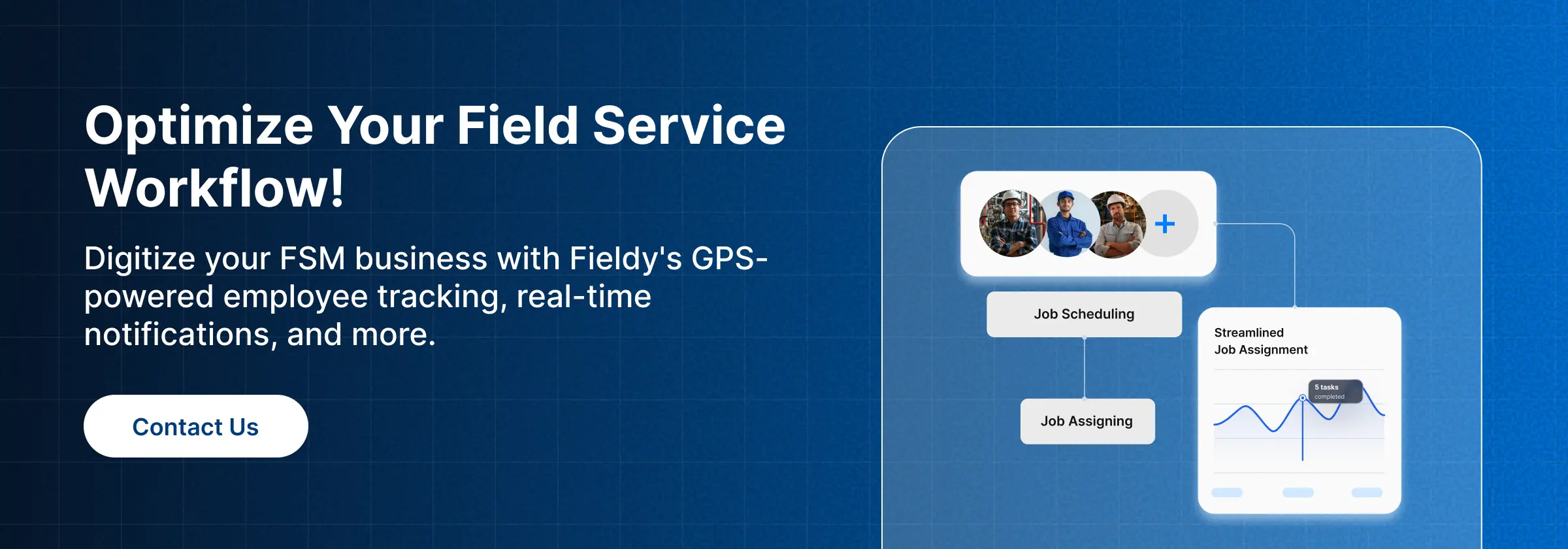
Fieldy is a field service management platform that can perform all work. It helps a service business to operate a single system. Instead of a separate tool for scheduling, customer management, estimating, invoicing, inventory, dispatching, and reporting, the product integrates these functions into one working process.
Their features are helpful to businesses with technicians dealing in plumbing, HVAC, electrical, landscaping, painting, roofing, cleaning, appliance repair, and other parts of the field service industry. With mobile, technicians can get work orders, report a job, upload photos, get signatures, and invoice without office staff, so paperwork and communication are minimized.
The ones that are also looking for integrated inventory with scheduling may take a look at the best inventory management software. Mostly, if inventory is very important in their operations. Combining stock control with field workflows can lower data reentry and increase the visibility of parts usage.
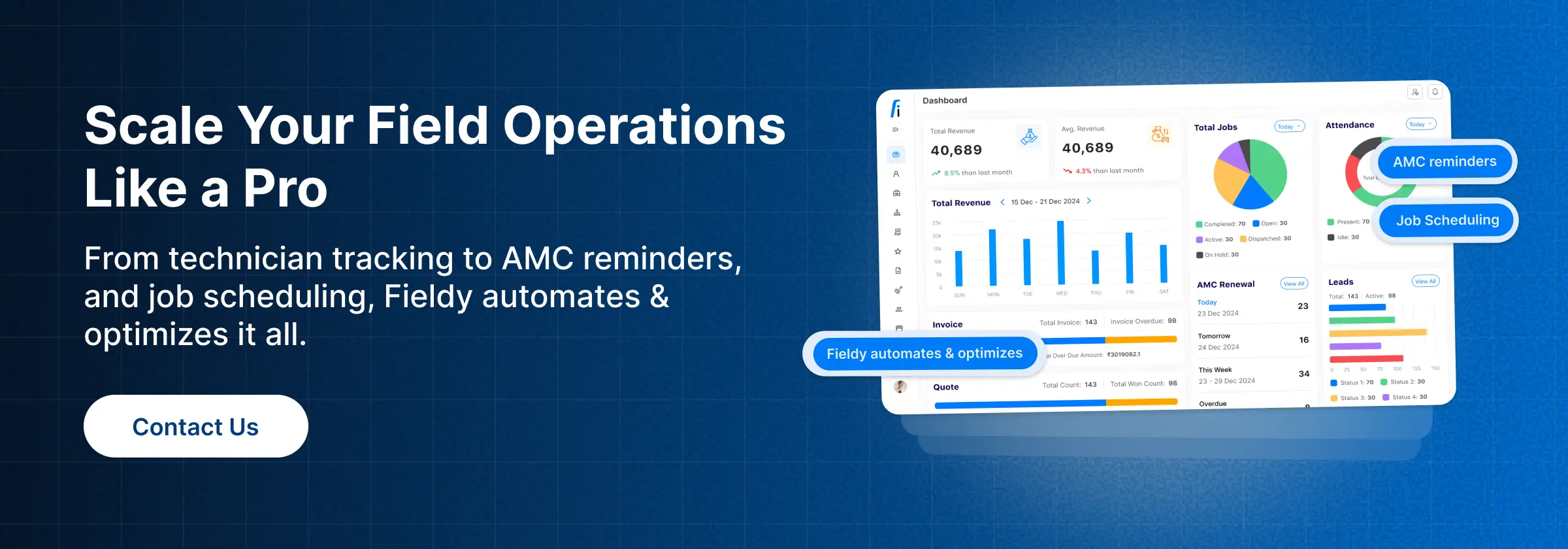
The other one is workflow transparency. A single dashboard is where the manager can see technician schedules, job statuses, customer history, estimates, invoices, and operational reports. It makes it simpler to manage a growing staff and, at the same time, provide good customer service.
Key Features
| ⚙️ Feature | 📈 Benefit |
|---|---|
| 👥 CRM | Centralized customer records |
| 📅 Scheduling | Faster technician assignment |
| 🚚 Dispatching | Improved route coordination |
| 📝 Estimates | Professional digital quotes |
| 🧾 Invoicing | Faster billing |
| 📱 Mobile App | Real-time field updates |
| 📦 Inventory | Parts tracking |
| 📍 GPS | Technician visibility |
| 📊 Reporting | Business performance insights |
Pros
- Broad field service feature set
- Mobile-first workflow
- Integrated customer management
- Digital estimates and invoicing
- Scheduling and dispatch tools
- Suitable for multiple service industries
Cons
- Pricing requires contacting sales
- Organizations may need onboarding to fully utilize advanced features
Pricing
Custom pricing based on business requirements.
Best For
- Plumbing companies
- HVAC contractors
- Electrical businesses
- Landscaping companies
- Roofing contractors
- Painting contractors
- Cleaning businesses
- Multi-service field operations
Why Businesses Choose Fieldy
One of the main goals of businesses looking for an integrated platform is to lower the number of disjointed software tools they rely on. A platform that integrates scheduling, customer management, estimates, invoicing, inventory reporting, and mobile workflows in one system can make running business operations more manageable and decrease the need for paperwork and other administrative tasks, instead of handling multiple separate applications.
2. Jobber
Overview
Jobber has established itself as one of the leading field service technology solutions for small and medium service businesses. Its main purpose is to assist contractors in managing quoting, scheduling, invoicing, customer communication, and payments through a fairly straightforward user interface. This is the reason why it is highly sought-after among companies that are moving away from the use of spreadsheets or paper-based systems.
For many cleaning firms that are looking for the best scheduling software for cleaning business, Jobber pops up because of features like scheduling of recurring jobs, calendar management, and customer communication. Thanks to these tools, businesses are able to group recurring appointments as well as reduce scheduling conflicts.
Besides that, the support of online booking, automated reminders, digital quotes, invoices, and payment processing on the platform lures companies that want to change the way they interact with customers without the need to install enterprise software.
Besides that, Jobber connects with several third-party accounting and payment platforms, so it will be simpler for businesses that are expanding to link their operational workflows with financial management.
Key Features
| ⚙️ Feature | 📈 Benefit |
|---|---|
| 📅 Scheduling | Drag-and-drop calendar |
| 👥 CRM | Customer records |
| 📝 Estimates | Digital proposals |
| 🧾 Invoicing | Faster billing |
| 💳 Online Payments | Convenient collection |
| 📱 Mobile App | Field access |
Pros
- User-friendly interface
- Strong scheduling capabilities
- Good customer communication tools
- Mobile application
- Widely adopted among SMBs
Cons
- Some advanced operational capabilities require higher-tier plans
- Businesses with complex workflows may eventually seek more customization
Pricing
Subscription-based pricing with multiple tiers.
Best For
- Small plumbing businesses
- Cleaning companies
- Lawn care services
- Appliance repair businesses
- Startups entering the field service
When Might an Alternative Be Better?
Jobber is usually an ideal match for small service businesses. As these companies grow and add more crews, warehouses, or even shift to more complex operational workflows, they may look at other platforms that offer wider field service management features to suit their long-term needs.
3. ServiceTitan
Overview
ServiceTitan is known as an enterprise-grade field service management software that is mainly designed for HVAC, plumbing, electrical, and other home-service industries. Over and above that, it offers features like detailed reporting, call booking, dispatching, estimating, invoicing, inventory control, marketing tools, payroll support, and business analytics.
Besides that, big service companies usually compare ServiceTitan with their other business management areas, including labor-related questions such as “how much do HVAC technicians make, ” considering that labor utilization, technician productivity, and compensation tracking are becoming more important as businesses grow.
ServiceTitan is well known for operational transparency. Through detailed reporting dashboards, managers can check sales results, technician output, average ticket values, marketing activities, customer service, and financial data.
Also, the software offers strong integration and configuration options, so it works well for businesses that operate a large number of techs and complex service operations.
Key Features
| ⚙️ Feature | 📈 Benefit |
|---|---|
| 🚚 Dispatching | Optimized scheduling |
| 👥 CRM | Detailed customer records |
| 📊 Reporting | Advanced business analytics |
| 📦 Inventory | Parts management |
| 📝 Estimates | Professional proposals |
| 📱 Mobile App | Technician productivity |
Pros
- Comprehensive enterprise functionality
- Excellent reporting capabilities
- Strong scheduling and dispatch tools
- Extensive integrations
- Scalable architecture
Cons
- Higher cost than many SMB-focused platforms
- Longer implementation and onboarding process
- May be more complex than necessary for very small businesses
Pricing
Custom enterprise pricing.
Best For
- Large HVAC companies
- Multi-location plumbing businesses
- Enterprise home service organizations
- Companies with extensive technician fleets
When Might an Alternative Be Better?
Organizations that have only a few technicians or less complicated operations might want to choose platforms that can be implemented more quickly, are cheaper, and are less complex. Such platforms should, though, still be able to provide scheduling, customer management, invoicing, and mobile field tools capabilities.
4. Housecall Pro
Overview
Housecall Pro is a widely used field service management software that targets mainly small and medium-sized home service businesses. It integrates scheduling, dispatching, customer management, estimating, invoicing, online booking, and payment processing into one cloud-based solution. One of its appealing features is the intuitive interface, which is ideal for companies switching from paper-based workflows or simple spreadsheets.
Housecall Pro is a software frequently compared by home service businesses when looking for the best cleaning business software because it is capable of handling recurring appointments, automated customer notifications, technician mobile access, and online payments. Even if it mainly focuses on the cleaning industry, this software’s simple procedure helps contractors get better organized without having to undergo intensive training to use the software.
Besides, the system contains customer communication tools including appointment reminders, technician arrival notifications, and review requests. All these features not only lessen the time and effort of administration but also assist businesses in offering a more professional customer experience.
Housecall Pro is compatible with several accounting and payment platforms, which enables the synchronization of operational and financial workflows.
Key Features
| ⚙️ Feature | 📈 Benefit |
|---|---|
| 📅 Online Booking | Simplifies appointment requests |
| 🗓️ Scheduling | Efficient calendar management |
| 🚚 Dispatching | Assigns technicians quickly |
| 👥 CRM | Centralized customer records |
| 📝 Estimates | Digital proposals |
| 🧾 Invoicing | Faster payment collection |
| 📱 Mobile App | Field access |
| 💳 Payment Processing | On-site payments |
Pros
- Easy to learn
- Strong customer communication features
- Mobile-friendly interface
- Digital estimates and invoices
- Online booking capabilities
Cons
- Some advanced reporting features are limited compared with enterprise platforms.
- Complex organizations may require additional customization
Pricing
Subscription-based pricing with multiple plans. Check the vendor’s website for current pricing.
Best For
- Residential service contractors
- Cleaning businesses
- Plumbing companies
- Electrical contractors
- Appliance repair services
- Small HVAC companies
When Might an Alternative Be Better?
Housecall Pro is a great option for those who mainly want an easy-to-use solution. But companies with several locations, intricate inventory, or very tailored workflows might eventually look at larger field service systems as their operational requirements increase.
5. Simpro
Overview
Simpro is mainly a software offering a bunch of features like job costing, estimating, inventory management, scheduling, purchasing, and project tracking in detail. Contractors in various fields like electrical, HVAC, fire protection, security, plumbing, and mechanical, working on large commercial projects, use it quite a bit.
Painting companies that want to use digital estimating tools might come across Simpro among other options for the best estimating software for painting contractors since its project management features allow detailed quotations, material tracking, labor management, and analysis of project profitability.
Simpro’s greatest feature is that it can easily integrate office operations and field technicians through the use of mobile apps. The managers have a clear insight into project status, while the technicians get the updated work orders, site details, and customer documents directly from the field.
Besides, it has excellent report generation features, assisting companies in the assessment of labor costs, project margins, technician productivity, and purchasing efficiency.
Key Features
| ⚙️ Feature | 📈 Benefit |
|---|---|
| 📋 Project Management | Tracks large jobs |
| 📝 Estimating | Detailed quotations |
| 📦 Inventory | Material control |
| 📅 Scheduling | Technician coordination |
| 🛒 Purchasing | Supplier management |
| 📊 Reporting | Financial insights |
| 📱 Mobile App | Field productivity |
Pros
- Strong commercial project capabilities
- Comprehensive estimating tools
- Excellent inventory management
- Robust reporting
- Suitable for larger contractors
Cons
- Learning curve for new users
- May exceed the needs of very small service businesses
Pricing
Custom pricing based on company size and requirements.
Best For
- Commercial contractors
- Mechanical contractors
- Fire protection companies
- Electrical contractors
- Larger plumbing businesses
- Project-focused service organizations
When Might an Alternative Be Better?
Companies focused primarily on residential service calls rather than commercial projects may prefer platforms with simpler scheduling workflows and shorter implementation timelines.
6. Salesforce Field Service
Overview
Salesforce Field Service is a solution that connects the Salesforce platform with field operations, turning Salesforce users into service center operators. The software includes features like scheduling, CRM, field workforce management, reporting automation, and analytics. Companies already have a Salesforce CRM and use this product to offer their customers a seamless management experience of sales, support, and field operations.
Enterprises that are looking for CRM with advanced features may also consider looking for the best CRM for a cleaning business when it comes to customer lifecycle management, recurring service contracts, automated communication, and reporting. Salesforce Field Service is very customizable, and So, it can be used by those businesses that have complicated operational needs and a team of implementation specialists.
The system allows the field workforce to access AI-based scheduling, plan and manage the mobile workforce, service contracts, share knowledge, record asset history, and provide customer self-service portals. Besides, it is so adaptable that companies from various industries can use it to manage their workflows, well beyond the traditional home services.
Given that the truth is it covers different capabilities, the implementation usually takes more time and requires a lot of configurations than those of smaller SMB-focused platforms.
Key Features
| ⚙️ Feature | 📈 Benefit |
|---|---|
| 🏢 Enterprise CRM | Unified customer management |
| 🤖 AI Scheduling | Optimized technician assignments |
| 📱 Mobile App | Technician productivity |
| ⚡ Automation | Workflow efficiency |
| 📊 Reporting | Advanced analytics |
| 👤 Customer Portal | Self-service capabilities |
| 🛠️ Asset Management | Equipment lifecycle tracking |
Pros
- Highly customizable
- Powerful CRM integration
- Advanced reporting
- Enterprise scalability
- Extensive ecosystem
Cons
- Higher implementation complexity
- Greater administrative requirements
- Premium pricing
Pricing
Custom enterprise pricing.
Best For
- Enterprise service organizations
- Multi-branch operations
- Large commercial contractors
- Organizations already using Salesforce
When Might an Alternative Be Better?
Smaller businesses without dedicated IT resources may benefit from platforms that provide faster deployment, simpler configuration, and lower ongoing administrative requirements.
How to Choose the Best FSM Software
Choosing the appropriate field service management system goes far beyond just checking features against one another. The finest software for you will be influenced by your company’s profile, industry, target expansion, number of technicians, financial resources, and the complexity of your operations.
While small businesses are more inclined to weigh in on user-friendliness and quick implementation, comparatively big ones need robust reporting, workflow automation, inventory management, CRM integration, as well as multi-location support. Also, you should document your current workflows and uncover the operational deficiencies to be addressed by the software before you decide.
Generally, companies with customer retention and service quality as their top priorities choose to compare different platforms by incorporating their overarching best customer experience management software strategies, since aspects like customer communication, technician visibility, and service history are key ingredients of a customer’s long-term satisfaction.
Evaluation Checklist
| 📋 Consideration | 💡 Why It Matters |
|---|---|
| 👌 Ease of Use | Faster staff adoption |
| 📱 Mobile App | Supports field technicians |
| 📅 Scheduling | Improves technician utilization |
| 👥 CRM | Centralizes customer data |
| 📊 Reporting | Better decision-making |
| 📦 Inventory | Track parts and equipment |
| 🔗 Integrations | Connects existing systems |
| 📈 Scalability | Supports business growth |
| 🎧 Customer Support | Easier onboarding |
How to Integrate Field Service Management Software with CRM
Many businesses run into the challenge of understanding how to connect field service management software with CRM since their customer data is usually scattered across different systems. A well-thought-out integration allows the office team, sales department, and field technicians to share the same customer data without having the hassle of creating duplicate databases.
One of the main points of an effective integration is the harmonization of customer profiles, contact details, equipment history, service records, proposals, invoices, and communication logs. Besides, companies should put together uniform workflows to ensure the changes made in one system become visible in another automatically.
Businesses looking for ways to raise their productivity often wonder how to manage purchase orders as they go through the implementation phase since their purchasing, inventory, and supplier management processes are closely linked to their service operations and CRM records, as a rule.
With a fully integrated CRM, technicians can pull up the full customer history while managers enjoy better customer lifecycle reporting.
Which Asset Management Software Is Best for Field Services?
Equipment is one of the major investments of many field service businesses. Vehicles, specialized tools, testing equipment, parts for replacement, and customer-owned assets all need to be tracked properly throughout their lifetime.
Knowing what asset management software is enables companies to recognize how it fits their overall field service mechanism. Asset management software keeps track of equipment locations, maintenance schedules, warranties, inspections, depreciation, repair history, and usage. When combined with FSM software, field technicians can have instant access to equipment data while supervisors receive alerts for preventive maintenance and asset replacement.
Companies that operate large vehicles or costly equipment fleets will probably have better returns through the use of systems that merge asset tracking with work orders, inventory control, technician scheduling, purchasing, and reporting. This holistic approach not only enhances the availability of equipment but also minimizes the risk of breakdowns and maintenance costs.
Industry-Specific FSM Software Recommendations
Although a lot of the Field Service Management platforms are serving a few industries, in fact, the best solution for you depends on what kind of tasks your techs do, how complicated your scheduling needs are, your compliance requirements, and how many recurring service agreements you manage. A plumbing company dealing with emergency repairs is very different for operations from a landscaping business that manages seasonal maintenance contracts or a roofing contractor who coordinates multi-week projects. Choosing software that is based on your workflows will help enhance technician productivity, customer satisfaction, and long-term profitability.
Industry Recommendation Table
| 🏭 Industry | 💻 Recommended Software |
|---|---|
| ❄️ HVAC | 🏆 Fieldy / 🏢 ServiceTitan |
| 🚰 Plumbing | 🏆 Fieldy |
| ⚡ Electrical | 🏆 Fieldy / 🏗️ Simpro |
| 🌿 Landscaping | 🏆 Fieldy |
| 🧹 Cleaning | 🏆 Fieldy / 🛠️ Jobber |
| 🎨 Painting | 🏆 Fieldy / 🏗️ Simpro |
| 🏠 Roofing | 🏆 Fieldy / 🏡 JobNimbus |
| 🔨 Handyman | 🏆 Fieldy / 📞 Housecall Pro |
| ❄️ Snow Removal | 🏆 Fieldy |
| 🛡️ Insurance Inspection | ☁️ Salesforce Field Service / 🏆 Fieldy |
Recurring scheduling, contract management, mobile checklists, and digital reporting are the features commercial cleaning companies regularly require. Besides these functionalities, businesses comparing platforms may also look for the best commercial cleaning software that can centrally manage multiple crews, recurring contracts, customer communication, and quality assurance inspections, in addition to providing a dashboard.
Since the workload of landscaping companies depends on seasonal demand, weather conditions, and recurring maintenance schedules, they face several operational challenges. Besides other features, FSM software for landscaping businesses, which is budget-friendly, should have route optimization, recurring scheduling, equipment tracking, digital work orders, and mobile apps that enable the crew to update the job progress directly from the field.
Snow removal operations run on tight response deadlines, so any delay can greatly impact customer satisfaction and contract performance. Scheduling accuracy, GPS tracking, and dispatching on-the-fly are the features that coordinate snow removal crews during storms effectively. Also, knowing what affects the snow removal cost helps contractors prepare their bids more competitively without sacrificing their profitability.
Typically, HVAC contractors juggle emergency repairs, preventive maintenance contracts, equipment replacements, and warranty servicing. Business owners wondering “can you finance a new HVAC system” are a major reason integrated quoting, financing documentation, and payment collection become FSM platform’s invaluable features.
Many service companies have moved beyond simple repair jobs to developing preventive maintenance programs. One of the ways commercial HVAC businesses demonstrate the effectiveness of routine maintenance in prolonging the life of equipment is by instructing how to clean HVAC coils. At the same time, such activities also offer recurring service opportunities and help develop strong long-term customer relationships.
Can FSM Software Help Insurance Companies?
Insurance companies are placing more and more emphasis on their field teams to carry out inspections, process claims, arrange for contractors, and keep policyholders informed. As a result, many experts have wondered how field service management (FSM) software could elevate insurance operations to be more effective and standardized.
FSM software helps claims inspections by automatically dispatching adjusters or inspectors, making scheduling efficient, keeping track of appointments, recording and documenting site visits through photos and videos, and creating digital reports that can be easily shared with customers and internal teams. Thanks to mobile apps, field workers can immediately upload their inspection files, thus minimizing the time it takes to process the documentation.
When it comes to communicating with customers, integrated tools increase the level of transparency by sending policyholders appointment confirmations, technician arrival notices, claim status updates, and digital copies of the documents shared during the inspection procedure. Together with reporting and analytics, these features allow insurance firms to enhance their operational efficiency while resolving claims more quickly and offering an excellent customer service experience.
It is a common fact that companies working with contractors on repair operations and at the same time handling their own inventory, often find it very beneficial to first understand the concept of what vendor-managed inventory is, in particular when they have to deal with replacement materials, the list of approved suppliers, and emergency restoration work at multiple claim locations.
How to Build Field Service Management Software
Some companies think about making their own platform instead of buying a ready-made package. Those businesses that want to know how to build field service management software should first analyze whether the long-term benefits of custom development can outweigh the adoption of an established commercial platform.
Generally, a modern FSM solution entails quite a few different components that are connected, for instance, customer relationship management, scheduling, dispatching, work order management, mobile technician apps, digital estimates, invoicing, payment processing, inventory management, reporting, GPS tracking, asset management notifications, customer portals, and API integrations. Being able to produce each of these features takes a heavy investment in software engineering, user experience design, cloud infrastructure, cybersecurity testing, maintenance, and continuous feature updating. Developing tailored software might be a fitting solution for companies with highly customized processes, in-house software creation teams, and a set of extraordinary regulatory requirements. However, for most of the small and medium-sized service providers, buying a recognized software solution ensures a much quicker time to get the system up and running, lower initial outlays, regular upgrades of features, support by the vendor, and a stable level of operating costs.
Before engaging in custom development, organizations have to thoroughly weigh up implementation expenses, maintenance obligations, scalability issues, security matters, integration requirements, and the capacity for future product improvements against commercially available options.
Conclusion
Field Service Management Software is no longer just a nice-to-have feature; it is now a critical part of the operation, mainly for those businesses that handle technicians, customer appointments, equipment, and service delivery in different locations. Manually scheduling, using disconnected spreadsheets, paper invoices, and communication via fragmented channels just cannot match today’s customer expectations or handle the demands of growing service organizations.
The leading FSM platforms not only facilitate scheduling and dispatching but also include customer relationship management, digital estimates, invoices, inventory tracking, reporting, mobile apps, GPS visibility, and workflow automation, all integrated into one closed system. Through the centralization of these major operations, companies will be able to spend less time on administrative tasks, increase their technicians’ output, accelerate response times, and ensure a superior customer experience that is more consistent.
Although each company will have its own unique operating requirements, purchasing software by taking into account factors like the potential to scale, user-friendliness, integrations, training and reporting capabilities, as well as business goals, will result in better returns than only concentrating on the cost aspects. Also during the consideration phase, enterprises may want to look at support given during the roll-out, the mobile side of things, and how much the supplier is devoted to continual product development.
Out of the software compared within this guide, Fieldy is a great standout for an all-in-one solution to field service business operations that are expanding, as it has the scheduling, dispatching, CRM, estimating, invoicing, inventory management, reporting, mobile workforce management, and operational visibility functionalities all under one roof. Whatever business you are in: HVAC, Plumbing, Electrical, Landscaping, Cleaning, Roofing, or even multi-services, the decision of opting for a software package that not only meets your needs at the moment but also supports your growth would be the one to bring maximum value in the long run.