
 Blog Details

By 2026, lead management will have moved beyond being simply a “sales function” to integrating with the entire nervous system of all service-driven businesses that are on the rise. Tracking leads quickly, managing timely follow-ups, automating sales workflows, and converting inquiries into revenue have become business-critical capabilities of any company that deals with installations, maintenance, repairs, inspections, or on-site service delivery. Additionally, as competition continues to intensify across the field service industry, companies that respond to leads the fastest are winning over those that still use spreadsheets, WhatsApp for follow-ups, or basic CRM and lite tools.
With the adoption of AI-driven sales automation, smart lead routing, and customer tracking in real-time, it is clear that outdated tools that only store contact information are no longer sufficient. Today, lead management platforms have the functionalities of CRM, FSM (field service management), invoicing, scheduling, payments, and workflow automation rolled into a single platform. This is the primary reason why most of the field-focused organizations have decided to adopt the all, in, one operational systems, such as Fieldy’s FSM software, which integrates sales and service operations without any hassle.
Businesses in HVAC, plumbing, security installation, electrical contracting, and facility maintenance, to name a few, are moving away from traditional CRMs towards specialized lead management platforms that are developed with service workflows in real life in mind, as customer expectations increase and sales cycles get shorter. The present guide is a comprehensive overview of what the best lead management software will be in 2026, reasons why Fieldy is leading the market, how it stacks against top CRMs, and the alternatives that are worth your consideration.
🎯 Why Lead Management Software Is Essential in 2026
1. Competition Has Intensified, and Speed Wins Deals ⏱️
Today, customers demand responses without any delay. No matter if they submit a form, make a call, or send a message through social channels, they expect answers in a very short time. Any impatience, even by a few minutes, can make a new customer decide to go to a competitor. In 2026, this “speed-to-lead” requirement is significantly higher, especially in sectors where the service is of a certain urgency, such as repairs, installations, or emergencies.
Lead management software is the tool that enables businesses to be absolutely sure that no question is left unanswered. Companies are able to follow up on every lead, give it a local presence, and automate the generation of the next sales call through engagement.
2. AI-Powered Sales Automation Has Become Standard 🤖
Artificial intelligence is already a part of the team, helping in lead scoring, predicting sales chances, and suggesting the next best action. This is what has helped businesses to reduce the amount of manual work, thus having more time to work with high-value leads and, at the same time, automate the handling of lower-priority follow-ups.
Enterprises that continue to use outdated CRMs or spreadsheets are simply out of the race as far as efficiency and intelligence are concerned, which is what modern AI-powered lead systems offer.
3. CRM-Lite Tools Are Not Sufficient for Handling Modern Lead Workflows 🛠️
Simple CRMs or attendance apps (like Pagarbook and similar tools) have not been designed to support full, cycle lead workflows. These tools are deficient in:
- Lead assignments
- Lead nurturing
- Activity tracking
- Pipeline automation
- Cross-team collaboration
- Conversion of leads into jobs
- Invoicing and payments integration
That is the reason why many companies have to start looking at more sophisticated systems when they outgrow simple workforce apps or limited CRMs. Companies that are on the path to becoming more efficient usually decide to move to more powerful systems when they come to the realization that a Pagarbook alternative or a similar upgrade is necessary to align sales and operations.
4. Combined Sales + Operations Workflows Have Become Inescapable 🔄
Now, companies require more than just a lead tracker; they need a system that interlinks:
Lead → Quote → Job Scheduling → Dispatch → Invoicing → Payment → Ongoing Maintenance
By unifying processes in this way, the company removes the need for double data entry, enhances the accuracy of the data, and builds a smooth customer journey.
Such solutions as Fieldy’s field service management software enable companies to oversee the entire lifecycle, starting from the moment a lead comes in till job completion and the after, sales service.
🚀 What Makes a Lead Management Software “The Best” in 2026?
Not every lead management tool works in the same way. The foremost ones, essentially, revolve around automation, efficiency, and up-to-the-minute insights. Here are the feature essentials of top-tier systems in 2026.
1. AI-Assisted Lead Capturing & Scoring
Intelligent solutions can automatically gather and lead information from:
- Sites
- Social media
- Email campaigns
- Phone calls
- Paid ads
- Referral partners
- Lead marketplaces
Then AI looks at the past and recognizes patterns to figure out which leads will most probably convert.
2. Automated Follow-Ups & Reminders
By far, tools of today do away with manual follow-up efforts via:
- Automated SMS/email reminders
- Intelligent follow-up sequences
- Task and call reminders
- Activity notifications
This not only brings about a quicker response but also helps to maintain a regular connection.
3. Lead-to-Job Conversion Tracking
The changes of leads-to-scheduled jobs serve as the centerpiece of field service-related industries. It should be easy for systems to accomplish the transition from a lead to:
- A quotation
- A scheduled job
- A technician dispatch
- An invoice
- A maintenance contract
This is the point where integrated FSM links become handy. Organizations operating on such complete FSM workflows simultaneously consider how platforms interconnect inventory, billing, and scheduling in the same manner as companies evaluate and compare Zoho Inventory alternatives when looking for tools that facilitate operational integrations.
4. Workflow Automation Across Sales & Operations
The foremost software is capable of automating:
- Lead-qualification
- Task-assignments
- Approval flows
- Notifications
- Escalations
- Job routing
Automation has reached its turning point and is no longer an option but a baseline standard.
5. Multi-Channel Lead Capture
As customers come up with their questions using multiple channels, lead management tools have to centralize everything so that no inquiries are left unanswered. This ensures that no leads get missed while at the same time, speed is improved.
6. Deep FSM Integrations
The software of field service businesses has to be able to merge with:
- Scheduling
- Technician tracking
- Inventory
- Maintenance contracts
- Billing
- On-site work orders
That is the reason why service organizations are mostly turning to unified solutions coordinating their whole operations instead of scattered tools.
Not all lead management tools are created equal. The best ones are built around automation, efficiency, and real-time insights. Below are the must-have features of top systems in 2026.
💎 Why Fieldy Leads the Market as the Best Lead Management Software for 2026
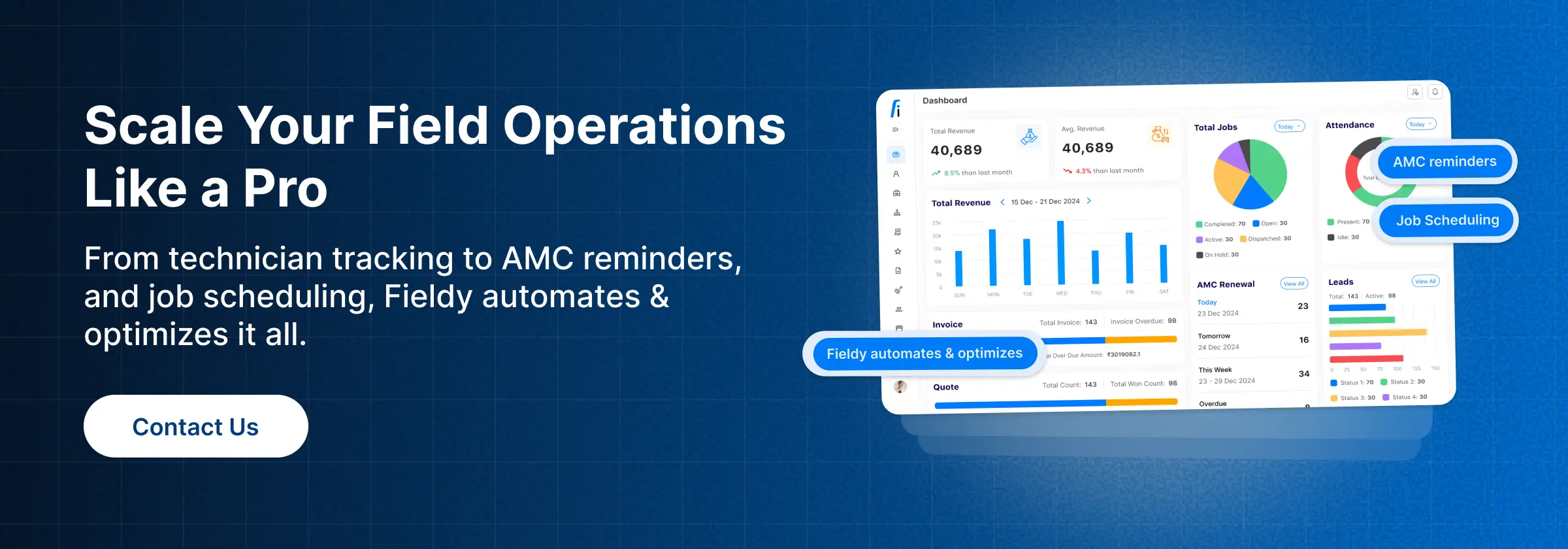
Fieldy is a different kind of CRM; it is essentially a lead-to-cash platform that has been designed exclusively for the field service sector. Rather than using different tools for managing leads, scheduling jobs, dispatching technicians, invoicing, and receiving payments, Fieldy links every step in a single integrated system.
Here is a detailed explanation of the features that make Fieldy’s lead generation management software stand out.
Key Strengths of Fieldy’s Lead Management System
1. Fully Automated Lead → Job → Invoice Workflow 🔄
Fieldy is the tool that does all the work for you in the background. It records the leads that come automatically, determines the value of the leads, sets the appointments, allocates the field staff, keeps the records of the work orders, and creates the bills without any human intervention. This complete process from start to finish is the reason why there are no unaccounted-for leads and no work orders that are late.
2. Built for Field Service Response Times 📱
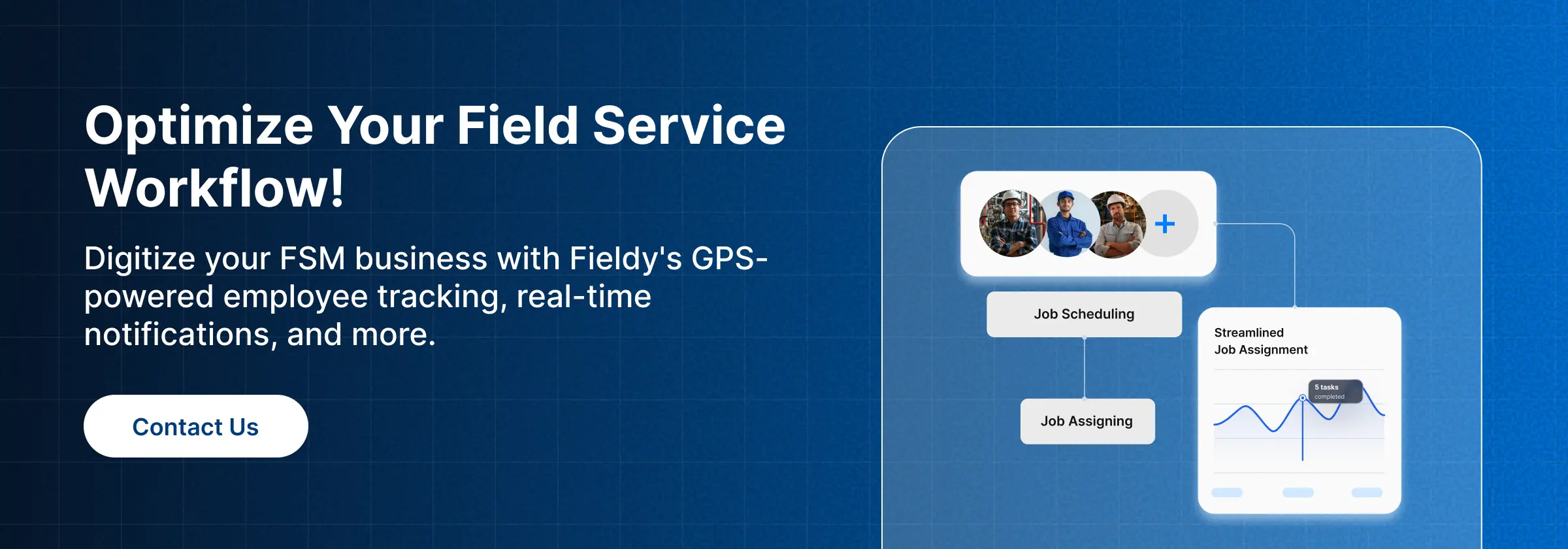
Industries such as HVAC, CCTV installation, electrical services, plumbing, and appliance repair are highly dependent on quick response times. Fieldy is a tool that is aimed at assisting field teams to be able to respond within a few minutes by:
- Making the communication immediate through notifications
- Determining the closest available technician to attend to the lead
- Allowing a mobile app for updates that are on the go
- This is a very big change in the client conversion rates.
3. Real-Time Lead Tracking for Cross-Functional Teams 🧩
Sales, ops, dispatchers, and technicians all see the same real-time updates. This eliminates miscommunication, confusion, and repeated customer calls.
4. Integrated CRM, FSM, Invoicing & Contract Management 🚚
Businesses no longer need to maintain separate systems for each function. Fieldy unifies:
- Customer relationship management
- Automatic recurring billing
- AMC contract automation
- Inventory and parts usage
- Job costing and profitability
This single-platform design reduces clutter and cuts software costs.
5. Smart Lead Routing Based on Industry, Location, or Team 📊
Leads can automatically be assigned to:
- Specific branches
- Territory-based teams
- Specialized technicians
- Industry-focused departments
This ensures the right person handles each inquiry instantly.
📝 Why Fieldy Outperforms Traditional CRMs
Here is a comparison table showing why Fieldy delivers far more value than traditional CRMs:
| 🧩 Feature / Capability | 🚀 Fieldy | 📊 Typical CRMs |
|---|---|---|
| Built for field service workflows | ✅ Yes — purpose-built for FSM | ❌ No — sales/marketing focused |
| Mobile-first design | 📱 Optimized for technicians on the go | ⚠️ Limited mobile usability |
| Lead → Job → Invoice automation | 🔄 Fully automated end-to-end | ❌ Not available |
| Route planning & scheduling | 🗺️ Included with smart routing | ➕ Requires add-ons or integrations |
| AMC / maintenance automation | 🧾 Built-in recurring contracts | ❌ Not supported |
| Inventory & parts usage tracking | 📦 Real-time field-to-warehouse sync | ❌ Not supported |
| AI-powered lead scoring | 🤖 Native AI-driven insights | ✅ Available (CRM-centric) |
| Ease of setup for SMEs | ⚡ Fast, no-code deployment | 🧩 Complex setup & onboarding |
| Cost efficiency | 💰 Affordable, flat pricing | 💸 Expensive (e.g., HubSpot, Salesforce) |
| Ideal for field service teams | 🎯 Perfect fit for FSM operations | ❌ Not optimized for field work |
A lot of companies move to Fieldy after their aged CRM is no longer able to sustain their operations or automate their workflows. There are cases where businesses use simple employee management tools at the beginning and then end up searching for a more sophisticated Pagarbook alternative as they become aware that they require more extensive sales and job management features.
🏆 Top 5 Best Lead Management Software for 2026
Below is a breakdown of the top platforms, along with pros, cons, and ideal use cases.
1. Fieldy (Most Preferred)
Fieldy is the most complete lead management and operational automation platform for businesses that rely on technicians, scheduling, and recurring service.
| ✅ Pros | ⚠️ Cons |
|---|---|
| 🔗 Unified CRM + Lead Management + FSM — everything managed in one connected platform. | 🏢 Best suited for field-heavy industries; may exceed the needs of office-only teams. |
| ⏰ Automated reminders, follow-ups & workflows reduce manual effort and missed actions. | — |
| 📊 Advanced lead analytics dashboards with clear conversion insights. | — |
| 🔄 Seamless lead-to-job assignment for faster dispatch and response. | — |
| 📱 Mobile app enables instant technician communication from the field. | — |
| 🚐 Ideal for on-the-go field teams managing jobs anywhere. | — |
Fieldy’s platform is specifically optimized for lead management within field operations, making it the most comprehensive solution for service-driven companies.
2. HubSpot CRM
HubSpot remains popular for businesses looking for strong automation and UI.
| ✅ Pros | ⚠️ Cons |
|---|---|
| 🚀 Excellent marketing and sales automation to manage campaigns, pipelines, and follow-ups efficiently. | 💰 Paid tiers become expensive as you scale, especially for growing teams. |
| ✨ Highly polished and modern interface that enhances usability and user experience. | 🤯 Can feel overwhelming for small companies due to feature depth. |
| 🔀 Supports multichannel lead tracking across email, forms, ads, and integrations. | — |
Best suited for marketing-driven organizations; not ideal for field-heavy operations.
3. Zoho CRM
Zoho is well-known for its flexibility and cost-effectiveness.
| ✅ Pros | ⚠️ Cons |
|---|---|
| 💸 Budget-friendly pricing makes it accessible for startups and cost-conscious teams. | ⚙️ Complex to configure, often requiring technical expertise or setup time. |
| 🧩 Extensive customization options to adapt workflows and data structures. | 🚫 Not optimized for field service workflows such as dispatching, routing, or technician apps. |
Teams requiring connected operations often eventually explore Zoho CRM alternatives or even broader Zoho Invoice alternatives from within the Zoho ecosystem.
4. Salesforce
Salesforce is the powerhouse CRM for enterprise companies.
| ✅ Pros | ⚠️ Cons |
|---|---|
| 🤖 Deep automation capabilities enable complex workflows, advanced triggers, and process optimization. | 💰 Very costly for SMEs, making it less suitable for budget-conscious small and mid-sized businesses. |
| 📈 Extremely scalable, capable of supporting enterprise-level growth and large operational volumes. | 🧠 Requires technical expertise to configure, often needing skilled admins or consultants. |
Best for large companies with internal CRM administrators.
5. Jobber
Jobber offers simple service management that includes basic lead flows.
| ✅ Pros | ⚠️ Cons |
|---|---|
| 🏢 Good fit for small field businesses, especially teams with straightforward service workflows. | 🤖 Limited advanced lead automation, reducing efficiency for complex sales funnels. |
| 👌 Easy to use with minimal onboarding and quick adoption by teams. | 📊 No strong pipeline management, making it harder to track leads across multiple stages. |
Companies that outgrow Jobber often explore more capable Jobber alternatives designed for deeper operational automation.
6. Housecall Pro
Another service app with basic lead features.
| ✅ Pros | ⚠️ Cons |
|---|---|
| 📲 Friendly mobile-first design that works smoothly for technicians on the move. | 🧩 Basic lead management tools with limited automation and insights. |
| 🧑🔧 Simple UI for field staff, reducing training time and user friction. | 🏢 Limited control for multi-location operations, making scaling harder. |
Businesses scaling their service teams often compare stronger Housecall Pro alternatives when they require more advanced lead automation.
💡 Comparison Table: Best Lead Management Software for 2026
| 🔍 Feature / Software | ⚡ Fieldy (Most Preferred) | 📈 HubSpot | 🧩 Zoho CRM | 🏢 Salesforce | 🛠️ Jobber | 📞 Housecall Pro |
|---|---|---|---|---|---|---|
| 🎯 Lead Capture | 🚀 Excellent lead capture built for service businesses | 📣 Strong marketing-driven lead capture | 📋 Reliable lead tracking & management | 🏗️ Enterprise-grade lead handling | 📝 Basic lead intake tools | 📨 Basic lead capture features |
| 🤖 Automation | ⚙️ Advanced automation across leads, jobs & follow-ups | 🔄 Powerful sales & marketing automation | 🛠️ Good CRM workflow automation | 🧠 Highly advanced & customizable automation | ⚠️ Limited automation capabilities | ⚠️ Basic workflow automation |
| 💰 Pricing | 💸 Affordable & scalable for all business sizes | 📈 Costs increase as you scale | 💵 Budget-friendly for small teams | 💎 Premium enterprise pricing | 💳 Moderate pricing | 💳 Moderate pricing |
| 🚚 Field Service Fit | 🏆 Best-in-class FSM-first platform | 🔧 Moderate fit with add-ons | ❌ Low suitability for field service | ⚙️ Requires heavy customization | 👍 Good for small service teams | 👍 Good for small service businesses |
| 📱 Mobile App | 📲 Full-featured FSM mobile app for technicians | 📊 Solid mobile app for sales teams | 📱 Moderate mobile experience | 📲 Strong mobile app (setup required) | 📍 Technician-friendly mobile app | 📲 Excellent mobile experience |
| 🔌 Integrations | 🧩 Deep FSM, CRM, invoicing & inventory integrations | 🌐 Wide third-party integration ecosystem | 🔗 Strong Zoho ecosystem integrations | 🔗 Massive enterprise integration library | ⚠️ Limited integrations | ⚠️ Limited integrations |
Fieldy stands out because it is the only platform offering true lead-to-job-to-invoice automation designed for field teams.
Industry Use Cases: Who Needs Lead Management the Most?
Lead management impacts nearly every service sector, but some industries depend on it for daily operations.
1. CCTV & Security Installation Companies
These companies process various lead sources, such as website forms, calls, walk-ins, inquiries from property managers, and referrals. A quick response is very necessary, particularly in the case of commercial installations and maintenance contracts.
Companies often rely on insights from in-depth guides, such as how to build a profitable CCTV installation business, to understand how lead automation affects conversions.
With the help of Fieldy’s security management system software, installation requests can be conveniently tracked along with AMC renewals and services that are going on.
2. Field Service Contractors (Plumbing, HVAC, Electrical)
These industries are required to change leads into scheduled jobs in a very short period of time. Their working method is always:
Lead → Schedule → Dispatch Technician → Invoice → Upsell Maintenance Contract
Tools that are perfect for on-site work allow contractors to get rid of waiting times, take leads straight to job schedules, and set up recurring maintenance notifications.
Expanding service businesses trying to decide on a choice of platforms usually consider well-known platforms mentioned in the guides, like Housecall Pro alternatives, for finding more advanced operational automation.
3. Organizations Moving Away From Legacy Tools
Companies that rely on outdated systems such as Fieldpoint or conventional spreadsheets generally move to automated platforms to enhance their operations in terms of speed, consistency, and control.
Most businesses looking for Fieldpoint alternatives end up picking a contemporary solution that integrates CRM, FSM, and automation.
Why the Right Lead Management Software Directly Impacts Revenue
Choosing the appropriate instrument is not only a matter of ease, but it also has some definite financial advantages.
Faster Response = More Deals Closed.
Almost every time, studies show that companies that answer their leads within five minutes have a conversion rate that is significantly higher than others.
Automated Nurturing Reduces Lost Opportunities
Prompt reminders and follow-up sequences are the ways through which a lead that has gone cold due to forgetfulness or a manual error is completely ruled out.
Accurate Tracking Prevents Lead Leakage
Those companies that manage leads manually stand a chance of losing about 20-30% of the potential customers every month. This is because they:
- Forgotten follow-ups
- Misplaced details
- Unassigned inquiries
- Slow response times
Operational Efficiency Increases Capacity Without Increasing Staff
Through the use of automated systems that streamline workflows, teams are able to handle more leads without the need for additional admin staff.
Integrated Workflows Reduce Costs and Boost Profitability
The outcome of a streamlined, cost-effective operation with higher margins is when lead management, in partnership with scheduling, invoicing, and inventory workflows, as discussed in Zoho Inventory alternatives conversations, is implemented.
Final Recommendation:
Fieldy — The Best Lead Management Software for 2026
Fieldy is a great combination of CRM, FSM automation, and lead management, which is a perfect fit for field service companies. By its way of unifying the entire lifecycle, from lead capturing to job scheduling, dispatch, invoicing, and recurring maintenance, it is the most complete platform for service-driven organizations.
On top of that, with automation, intelligent routing, real-time mobile updates, and integrated job workflows, Fieldy is enabling companies to:
- Close leads faster
- Increase service levels
- Cut the time and labor spent on admin tasks
- Grow their business without adding more complexity
If you are willing to step up from archaic spreadsheets or constrained CRMs, this would be a great moment to look at what Fieldy’s lead management software can do, thereby opening the way to true end-to-end automation for your service business.