

 Blog Details

📘 Introduction
🔍 Why Are Businesses Looking for Housecall Pro Competitors or Alternatives in 2026?
With the move of field service companies towards a more automation-driven decade, a lot of teams are finding that Housecall Pro is no longer sufficient for their needs. While Housecall Pro has been a dependable option for small service businesses, the moment a company decides to scale, whether it is by diversifying service offerings, adding more technicians, or running multiple locations, it starts to feel less adaptable. It is common for companies to mention difficulties such as low customization despite the subscription cost going up whenever new users are added, and feature gaps becoming more apparent when entering industries like HVAC, electrical contracting, security systems, pest control, or elevator servicing.
Such restrictions become significantly apparent now when field service enterprises require full automation of their workflows, utilization of data for decision-making, and smooth connectivity between different departments. The overall field service industry is gaining momentum at a fast pace, which can be confirmed by our comprehensive report on the Field Service Management Market Size, Share & Analysis. This rise implies that companies have to take up modern FSM platforms that not only have the capacity to scale with them but also do not bind them.
In fact, this is the point where the first-ranked platform in this list, Fieldy, differs. It provides more advanced automation, intelligent scheduling, efficient inventory and asset management, and a cost structure that is more affordable in the long run. In the case of businesses that are considering Housecall Pro alternatives or Housecall pro competitors, Fieldy is now the leading suggestion for 2026, designed for teams that require speed, scalability, and advanced field automation.
🧠 What Makes a Modern Housecall Pro Alternative or a Housecall Pro Competitors? (2026 FSM Buyer Criteria)
The standards for field service software have been altered radically. Departments are no longer content with just job scheduling and invoicing. What they ask for is the complete automation of the processes, which is free of repeated tasks, is capable of handling different service verticals, and at the same time, centralizes operations under one smart system.
Firstly, a modern Housecall Pro alternative ought to be equipped with features like the automated creation of jobs, multi-industry workflow support, predictive scheduling, advanced dispatching, asset and inventory management integration, a well-developed technician mobile app, and effective reporting dashboards. Additionally, it should allow the use of custom workflow logic, which many businesses now consider a must-have feature.
Besides, connectivity is equally important. Integration and API-first architecture are the tools that enable companies to create a digital ecosystem that is in line with their operations. If you are interested in knowing how automated FSM systems move smoothly from one step to another, our article titled “What Does a Field Service Management Process Involve?”.
Essentially, it means that companies’ demands for Housecall Pro alternatives or Housecall pro competitors are not less than basic on the contrary, they are strategic and forward-focused.
🏆 Top 5 Best Housecall Pro Alternatives/Housecall pro Competitors for 2026
The expanded and updated list of best Housecall Pro alternatives/competitors is presented below. Fieldy is ranked first as the most modern and future-ready FSM platform.
1. Fieldy (Best Housecall Pro Competitor) 🚀
By providing the most comprehensive end-to-end field service ecosystem, better automation, stronger workflows, and more customization, Fieldy’s FSM software surpasses Housecall Pro and any other platform on this list and thus is ranked first. The company is created specifically for the field service industry, which is expanding and wants to have a clear view of the situation, intelligent scheduling, and full workflow automation without increasing the cost of operations at once.
In contrast to Housecall Pro, Fieldy enables businesses to set up custom workflows for multi-step processes, automate everything from job assignments to follow-ups, and handle inventory and assets without the need for a different system. Its AI-driven scheduling and quoting functionalities deliver the teams’ advantage of a strategic position, especially in competitive industries. Additionally, the platform facilitates the implementation of the most advanced routing, contract management (AMC), and technician productivity tools, resulting in a considerable reduction of manual work in the field.
Fieldy is also very versatile in terms of growth, which allows it to be not only a portable solution for the small businesses in the field that will shortly become a trend but also for medium- and large-sized service brands willing to unify operations across multiple locations without being forced to use separate tools. When the number of employees grows, the pricing structure offered by Fieldy remains quite affordable, even if you add more technicians; thus, it is a much more cost-effective choice than Housecall Pro over time.
This ability to scale becomes even more important when companies decide to deepen automation across their workflow processes. Those teams embarking on automation-first operations frequently cite our comprehensive breakdown of Digital Process Automation for Field Service in 2026 as their guide, which describes how job assignments, data capture, and technician workflows are streamlined by modern FSM platforms. And for instance, if you are a company in a niche industry like electrical contractors requiring asset-level tracking, AMC servicing, and precise scheduling, our best software for electrical contractors in the FSM industry guide is the reason why scalable platforms such as Fieldy can offer you significant operational advantages.
✨ Pros & Cons
| Pros 👍 | Cons 👎 |
|---|---|
| ⚙️ Extremely strong automation across workflows | ⏳ Requires onboarding time due to its depth |
| 🎛️ Highly customizable for different industries | 📉 Many features may feel advanced for very small teams |
| 🗺️ Advanced scheduling with predictive routing | 🎯 Best suited for companies planning to scale |
| 📦 Integrated asset, AMC, and inventory management | |
| 📱 Strong mobile app with real-time tracking | |
| 💰 Affordable and scalable pricing structure | |
| 🏢 Ideal for organizations with multiple service verticals |
2. ServiceTitan 🛠️
ServiceTitan continues to be a leading first-tier field service management (FSM) platform, especially for the enterprise-level electrical, HVAC, and plumbing companies. The company has a lot of features that include automation in marketing, advanced reporting, phone-system integrations, and KPI dashboards that are very detailed. ServiceTitan can consolidate various tools into one central platform and give a good overview of the whole workflow if a large-scale operation requires a deeply integrated ecosystem.
Nonetheless, the power and profundity of this quality come with significant disadvantages. ServiceTitan is among the most costly solutions in the FSM space, and its broad feature set may result in a steep learning curve that makes it less appropriate for small or medium-sized service teams who require faster onboarding and simpler configurations. The platform becoming increasingly expensive as more technicians or modules are added is something that many businesses additionally complain about, and there are still fewer rigid customization options than in a flexible system like Fieldy.
In case the companies are comparing similar enterprise-grade solutions or wanting to find more affordable alternatives, our detailed breakdown of the best ServiceTitan alternatives in the FSM industry gives a thorough comparison to facilitate the decision-making process.
🏢 Pros & Cons
| Pros 👍 | Cons 👎 |
|---|---|
| 🏆 Highly advanced enterprise features suitable for large field teams | 💸 Very expensive for small and mid-sized service companies |
| 📊 Excellent reporting and analytics for data-driven decisions | ⏳ Steep learning curve due to extensive functionality |
| 🔧 Extensive HVAC and plumbing functionality built for industry-specific workflows | 🧩 Overkill for simpler operations that don’t need enterprise-level tools |
| 📞 Great phone, communication, and marketing integrations |
3. Jobber 📋
Jobber is still the first solution that comes to mind for small service business which just simply requires scheduling, quoting, and invoicing. Its neat interface and basic functionality make it perfect for a team that wants to start right away without delving into complicated automation or configuration settings. In case of companies that are handling maintenance routines or operating with only a handful of technicians, Jobber is often the tool that delivers precisely what they need at a reasonable learning curve.
On the other hand, the simplicity of Jobber turns into a limitation as businesses expand. It doesn’t have the features like highly customizable workflows, more extensive automation, and stronger dispatching tools that a medium-sized or multi-location business would need. A lot of teams decide to hunt for a more scalable solution when they find out that Jobber cannot facilitate complex job workflows, industry-specific requirements, or automation-driven operations.
In case your business is experiencing similar restrictions, our comprehensive guide on the best Jobber alternatives in 2026 unpacks the next generation of FSM platforms, which provide more flexibility, automation, and long-term scalability.
🟦 Pros & Cons
| Pros 👍 | Cons 👎 |
|---|---|
| 🧩 Very easy to learn and use even for non-technical teams | ⚙️ Limited automation and customization options |
| ✨ Clean and intuitive UI that users pick up quickly | 🚫 Not suitable for multi-industry operations |
| 👥 Great for small teams and simple FSM workflows | 📉 Lacks advanced routing and analytics capabilities |
| ⚡ Fast onboarding with minimal setup time |
4. Workiz 🔑
Workiz is a powerful alternative for service companies that are extremely dependent on in-field technicians. It is especially beneficial for businesses in the on-demand sector, such as locksmithing, junk removal, and appliance repair. Workiz provides call tracking, marketplace integrations, and technician visibility tools that give dispatchers the ability to track jobs more efficiently.
Workiz also offers good automation and scheduling features, but its main emphasis is a bit narrower than that of platforms like Fieldy or ServiceTitan. The company is perfect for technician-heavy businesses but may not be the right choice for multi-industry service operations that require advanced workflows, asset management, or contract servicing.
🟧 Pros & Cons
| Pros 👍 | Cons 👎 |
|---|---|
| 📍 Excellent technician tracking with strong real-time visibility | ⚙️ Limited advanced workflow features for complex operations |
| 🤖 Good automations for basic and repetitive jobs | 🏢 Not suited for enterprise-level operations |
| 📞 Useful call integrations and access to a service marketplace | 📦 Lacks deeper asset and inventory management |
| ⚡ Ideal for on-demand service providers like repair & quick-fix teams |
5. Kickserv 🌱
Among all, Kickserv is the least expensive option on this list, thus, it would be a good suited decision for new service businesses or teams that are at the very beginning of their FSM journey. Along with easy scheduling, it also provides CRM features, customer communication tools, and light automation workflows. It offers enough functionality for small operations to manage their day-to-day tasks efficiently.
On the other hand, Kickserv is not the right choice for a mature stage kind of field service company that is looking forward to advanced capabilities. The product’s automation, routing, and reporting features are at a very basic level, so it is less appropriate for companies that aspire to scale or broaden their service offerings.
🟩 Pros & Cons
| Pros 👍 | Cons 👎 |
|---|---|
| 💲 Very affordable for small teams and startups | ⚙️ Limited automation and customization options |
| 👌 Easy to use for simple day-to-day field operations | 🗺️ No advanced route optimization included |
| 🌱 Great starter tool for new or early-stage service businesses | 📈 Not ideal for growing companies that need scalable workflows |
⚡ Feature-by-Feature Breakdown
Why Fieldy Beats Housecall Pro & Other Competitors
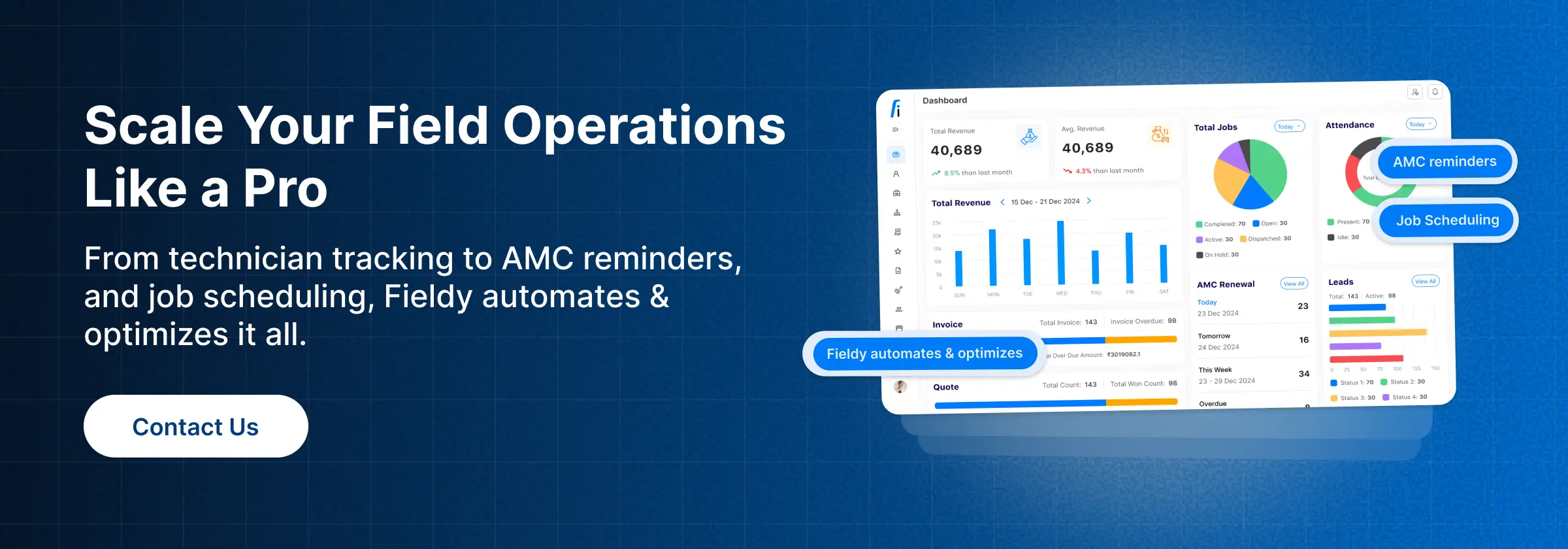
Fieldy beats Housecall Pro in meeting field service management (FSM) requirements in a modern way most of the time. The platform offers far deeper, no-code workflow automation, which teams can use to get rid of repetitive tasks and create industry-specific processes without any technical intervention. Its scheduling and dispatching engine, therefore, can use advanced routing intelligence as well as real-time technician data to accomplish faster job assignments, less travel time, and service request turnaround in no time.
Fieldy’s field service mobile application has been equally thought out for speed and efficiency; therefore, technicians are given the capability to fill out digital forms, get signatures, record parts usage, track assets, submit invoices, and communicate with the office, that too all in the field. In addition, customers are also benefiting through Fieldy’s built-in experience engine, which automates notifications, service reminders, and appointment updates, thus delivering a smooth and transparent service journey from start to finish.
The platform’s analytics suite is, therefore, giving a manager a live view of technician productivity, profitability, job performance, and overall operational efficiency. Moreover, Fieldy’s architecture offers a lot more substantial scalability and centralized control than Housecall Pro for multi-location or rapidly growing service brands, which, in turn, makes it a better operational platform for the long run.
When you are conducting industry-wide platform comparisons, you may want to consider our insights on the Fieldy vs ServiceTitan short comparison could help you understand how enterprise-grade tools stack up. Also, our short breakdown of Fieldy vs Jobber gives small to mid-sized teams evaluating mid-tier options a clear look at more flexible and automation-driven solutions.
⏳ When Should a Business Switch from Housecall Pro? (Signs It Is Time)
It is clear when you should make a change if the people in your team have to do repetitive tasks that are not automated, and your staff are scheduling and dispatching more than before, and they need more automation than Housecall Pro can provide. In case work processes cannot be customized, detailed reports cannot be created, and preventive maintenance contracts cannot be managed, these are some of the signs that you have outgrown the system.
The limitation of asset tracking, contract management, or having a technician app with more features will especially make the situations of the companies that require these things unbearable. Growth becomes heavily slowed by just using basic tools when the company’s operations have become multi-layered or multi-location.
🤖 How Fieldy Helps FSM Teams Operate Better Than Housecall Pro
Fieldy was created with automation as the primary focus for FSM operations. In fact, the predictive scheduling, along with the route optimization, allows the dispatchers to make the job assignments quicker; at the same time, the technicians being monitored in real-time enhance their accountability and overall performance. The mobile application integrates GPS tracking, digital forms, workflow automation, and asset servicing into one user-friendly interface.
This platform executes AMC and contract services with ease through the use of automated schedules, reminders, and job creation, which is something that Housecall Pro does not handle efficiently. The use of AI in creating quotes allows for the situation of revenue being raised while at the same time, the unified CRM, invoicing, and payment platform being the bottleneck removers across the entire job lifecycle.
✅ Final Verdict
Fieldy Is the #1 Housecall Pro Alternative for 2026
By automation, scalability, workflow intelligence, and long-term value, a comparison between Fieldy and Housecall Pro alternatives or competitors would show that Fieldy is the clear winner. The latter is providing the strongest combinations between automation, pricing, and advanced field operations; thus, it can be used by small teams, mid-size businesses, and fast-growing enterprises.
Fieldy holds the field service of tomorrow from 2026 and beyond, thus granting the teams the tools they must have to be able to work in a smarter, quicker, and more efficient way. ⬇️⬇️⬇️

❓ FAQs
Why Are Companies Moving Away from Housecall Pro in 2026?
Many teams feel limited by Housecall Pro’s basic scheduling and invoicing once they scale. Costs rise rapidly with more users and add-ons, while automation, customization, and multi-location controls remain limited. Businesses now require deeper workflow intelligence and enterprise-grade features.
What Features Should a Modern Housecall Pro Alternative Offer?
The must-have features include strong automation, custom workflows, predictive scheduling, inventory and asset tracking, advanced dispatching, a powerful mobile app, real-time reporting, and API-based integrations.
What Is the Best Housecall Pro Alternative in 2026?
Fieldy is considered the leading alternative thanks to deep automation, smart scheduling, scalable pricing, and advanced asset/AMC management. It supports multi-industry workflows and multi-location operations beyond
SMB-level software.
Which Housecall Pro Alternative Is Most Affordable for Growing Businesses?
Fieldy offers scalable pricing without spikes when adding more technicians. Kickserv and FieldPulse are cost-efficient for teams just starting. Choosing a system that can scale without requiring an upgrade is key.
Are There Any Alternatives That Offer Advanced Routing and Dispatching?
Yes. Fieldy provides AI-driven routing and scheduling to reduce travel time and speed up completion. ServiceTitan also offers advanced dispatching, but at enterprise prices, while Housecall Pro remains basic.
Which Option Is Better for Multiple Service Verticals or Complex Workflows?
Fieldy supports trade-specific workflows for HVAC, electrical, security, elevators, and more. Its customizable job logic, asset tracking, and preventive maintenance tools make it ideal for complex operations. Housecall Pro is limited to preset processes.
Is It Possible to Migrate My Data from Housecall Pro?
Yes. Most alternatives support CSV imports for clients and job data. Fieldy also provides onboarding assistance to ensure accurate data mapping and a smooth migration.
Which Platform Is Best for Enterprise or Multi-location Operations?
Fieldy and ServiceTitan are top choices. Fieldy is more cost-effective while still offering centralized control and automation-focused operations. Housecall Pro is not ideal for large or complex scaling needs.
Are There Trade-Specific Alternatives That Outperform Housecall Pro?
Yes. HVAC, electrical, plumbing, and fire-safety companies benefit from platforms with built-in asset management and contract servicing. Fieldy includes these natively, reducing manual tracking for teams.
When Is the Right Time to Move Away From Housecall Pro?
If your team is overloaded with manual tasks, lacks customization, needs asset-level visibility, or is expanding service lines or technician count, it may be time to upgrade to a more robust FSM platform.