

 Blog Details

📘 Introduction
🎯 Why 2026 Is the Best Time to Build a Security Camera Installation Business
In case you are planning to start or increase the volume of your security camera installation business, 2026 offers one of the strongest opportunities in a long time. The demand for the surveillance industry is revolutionizing with a major change by AI, cloud technology, and the necessity of 24/7 monitoring in every business environment, from retail stores to commercial warehouses, office buildings, schools, and industrial facilities.
Globally, the demand for business security camera system installation is growing at a fast rate as companies modernize their surveillance to cut theft, improve safety, and get real-time visibility of their multi-location. Organizations are no longer buying cameras only; they want integrated AI video analytics, remote management, and proactive monitoring solutions that are helpful in incident prevention. This change is making installers the company’s strategic partners, not just equipment providers, as their role expansion is inevitable.
Moreover, the customer’s requirements for professional installers have changed due to the rise of AI, enhanced surveillance, automatic event detection, cloud-based NVRs, and smart building ecosystems. Customers of today want a person who not only can design smart security systems but also implement them without a hitch and provide ongoing service and maintenance for guaranteed uptime.
FSM (Field Service Management) software, however, is simultaneously doing the same by raising the bar for competition. Small local businesses that previously lacked the power of big national security integrators can now run like them and even more efficiently. With automated scheduling, digital checklists, preventive maintenance reminders, inventory tracking, and customer portals, FSM platforms are a great hold for security camera businesses to climb the ladder and still be in control.
If you want to get the full picture of that change, you can always find out the future of CCTV operations via our FSM Security Webinar alongside our guide on Reinventing CCTV FSM. It tells how contemporary field service workflows are internally transforming the surveillance sector.
We could analyze what is required to create a profitable security camera installation business that is prepared for the future of 2026 by going through it step by step.
📊 Understanding the Modern CCTV Market (Technology, Trends & Customer Expectations)
The security industry is very dynamic, and customers are much more knowledgeable than before. If you plan to start a security camera installation business, it is necessary for you to know the factors that are influencing the market.
☁️ 1. Shift Toward Cloud, Managed Surveillance
Cloud surveillance is now a trend that is widely accepted. Clients want to have access to their camera systems from a mobile phone or computer without the need to keep heavy servers at the on, premise location. This trend opens up continuous service opportunities such as a cloud subscription, remote monitoring contracts, and system optimization on an ongoing basis.
🛠️ 2. Increased Need for Business Security Camera Maintenance
As more businesses use video footage for security, compliance, insurance claims, and operational insights, the need for continuous operation has become critical. Thus, this leads to the recurring revenue model through maintenance plans that include cleaning, camera refocusing, firmware updating, and NVR check-up.
🔗 3. Integrations With Alarms, Access Control & AI Analytics
Nowadays, the systems are components of larger security ecosystems. Technicians, who are able to integrate access control, intrusion alarms, and analytics, provide solutions with a higher value to customers, and they become distinguished from other competitors.
🏬 4. Demand From Multi-Location Enterprises
Retail chains, warehouses, logistics hubs, and corporate offices are the most common examples of businesses that operate numerous branches or sites. Such companies need centralized visibility and standardization of services, which leads to a lot of installation and maintenance work in the long run.
💼 5. Rise of Service-Based Business Models
The most profitable companies are those that not only handle installation but also provide services such as ongoing monitoring, maintenance, licensing renewals, and hardware refresh cycles.
You can learn more about contemporary software and ecosystem tools that are transforming the industry by reading our guide on the best security system software for deeper insights.
🚀 12 Steps to Build a Profitable Security Camera Installation Business in 2026
Before we actually go through each step, it is still very much necessary to figure out how important it is to follow an organised approach. Most of the security camera installers initially perform a small part of the job, i.e., they might run some cables, set up a few cameras, and configure a basic NVR. However, the companies that grow to six- or seven-figure levels follow a structure that is based on repeatable processes, vendor relationships, predictable recurring revenue, and efficient field operations.
Every step of this guide is a tool to lift the professionalism of your security camera business installation to a level where your customers will trust you, thereby reducing your risk, increasing your profit, and helping your business operate. Whether you are just starting or you have an existing business that you want to expand, these steps are ways to build the base of long-term success.
We will explore each step more thoroughly.
1️⃣ Step 1: Decide Your CCTV Business Model
This is perhaps one of the most crucial decisions you will ever make. Your business model essentially shapes not only your target market, pricing, etc., but also your service offerings.
🏗️ 1. Installation-Focused Security Camera Business
The focus of this model is on creating and installing security camera systems for small, medium, and large commercial clients. The team should be trained and experienced in wiring, system configuration, and on-site deployment for this model to work effectively.
🔁 2. Maintenance & Recurring Service Contracts
Surely, businesses desire system uptime to be their reality at all times. Different maintenance plans, be they monthly, quarterly, or annual, serve as a source of steady cash flow besides strengthening client relationships.
📦 3. Video Surveillance Distributor / Reseller
There is a possibility to sell cameras, NVRs, cable, and accessories. The reseller model will be reselling service installation.
🧠 4. Security Camera Consultant / Systems Designer
Consulting can be a significant source of income if you are an expert in designing complex solutions or security architecture for enterprise-grade environments.
🤝 5. Wholesale Supplier Partnerships
This means buying the equipment in bulk and selling it to smaller installers or end consumers at a lower price.
💡 Why Combining Installation + Maintenance Is Best
On the one hand, installation is what brings you cash flow now; on the other hand, maintenance is what gives you predictable income forever. The most successful security camera installation businesses are those that do both.
2️⃣ Step 2: Register, License & Structure Your CCTV Installation Business
A properly organized legal setup will not only help to build trust but will also ensure the safety of your company.
- 📑 Set up an LLC, corporation, or partnership
- 🔐 Get installation licenses for low-voltage or security systems (depending on your location)
- 🛡️ Acquire necessary insurance (liability, property, workers’ compensation, E&O coverage)
- 📷 Abide by privacy and video surveillance regulations
- 🏅 Submit vendor certification applications (Hikvision, Dahua, Uniview, Hanwha, Axis, etc.)
Partner brands typically offer training, marketing assistance, and access to priority hardware as some of the benefits.
3️⃣ Step 3: Select Your Product Line (Cameras, Storage, AI Analytics & Accessories)
To run a serious security camera installation business, you need reliable products—because poor equipment leads to callbacks, failures, and unhappy customers.
🔍 How to Evaluate Security Camera Suppliers
Look for distributors offering:
- Competitive pricing
- Warranty replacements
- Training resources
- Local inventory
- Technical support
📹 Choosing Camera Types
Your product line may include:
- IP cameras
- HD-over-Coax
- PTZ cameras
- Thermal cameras
- Wireless/solar cameras
- AI-enabled models with advanced analytics
💾 Selecting Storage Platforms
Offer:
- NVR
- DVR
- Cloud video platforms
➕ Optional Add-ons
- Access control
- Alarms
- Sensors
- Intercoms
To manage this inventory effectively, you can optimise your hardware inventory using Fieldy’s Security Management System Software, which simplifies tracking and replenishment.
4️⃣ Step 4: Build a Strong Vendor & Supplier Network
Your vendors determine your pricing, margins, and ability to scale.
🏭 Secure relationships with:
- Camera manufacturers
- Distributors
- Cable suppliers
- Networking equipment dealers
💬 Negotiate:
- Volume discounts
- Replacement units
- Priority support
- Product certifications
Strong vendor partnerships make your security camera installation business more competitive and reliable.
5️⃣ Step 5: Create a Service Catalog & Pricing Framework
Define what you offer and to whom.
📦 Installation Packages for:
- Retail shops
- Warehouses
- Office spaces
- Commercial buildings
🔧 Maintenance Plans: Monthly, quarterly, or annual service contracts ensure stable revenue.
👁️ Remote Monitoring: More customers want real-time alerts and live monitoring support.
📈 Pricing Tiers: Base your pricing on camera resolution, analytics capabilities, cabling requirements, and complexity of installation.
🔗 Bundled Services: Combine surveillance + alarms + access control for higher client value.
6️⃣ Step 6: Use FSM Software as the Backbone of Your CCTV Operations
Without current software, your business faces a limitation on its operations. Field Service Management (FSM) software is the tool that keeps the whole flow of your business, from scheduling to invoicing, going without a hitch.
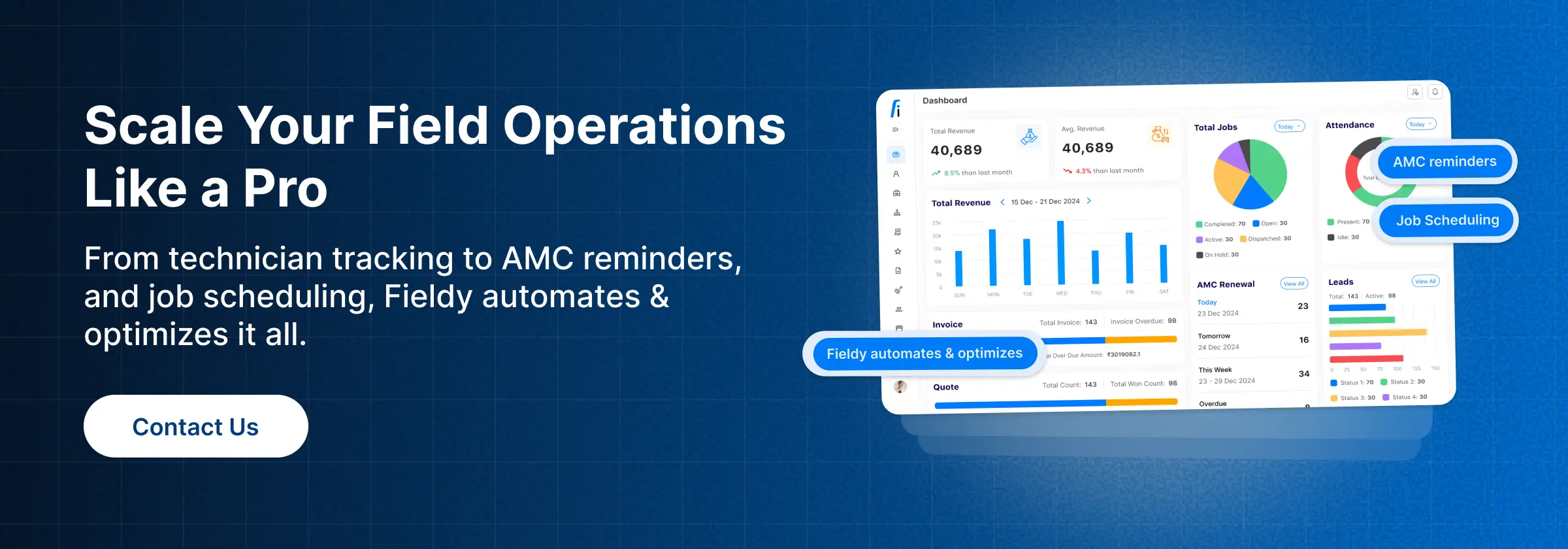
⚙️ How FSM Software Transforms CCTV Businesses
FSM systems help you:
- Centralize scheduling for installation & maintenance
- Automate technician dispatching
- Capture on, site photos & checklists
- Track inventory (cables, cameras, NVRs, accessories)
- Send automated maintenance reminders
- Provide client portals
- Manage leads, estimates & invoices
- Integrate payments
These are how small teams function with the productivity of large national enterprise-level security firms.
🧩 Why Fieldy Is Ideal for Security Camera Companies
Fieldy is a great fit for a cutting-edge security camera installation business that would require:
- Workflows created directly from security installation requirements
- An efficient mobile app for the technicians
- Preventive maintenance automation
- Proposal, estimate, and invoice templates
- Job costing and profitability tracking
There is so much more you can discover with the complete Fieldy Security System Software overview.
7️⃣ Step 7: Build an Efficient Technical Team
Your team defines your reputation.
👷♂️ Skills to Look for in Technicians
- Experience in structured cabling
- IP networking knowledge
- CCTV certifications
- Camera configuration skills
- Professionalism and punctuality
Train them to use a field service management app for checklists, photo documentation, and job updates. For commercial installations, ensure they understand multi-site workflows and complex networking environments.
8️⃣ Step 8: Design Repeatable Installation & Maintenance Processes
Standardization = efficiency + consistent quality.
Processes to Build
- 📋 Site Survey Checklists
- 🪛 Standardized Installation Steps
- 🔌 Networking & NVR Setup
- ✔️ Quality Assurance Procedures
- 🔄 Maintenance Protocols
FSM automation allows you to replicate these processes across teams and job sites effortlessly.
9️⃣ Step 9: Marketing Your Security Camera Installation Business
You need a constant flow of leads to grow.
🌐 Digital Marketing Strategies
- SEO for keywords like security camera installation business, commercial security camera installers, etc.
- Google Maps & Local Services Ads
- Landing pages targeting retail, warehouses, and offices
- Educational blog content (guides, checklists, case studies)
🏢 Offline Marketing & B2B Networking
- Partnerships with electricians, IT providers & contractors
- Networking with property managers
- Trade shows
- Referral programs
Where relevant, you can explore our blog on the best security system software to understand how marketing and technology intersect in this industry.
🔟 Step 10: Selling to Businesses (B2B Sales Strategies for 2026)
Commercial clients think differently from homeowners.
To win B2B deals:
- 🤝 Focus on long-term partnerships
- 📡 Present multi-location security solutions
- 📉 Sell ROI through loss prevention & risk reduction
- 🔐 Offer system health monitoring and analytics
- 📂 Use Fieldy CRM to manage your sales pipelines
Professional proposals and documentation make you stand out immediately.
1️⃣1️⃣ Step 11: Scaling Your CCTV Company With Recurring Revenue
Recurring revenue is what transforms small installers into large companies.
Best Recurring Revenue Streams:
- 🔄 Maintenance plans
- 📡 Monitoring services
- ☁️ Cloud storage subscriptions
- 🆙 Annual upgrades
- 🔔 Access control & alarm add-ons
- 📦 Wholesale product resale
The more you automate these offerings, the more consistent and predictable your revenue becomes.
1️⃣ 2️⃣ Step 12: Case Examples — How FSM Software Helps Real CCTV Companies Grow
Real companies see major improvements after implementing FSM tools:
- 📉 30–40% reduction in technician travel time
- ⚡ 50% faster installation workflows
- 🌟 Higher customer satisfaction
- 💰 Lower operational costs
- 🔁 More contract renewals
- 📈 Predictable recurring revenue
- 🧾 Improved compliance and documentation
FSM software becomes the invisible backbone of your security camera installation business.
🏁 Conclusion:
🎥 Build a Security Camera Installation Business That Lasts Into 2026 & Beyond
The need for high-quality security measures is going up very fast. Thanks to improvements in AI, cloud platforms, and smart building integrations, the sector is getting bigger and bigger. Professional installation is a must for companies in every industry, not only to have the systems deployed but also to be maintained, optimized, and managed in the long run.
Using a combination of technical skills, good vendor relations, a well-thought-out service catalog, and FSM-driven operations, you can create a security camera installation business that is scalable, profitable, and future-ready and therefore will be successful in 2026 and beyond.
Consider deepening your knowledge and sharpening your strategy by looking at:
- 🎥 Our Reinventing CCTV FSM Webinar for insights into the future of surveillance operations
- 🧰 A full review of Fieldy’s Security System Software to modernize your workflows
- 📚 The comprehensive guide on the best security system software to compare tools shaping the industry
With the right approach and the right technologies, your business is positioned to become a dominant force in the security installation landscape.