
 Blog Details

Introduction
Picking an ERP platform has moved beyond being mainly a choice for the IT department. The ERP system has become a central tool in many companies, connecting finance, sales, purchasing, inventory, employees, customers, projects, and day-to-day operations. ERP is not going to be mere data storage in the top ERP systems of 2026. Instead, they have to automate repetitive work and provide immediate access and visibility that connects different departments and, at the same time, provide information to management so that it will enable them to make faster decisions.
One of the problems that users come across when it comes to selection is that different ERP vendors offer solutions with different ranges of features. Some systems serve global companies with complicated production and supply-chain problems, whereas others target small and mid-size businesses needing core accounting, CRM, inventory, and operations tools without a major implementation project. Also, service-oriented enterprises might require features that traditional ERP platforms do a relatively poor job of handling, like technician work order scheduling, customer call dispatch, remote mobile work orders, and field-team coordination. This guide will help you select the best-suited ERP solution from a set of 10 market-leading platforms based on several criteria like functionality, adaptability, integrations, fit with industry usability, price structures, security, and implementation factors. Also, the article will cover the differences between different ERP software solutions based on the business scale, industry, and function. This approach is recommended if you want to limit your consideration to platforms that truly meet your business needs and not just those whose feature list is the longest.
What Is an ERP System?
ERP is an acronym for Enterprise Resource Planning. ERP software is nothing more than a business application that takes different company functions like marketing, purchasing, sales, HR, accounting, etc., and combines them into a centralized system. It means that, through such software, a business can run its day-to-day and month-to-month activities from one place.
Not having to worry about different databases for different functions like accounting inventories sales purchasing projects and operations is made possible by ERP systems. Through the ERP, one department’s data flows to another department very easily, which was not possible before. When a sales order is created, apart from inventory adjustment to the stock, purchase of the raw materials can also be done, financial entries can be recorded, and management will get visibility of revenue, work orders in backlogs, etc.
How Does an ERP System Work?
Most Enterprise Resource Planning (ERP) systems are mainly based on a central database. The various departments retrieve their required data from their own modules without disrupting one another. All the data at the core level is still interconnected. In such a scenario, there is no need for staff to keep pasting information manually from one app to another.
In general, this type of main operating mode would involve:
- Centralized business data: Customer, financial, inventory, employee, supplier, and operational information is stored in connected records.
- Connected departments: Finance, sales, procurement, operations, and management can work from the same underlying information.
- Automated workflows: Routine activities such as purchase approvals, invoicing, notifications, and reporting can be automated.
- Real-time reporting: Managers can monitor financial, operational, inventory, and sales information without waiting for manually prepared reports.
This single source of information is particularly helpful for companies that consist of many parts, like different office locations, departments, warehousing, and sales teams, or those with a lot of operational staff. Instead of getting information from multiple teams separately, company leaders can utilize an ERP system to monitor how various activities impact the overall business.
For organizations that have a huge part of their business relying on technicians and workers outside the office setting, ERP systems might require integration with specialized field service software that manages scheduling, work assignment, remote work, and customer service activities.
What Does ERP Software Manage?
The exact modules you will get depend on your chosen platform, but to give you an example, a modern ERP may handle these features:
- Finance and accounting
- CRM and sales
- Inventory
- Procurement
- Projects
- Employees
- Assets
- Manufacturing
- Supply chain
- Customer orders
- Service operations
- Reporting and analytics
The biggest benefit is all of these features being interconnected. When a sale is made, this results in changes to inventory levels and accounting. Purchasing an item results in a decrease in stock and an increase in accounts receivable. Finishing a job results in preparing a bill and also updating the history of customer services.
What Problems Does ERP Software Solve?
Businesses install ERP software usually when they notice that the various systems have become incompatible, and this leads to operational issues as the company grows. For example, the same customer data might be input multiple times by different department employees. The finance team may have to wait for operational data before they can carry out their activities. Then again, the purchasing department may have no prior information about the stock needs, and managers might find it very tedious trying to discover which numbers are up-to-date in the system. A well-integrated ERP system can resolve these issues, among others, by serving as a single, integrated database where everyone can get a consistent view of their business operations. This leads to a reduction in manual effort, like typing and rekeying the same data multiple times, helps departments coordinate better, improves inventory management, and makes financial reporting faster and easier.
Still, having an ERP system with many modules does not mean your operational problems will be solved automatically. To really gain value from an ERP system, it has to be aligned with the real day-to-day operations of the company.
Types of ERP Software
An ERP system can be divided into multiple categories. Learning these categories would enable companies to identify differences in systems and refrain from comparing platforms operating in different environments.
Cloud-Based ERP Software
Cloud ERP is accessible via internet-connected infrastructure, with a software-as-a-service model being a common choice. Companies usually access ERP via web browsers or mobile app versions rather than keeping it all on their servers.
This delivery model may appeal to businesses because they do not have to maintain a physical ERP platform. In fact, the cloud takes care of most of these problems: software updates, database recovery, security, and availability. Also, business people can remotely access ERP data.
Of course, the platform can also support the expanding organization. At that time, though, you should still consider the main issues of user quantity, storage system modules, integration customization options, and subscription fees to find the most suitable platform.
On-Premise ERP Software
On-premise ERP solutions are installed and run using an organization’s own infrastructure that is in its control. Using this method can offer a greater degree of control over the environment, data architecture, customization, and upgrade schedule.
This control has its price. The company may have to provide internal IT staff or bring in external consultants to manage server security, backups, maintenance, upgrades, and system availability.
On-premises ERP may be the right choice for organizations that have very specific infrastructure requirements, well-established IT teams, or require compliance with very specific laws and custom features, respectively. Still, for small companies, the burden of maintaining their own infrastructure might mean that cloud ERP is a more appealing option.
Hybrid ERP Software
Hybrid ERP integrates cloud and on-site software components. A company may choose to retain some of its data or processes on internal servers while leveraging the cloud services for some functions.
This solution suits businesses that have no possibility of converting all their processes simultaneously. It also provides a way for slow modernization, where replacement of older software is done step by step and without a complete overhaul. The disadvantage of such an arrangement is that there has to be extra effort and planning for the integration and maintenance of the architecture.
The company has to figure out how a cloud and a local server can share a common database and how the operations running in the cloud have access.
Open-Source ERP Software
Open-source ERP platforms allow users to get source code and generally give more freedom for modifications compared to the traditional proprietary ones. Those who run companies with skilled technical staff can change workflows, user interface, modules, or the way that the system connects to other systems to suit their purposes.
But the price of doing all those changes is that things like implementing the changes and looking after what is implemented might get more complicated. It is not exactly that open-source gives you something for nothing. Costs of hosting, designing, getting support, doing updates, safeguarding the system, and even consulting experts can be part of your outlay on the system.
Industry-Specific ERP Software
An industry-specific ERP system is a type of software that is created with specific business processes of certain industries in mind. It is common to see manufacturing ERP software with features related to the shop floor, work order releases, material requirements, and bills of materials. Construction project ERP software could deal mainly with issues like contracts, subcontractors, scheduling machinery, etc.
Similarly, for service industries, an ERP system would likely cover features related to scheduling, job management, and service tickets, dispatch, customer relationship management, quotation invoice, asset tracking, and management of mobile workforce. Using ERP tailored around industries will mean less need for customizations, as against the case of general-purpose ERP where you would have to make it conform to your specialized ways of working.
How We Ranked the Top ERP Systems
It is a misconception that a universal Enterprise Resource Planning (ERP) platform can work as the best fit for all companies automatically. For example, a global manufacturer and a relatively small service company might have drastically different needs, although both technically require an ERP system.
With this comparison, the platforms are looked at based on several practical points:
| 📌 Evaluation Criteria | 🔍 What We Consider |
|---|---|
| ⚙️ Core ERP Functionality | Breadth and depth of business management capabilities |
| 💰 Financial Management | Accounting, financial reporting, billing, and related workflows |
| 👥 CRM | Customer records, sales, and relationship management |
| 📦 Inventory & Procurement | Stock control, purchasing, suppliers, and replenishment |
| 🤖 Automation | Workflow automation and reduction of manual work |
| 📊 Reporting & Analytics | Operational visibility and business intelligence |
| 🔗 Integrations | Ability to connect with other business applications |
| 📈 Scalability | Ability to support organizational growth |
| 🔐 Security | Access controls and protection of business data |
| 🖥️ Ease of Use | Learning curve and day-to-day usability |
| 💵 Pricing | Overall pricing approach and cost considerations |
| 🏭 Industry Suitability | Fit for specific industries and workflows |
| 🎧 Customer Support | Availability of implementation and ongoing assistance |
We do not aim to say that the most expensive or feature-rich platform is the automatic winner. A business’s selection of an ERP system should also consider the complexity of the business and the functions the employees will actually use.
Top 10 ERP Systems in 2026
Below is a list of platforms that demonstrate the variety of ways to implement enterprise resource planning. Whereas certain types may be more appropriate for multinational corporations, others are probably more suitable for expanding businesses or for organizations in search of flexible, modular, and customizable systems.
Quick Comparison: Top ERP Systems in 2026
| 💻 ERP System | 🎯 Best For | 🏢 Company Size | ⭐ Key Strength | ☁️ Deployment |
|---|---|---|---|---|
| Fieldy | Service businesses and field operations | Small to mid-sized | Field operations + CRM + job management | Cloud |
| SAP S/4HANA | Complex global enterprises | Large enterprise | Enterprise resource planning | Cloud / On-premises |
| Oracle NetSuite | Cloud-first businesses | Mid-market to enterprise | Financial and business management | Cloud |
| Microsoft Dynamics 365 | Businesses needing ERP + CRM | Mid-market to enterprise | Microsoft ecosystem | Cloud |
| Odoo | Modular business management | Small to mid-market | Flexibility and customization | Cloud / On-premises |
| Infor CloudSuite | Industry-focused enterprises | Mid-market to enterprise | Industry-specific ERP | Cloud |
| Acumatica | Growing businesses | Small to mid-market | Flexible cloud ERP | Cloud |
| Sage X3 | Complex mid-market organizations | Mid-market | Finance and supply chain | Cloud / On-premises |
| ERPNext | Businesses wanting open-source ERP | Small to mid-market | Customization and breadth | Cloud / Self-hosted |
| Epicor Kinetic | Manufacturing businesses | Mid-market to enterprise | Production and manufacturing | Cloud |
1. Fieldy — Best ERP Overall
Fieldy distinguishes itself from traditional enterprise ERP platforms by putting a strong emphasis on companies whose everyday work is done in the field. For service organizations, managing customers, employees’ jobs, schedules, estimates, invoices, assets, and operational information in separate systems can fragment them almost as much as ERP software was meant to eliminate. Fieldy combines customer management, scheduling and dispatching, quoting, invoicing, work orders, field-team management, and service workflows into one unified platform.
This is very convenient, mostly for HVAC, plumbing, electrical, cleaning, roofing, pest control, and other companies whose services require coordinating office and field crews. Apart from treating field activity as a secondary consideration, the platform integrates operational workflows at the heart of the system.
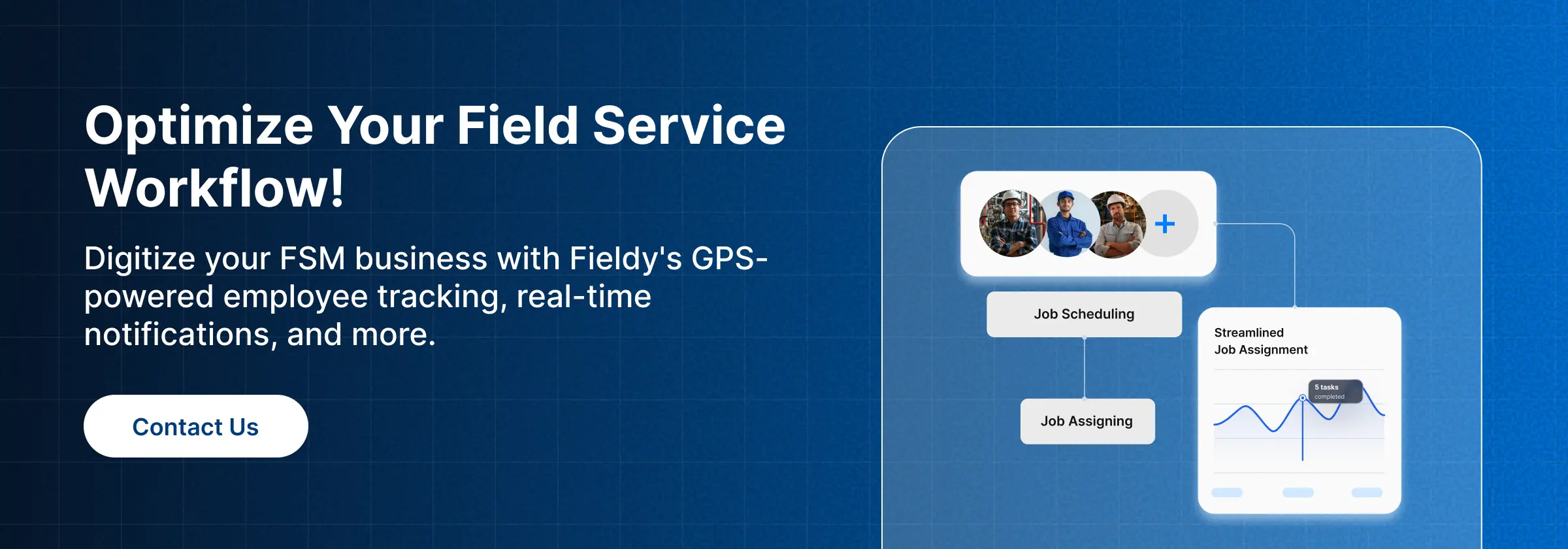
To put it into practice in a service company, this works below. A customer request goes first through scheduling; the work is dispatched through a mobile workflow for the technician, the team documents the work and parts, and the office proceeds with billing and follow-up based on the finished work. Through reporting, management can assess workload, technician productivity, customer details, and other operational aspects.
Best For
- HVAC and plumbing companies
- Electrical contractors
- Cleaning businesses
- Roofing and home-service companies
- Pest control businesses
- Growing field-service organizations
- Companies managing mobile technicians
- Businesses that need CRM and operational workflows together
Key Strengths
- Customer management
- Scheduling and dispatch
- Quoting and estimates
- Invoicing
- Work orders
- Field-team management
- Asset and service workflows
- Reporting
- Mobile access
- Operational automation
Pros
- Strong fit for field-service businesses
- Connects customer and operational workflows
- Useful for businesses managing mobile teams
- Combines multiple service functions in one platform
- Designed around practical service workflows
Cons
- Traditional manufacturers may require a more specialized manufacturing ERP
- Large multinational enterprises with highly complex global requirements may need a broader enterprise platform
Overall assessment: Fieldy can be an excellent solution for companies that have expanded their ERP definition from a simple accounting and inventory system to one that manages customers, jobs, technicians, assets, scheduling, and service operations on a daily basis.
2. SAP S/4HANA
SAP S/4HANA is one of the major enterprise ERP systems ideal for organizations that have a lot of operations such as financial, manufacturing, supply chain, etc. This system caters to a company requiring a highly controlled, integrated, and multi-departmental workflow management tool that goes well beyond a simple business-frontend application. Besides, this system is used in finance, procurement, manufacturing, supply chain, asset management, and sales & analytics areas; its advantage lies in the wide spectrum and diversity of services offered that fit very well the needs of big companies that possess in-house teams responsible for handling ERP processes, security, data, configuration, and company policy.
Operating in one country versus many, or handling complex manufacturing, procurement, and logistics chains of supply, are the main factors that would make an organization think that SAP is the most suitable. Even so, with the help of implementation, the company should figure out not only the type of software license they want but also, for example, an implementation partner, configuration, data migration, employee training, integrations, and administration of the system post-go-live.
Best For
- Large enterprises
- Global organizations
- Complex manufacturers
- Large supply chains
- Organizations with sophisticated financial requirements
Key Strengths
- Extensive enterprise functionality
- Strong financial management
- Manufacturing and supply-chain capabilities
- Global operations support
- Advanced analytics
- Extensive ecosystem
Pros
- Extremely broad functionality
- Strong enterprise scalability
- Suitable for complex global operations
- Extensive integration and partner ecosystem
Cons
- Significant implementation complexity
- Can require specialist expertise
- May be excessive for smaller businesses
- Total implementation cost can be substantial
Overall assessment: In summary, SAP S/4HANA is ideal for those who truly need the intricacies of an enterprise-grade solution. Meanwhile, a small service business stands a better chance of succeeding with a more specialized platform that allows the employees to set themselves up and operate without the burden of big enterprise ERP systems.
3. Oracle NetSuite
Oracle NetSuite gives a cloud ERP solution integrating financial management and other primary business operations on one platform. Innovative growth-oriented businesses choose NetSuite over disjointed setups of accounting, warehouse, CRM, and operational applications to work together.
NetSuite not only has the ability to manage the financial aspect but also does well when it comes to inventory, order management, CRM, purchasing, e-commerce, reporting, and automation. This feature is mainly beneficial to companies where the financial and operational activities were not closely related, but they need to be for the company’s success. The main advantage of NetSuite for such companies is its being cloud-based. That allows different company branches to have one shared system, yet each location to manage its local operations independently without owning and maintaining the ERP environment. Still, there is a necessity for businesses to assess their needed modules and the amount of implementation work for the project because the result’s cost and complexities can be dramatically different according to a company’s configuration and integrated systems.
Best For
- Growing companies
- Multi-location businesses
- E-commerce organizations
- Wholesale and distribution companies
- Mid-market and enterprise organizations
Key Strengths
- Cloud ERP
- Financial management
- Inventory management
- CRM
- E-commerce
- Order management
- Reporting and automation
Pros
- Broad cloud ERP capabilities
- Strong financial functionality
- Useful for growing and multi-location organizations
- Supports multiple business functions
Cons
- Implementation can be complex
- Pricing can vary based on modules and requirements
- May require specialist configuration
- Can be more than a small business needs
Overall assessment: NetSuite is a strong choice for companies that need comprehensive cloud ERP, mostly if finance, inventory, order management, and e-commerce are expected to work together from a unified system.
4. Microsoft Dynamics 365
Microsoft Dynamics 365 bundles its ERP and CRM features with business applications of Microsoft. This appeals a lot to businesses that are hoping for the integration of business functions like finance, supply chain, customer management, analytics, and other business applications to work in harmony.
By picking different products, businesses could deal with finance, supply chain management, sales, customer service, project operations, and other functions. It is also a plus for organizations using Microsoft 365, Power BI, Teams, and other Microsoft services to seamlessly integrate with the platform.
Dynamics 365 is ideal for small and mid-market, as well as large organizations, that have more complicated operational needs since the platform supports the business activities of different industries. The wide range of offerings on the platform can provide businesses enormous flexibility, though organizations need to align their business needs very clearly before Dynamics 365 is rolled out, as it’s an application ecosystem and not a singular package.
Best For
- Mid-sized businesses
- Large organizations
- Businesses already invested in Microsoft
- Companies needing ERP and CRM
- Organizations requiring advanced reporting
Key Strengths
- Finance
- Supply chain management
- CRM
- Business intelligence
- Microsoft ecosystem integration
- Workflow and automation capabilities
Pros
- Strong ERP and CRM combination
- Excellent fit for Microsoft-centric organizations
- Broad ecosystem
- Strong analytics capabilities
- Scalable for complex organizations
Cons
- Product ecosystem can be complicated
- Implementation requires careful planning
- Costs depend heavily on applications and users
- May be excessive for smaller companies
Overall assessment: Microsoft Dynamics 365 works very well for those companies whose business processes are not only integrated with ERP, CRM, and analytics but also with a Microsoft platform. If you have not much to manage, you might opt for one single-purpose platform.
5. Odoo
Odoo is basically a set of modular ERP features built upon an approach that says businesses can just choose the apps they really need at first and later expand. Rather than forcing every company to implement a set of dozens of large-scale enterprise modules right away, Odoo lets them develop an environment using a few core functions such as CRM, accounting, inventory, manufacturing, sales, purchasing, projects, etc., with the ability to add more as needed. Such a modular architecture is what makes Odoo stand out mainly among small and medium organizations that wish they had wide-ranging business capabilities yet would still prefer to have some flexibility and choice. A startup, for instance, could start with CRM and accounting, and then gradually bring in inventory, purchasing, manufacturing, or other modules as the company grows into more complex demands.
Another big factor is customization. One of the main features that companies love is the ability to define workflows and tailor actions as required, but doing thorough customization is something one needs to be careful with. In fact, every customization comes with its share of potential maintenance and upgrade challenges, so organizations need to clearly decide which is necessary to implement, and the rest could be solved by standardization and configuration alone rather than by coding.
Best For
- Small and mid-sized businesses
- Businesses wanting modular ERP
- Companies requiring customization
- Manufacturing organizations
- Businesses combining CRM, accounting, and inventory
Key Strengths
- Modular architecture
- CRM
- Accounting
- Inventory
- Manufacturing
- Purchasing
- Customization
Pros
- Flexible application structure
- Broad range of modules
- Suitable for different industries
- Customization options
- Can grow with business requirements
Cons
- Extensive customization can increase complexity
- Implementation quality depends heavily on configuration
- Businesses may need specialist assistance for advanced requirements
Overall assessment: Odoo, to sum up, is suitable when your company is modular and ERP-oriented and when you can customize the system based on the way your business actually works. Still, to your detriment, if you over-customize the ERP system, you lose its flexibility, and you get a highly specialized system, which in many cases is not necessary.
6. Infor CloudSuite
Infor is offering several solutions through CloudSuite, which is an on-demand system. These systems are tailored to industry and business operations. Instead of business process uniformity, Infor brings an industry-specific environment covering areas like manufacturing, distribution, healthcare, and other fields. This approach is a real benefit to organizations that cannot be served by generic ERP solutions because their workflow are highly specialized.
The platform can connect departments for manufacturers and distributors, such as finance, supply chain, inventory, production, procurement, and operations planning. Industry-tailored processes will help decrease the degree of change needed for the implementation of an ERP mostly if the organization already has somewhat complicated processes. Rather than focusing on very small businesses, Infor is more suitable for mid-sized or bigger organizations.
It should be understood that planning is still essential even though it is an industry-specific ERP. Because it is such a multifunctional software, the entire business process needs adjustment to match the product. Before choosing Infor CloudSuite, a company needs to understand its different Cloud editions and modules to see if they match their requirements. It would not be fair to think that the software fits your business just because it is a standardized ERP package.
Best For
- Manufacturing companies
- Distribution businesses
- Mid-market organizations
- Large enterprises
- Industry-specific operations
Key Features
| ⚙️ Feature | 💡 Benefit |
|---|---|
| 💰 Financial Management | Centralizes financial operations |
| 🏭 Manufacturing | Supports production processes |
| 🔗 Supply Chain | Improves visibility across supply operations |
| 📦 Inventory | Tracks stock and materials |
| 🚚 Distribution | Supports warehouse and distribution workflows |
| 🏢 Industry Workflows | Reduces unnecessary customization |
| 📊 Analytics | Provides operational and business insight |
Pros
- Strong industry-specific functionality
- Broad manufacturing capabilities
- Suitable for complex operations
- Cloud-based deployment
- Strong supply-chain capabilities
Cons
- Can be complex for smaller companies
- Implementation requires planning
- Pricing depends on configuration
- Businesses may need implementation specialists
Best For: Mid-sized and large organizations with specialized manufacturing, distribution, or supply-chain requirements.
7. Acumatica
Acumatica is a cloud ERP platform targeted at emerging organizations requiring far more functionality than entry-level accounting or stand-alone business applications can offer. It offers a product architecture for distributed management, financial management, manufacturing, customer management, project accounting, and other operational systems.
Flexibility is also part of the platform’s strength in growing businesses. Connecting financial data with inventory, purchasing, projects, sales, and operations is one of the advantages.
This is during a time when a business has already had separate applications working together to duplicate one’s work and utilize less visibility. Acumatica is equally suitable for growing organizations, but purchasing decision-makers should consider implementation requirements. When workflows are created without a full understanding of business processes, ERP customization might be a liability. Implementation should start by identifying what information employees need to do their jobs.
Best For
- Growing businesses
- Mid-sized companies
- Distribution companies
- Manufacturing businesses
- Project-based organizations
Key Features
| ⚙️ Feature | 💡 Benefit |
|---|---|
| ☁️ Cloud ERP | Remote access and centralized data |
| 💰 Financial Management | Accounting and financial visibility |
| 🚚 Distribution | Purchasing, sales, and inventory workflows |
| 🏭 Manufacturing | Production management |
| 📋 Project Accounting | Connects projects with financial information |
| 👥 CRM | Customer and sales management |
| 📊 Reporting | Operational visibility |
Pros
- Strong cloud ERP capabilities
- Good fit for growing businesses
- Broad functionality
- Manufacturing and distribution support
- Project accounting capabilities
Cons
- Implementation can require specialist expertise
- Configuration can become complex
- Costs vary based on requirements
- May be more than very small businesses need
Best For: Growing and mid-sized businesses that need a flexible cloud ERP covering finance, distribution, manufacturing, and projects.
8. Sage X3
Sage X3 is an ERP platform for businesses that are fairly sophisticated in their financial, supply-chain, manufacturing, and multi-site needs, yielding an environment of activity that is more expansive than a simple accounting program would deliver. This system links finance to procurement, inventory, production, sales, and supply chain.
The platform is particularly useful for multi-site or multinational companies. By centralizing its information, management can have a better understanding of transactions, inventories, purchasing, and operational performance.
Manufacturing companies may use ERP capabilities to integrate production and materials schedules with financial data. Considered as an ERP, a serious project rather than a software subscription, Sage X3 can be cost-effective if proper process mapping is done before subscribing to the application. Modules and integrations need to be carefully selected and accounted for in the cost of implementation and training. For less complex companies, a lighter platform might be more cost-effective and quicker to adopt.
Best For
- Mid-market companies
- Multi-site organizations
- Manufacturing
- Distribution
- Supply-chain-intensive businesses
Key Features
| ⚙️ Feature | 💡 Benefit |
|---|---|
| 💰 Financial Management | Centralized accounting and reporting |
| 🔗 Supply Chain | Connects purchasing and operational processes |
| 🏭 Manufacturing | Supports production operations |
| 📦 Inventory | Tracks materials and stock |
| 🏢 Multi-site Management | Supports distributed operations |
| 🛒 Procurement | Manages purchasing workflows |
| 📊 Reporting | Improves management visibility |
Pros
- Strong financial capabilities
- Suitable for complex supply chains
- Manufacturing support
- Multi-site functionality
- Broad ERP coverage
Cons
- Implementation can be substantial
- May require experienced consultants
- Not ideal for very small businesses
- Total cost depends on deployment and requirements
Best For: Mid-sized organizations with complex finance, manufacturing, distribution, and multi-site requirements.
9. ERPNext
ERPNext is a community-driven open-source ERP system that offers the essential features of comprehensive management software that a typical business might expect to get with such a solution. The system features various modules like accounting, CRM, inventory, manufacturing, purchasing, sales, projects, human resources, and other business processes.
Such a platform would probably appeal to the kind of businesses that like freedom to be as flexible and in control as possible. The companies can have it as a cloud solution or choose to run the software on their own premises if their situation so demands. And since it is open-source, such a move would allow technologically capable companies greater freedom for customization and integrations.
However, flexibility mustn’t be mistaken for a sign of simplicity. Companies that go for heavy customization of the ERP must be prepared for in reality, these aspects require the attention of time and effort, including regular maintenance, security, and upgrades, as well as technical support.
Best For
- Small and mid-sized businesses
- Open-source ERP users
- Companies requiring customization
- Manufacturing businesses
- Organizations seeking broad ERP functionality
Key Features
| ⚙️ Feature | 💡 Benefit |
|---|---|
| 💰 Accounting | Financial management |
| 👥 CRM | Lead and customer management |
| 📦 Inventory | Stock and warehouse management |
| 🏭 Manufacturing | Production workflows |
| 🛒 Purchasing | Supplier and procurement management |
| 📋 Projects | Project tracking |
| 👤 HR | Employee-related processes |
| ⚙️ Customization | Greater control over workflows |
Pros
- Open-source platform
- Broad ERP functionality
- Strong customization potential
- Manufacturing support
- Suitable for different industries
Cons
- Technical expertise may be required
- Customization can increase maintenance
- Implementation quality varies
- Businesses must plan upgrades carefully
Best For: Businesses looking for a flexible ERP platform and willing to invest in configuration or technical expertise.
10. Epicor Kinetic
Epicor Kinetic has been identified as a powerful ERP software mainly used by manufacturing and production-oriented businesses. The software offers the means for linking different aspects like production, inventory, finance, etc. in one location.
Manufacturing companies have access to several functionalities such as managing production, processes, materials inventory, purchasing operations, supply-chain activities, and connected financial records. Through manufacturing analytics, management will be able to gain insights into production efficiency, productivity, etc.
Epicor Kinetic is ideal when complex production processes constitute a main point of consideration. A manufacturer whose operations involve bills of materials, production plans, and availability and requirements of inventories and manufacturing work orders will probably achieve more with a manufacturing-centric ERP solution. In comparison, small service or administrative organizations with simple requirements may not need such extensive manufacturing features.
Best For
- Manufacturers
- Mid-sized businesses
- Large manufacturing organizations
- Production-intensive companies
- Businesses requiring manufacturing analytics
Key Features
| ⚙️ Feature | 💡 Benefit |
|---|---|
| 🏭 Production Management | Coordinates manufacturing processes |
| 🔗 Supply Chain | Improves material and supplier visibility |
| 📦 Inventory | Tracks materials and finished goods |
| 🛒 Purchasing | Supports procurement |
| 📊 Manufacturing Analytics | Provides production insight |
| 💰 Finance | Connects operational and financial information |
| 📋 Planning | Helps coordinate production requirements |
Pros
- Strong manufacturing focus
- Production management capabilities
- Supply-chain functionality
- Manufacturing analytics
- Suitable for complex production environments
Cons
- Primarily oriented toward manufacturing
- Implementation can be complex
- May require specialist support
- Not necessarily appropriate for simple service businesses
Best For: Manufacturing businesses that need deep production, inventory, purchasing, and supply-chain capabilities.
Top ERP Systems Comparison
Getting a closer look at the different platforms by comparing them side by side highlights a better understanding of the distinctions between these two major systems. It really all depends on what you, as a business, want to achieve. If the company, for instance, handles complex manufacturing processes well, SAP and Epicor would be good choices. Whereas Odoo and ERPNext are more suitable options for companies that are looking out for flexible or customizable ERP solutions.
| 💻 Platform | 🎯 Best For | 💰 Finance | 👥 CRM | 📦 Inventory | 🏭 Manufacturing | 🤖 Automation | 🔗 Integrations | 📈 Scalability |
|---|---|---|---|---|---|---|---|---|
| Fieldy | Service businesses | ✅ | ✅ | ✅ | Limited | ✅ | ✅ | High |
| SAP S/4HANA | Global enterprises | ✅ | ✅ | ✅ | ✅ | ✅ | ✅ | Very High |
| Oracle NetSuite | Cloud businesses | ✅ | ✅ | ✅ | ✅ | ✅ | ✅ | High |
| Microsoft Dynamics 365 | ERP + CRM | ✅ | ✅ | ✅ | ✅ | ✅ | ✅ | Very High |
| Odoo | Modular businesses | ✅ | ✅ | ✅ | ✅ | ✅ | ✅ | High |
| Infor CloudSuite | Industry-focused companies | ✅ | ✅ | ✅ | ✅ | ✅ | ✅ | Very High |
| Acumatica | Growing businesses | ✅ | ✅ | ✅ | ✅ | ✅ | ✅ | High |
| Sage X3 | Mid-market operations | ✅ | ✅ | ✅ | ✅ | ✅ | ✅ | High |
| ERPNext | Open-source ERP | ✅ | ✅ | ✅ | ✅ | ✅ | ✅ | High |
| Epicor Kinetic | Manufacturing | ✅ | ✅ | ✅ | ✅ | ✅ | ✅ | High |

Specialization is the most significant difference. A company should never go for SAP, Oracle, or Microsoft without thinking just because these are the big names on the block. The needs and priorities of an organization that manages hundreds of technicians, service appointments, work orders, field employees, assets, and the like may well diverge from those of a multinational manufacturer.
Fieldy is unique here as it is built to handle service-focused operations. Companies whose operations include customer management, scheduling, dispatching, quoting, invoicing, field team coordination, and the like will probably find a dedicated solution more suitable than trying to bend an enterprise-level ERP solution for field activities.
Top ERP Systems by Business Size
Best ERP Systems for Small Businesses
Small businesses mostly require an ERP system that is able to provide essential features and at the same time avoids being difficult to implement. While budget is a factor, user-friendliness may be just as significant. A system that calls for a heavy dose of training and administrative efforts may drain the resources of a small company, and it may turn out to be a very expensive investment.
Core functionalities for smaller firms include accounting, CRM, inventory management, purchasing, sales, reporting, and workflow automation. Companies can start with the areas they see a need for and after that expand their use of other modules through modular systems like Odoo and ERPNext. Organizations with fieldwork or outdoor operations would be better off with platforms emphasizing service, like Fieldy, which they find more practical.
One more thing is that small businesses must not neglect user adoption. The most suitable ERP for their situation will be determined when employees have a good grip on a system that they use regularly and reliably keep the information up to date.
For a company, if they require customer management integrated with core operations, then choosing the best CRM for small business might be a key step towards the selection of an overall ERP solution to get things going properly.
Best ERP Systems for Mid-Sized Businesses
Businesses of this size typically have a different set of dilemmas. They might have simply outgrown the small business applications, but not yet the enterprise global ERP complexity.
Scalability, department-level workflows, reporting, integrations, accounting & inventory, and customization begin to factor in more heavily. Acumatica, Odoo, Sage X3, Microsoft Dynamics 365, and Oracle NetSuite may all be applicable regardless of industry or depth of operation.
An expanding company needs to take future needs into account also and not just select one around what the company currently does. E.g., a company that plans to increase the number of shops or the number of items in the product range needs to take multi-location support into account.
Best ERP Systems for Large Enterprises
Large corporations, however, usually need a lot more advanced capabilities. International operations, very complicated organizational charts, highest standards of security, compliance issues, multi-country financial regulations, very sophisticated supply chains, and highly detailed analytics may all affect ERP choice.
SAP S/4HANA, Microsoft Dynamics 365, Oracle NetSuite, Infor CloudSuite, iFS Applications (formerly IFS Enterprise), Sage X3, and Epicor Kinetic may be good choices based on the industry and operating model of a company.
Enterprise ERP initiatives also need major governance. Implementation is sometimes just as crucial as software choice because, in reality, things like bad data migration, unclear ownership, excessive customization, or poor training can destroy what otherwise would be a very well-functioning platform technically.
Based on what I just said, big companies should assess the ERP developer, implementation partner, available internal resources, integration plan, security setup, and the overall long-term cost, not just the features of the software itself.
ERP Examples by Industry
ERP software is most of all helpful in enhancing its value when it reflects the way an individual industry functions. A manufacturing business needs to focus on production planning and materials, whereas a retailer will pay close attention to inventory, purchasing processes, orders, and the accounting aspect. Another type of business, like a field servicing company, would have another way of operating, where customer requests are translated into scheduling work, dispatching jobs, work orders, assigning technicians, keeping up with service history, and invoicing.
That is why companies need to take a closer look at the term “ERP” beyond just the surface. There are cases where two platforms can be classified as ERP at the same time and still provide a completely different experience for their users. It all comes down to that: which processes do they care the most about?
ERP Software for Manufacturing
Manufacturing ERP software is meant to bridge the gap between production and business departments. Rather than considering the work area, buying section, warehouse, sales force, and accounting department as isolated businesses, enterprise resource planning (ERP) software integrates information so that each department is working with the same data.
Common features of a manufacturing ERP system:
- Production planning
- Bills of materials (BOMs)
- Material requirements planning
- Inventory control
- Purchasing
- Work orders
- Quality management
- Job costing
- Shop-floor reporting
- Financial management
Since manufacturing of metal parts and fabrication needs different processes – starting from a piece of metal and ending up with a finished product – companies need the best ERP software for metal fabrication that can track all operations, including production scheduling, material consumption, job costing, purchasing, inventory, and so on. They shouldn’t look for an ERP mainly that can do accounting jobs well, but rather a system that has all the capabilities of metal fabrication production covered.
ERP Software for Field-Service Businesses
Many field service businesses face a specific challenge with their operational management: most of the work goes on away from the office premises. Customer details, employee appointments, vehicle management, the use of equipment, delivery and installation of spare parts, creation of work orders and estimate slips, as well as issuing invoices need to be handled through an ERP or business management platform.
When such companies differentiate a standard ERP from field service software, they realize that specialized software can handle operational tasks like scheduling, dispatch, mobile service job management, communication with customers, and tracking of technicians as the main feature of the system.
Scheduling
Scheduling of field operations is one of the primary activities for field services. Field technicians’ availability has a direct bearing on making customer appointments, their travel time, level of work, and so total sales. Using the new generation of field service scheduling software makes it possible for a company to assign tasks based on availability, geography, skills, levels of precedence, and other constraints of the business operation.
A dispatcher can monitor all the appointments and technician workload without needing paper calendars or multiple Excel spreadsheets. This helps greatly in detecting any overlapping schedules before they get too bad, as well as being able to fit in an urgent job in case an emergency comes up on a busy schedule.
Dispatching
Scheduling is the process of deciding when certain work should be done, while dispatching is the one who decides who among the staff would be responsible and how the field personnel will be informed about the job. Field service dispatching software allows the dispatchers to have a complete overview of technicians, job status, locations, and assignments in a centralized manner.
This feature of field service dispatching software proves to be a big plus when a business deals with tens or hundreds of service calls daily. Instead of constantly calling a technician to know his/her status, the office staff can access all the job information from one place and make it easier to coordinate work and inform them about the changes.
Customer Booking
Customer service is often a process that begins well before a technician has actually come into contact with the client. For one thing, the ability to book appointments online will free the office staff from having to respond manually, as it will provide customers with a way to request an arrangement without actually going through the hassle of waiting. To reduce administrative activities and the manual effort that one would have to put into arranging services, the use of a field service booking software could be a good one. A request for an appointment gets matched with the scheduling function, and so it saves you time and energy.
Let’s say that a residential HVAC company allows you as a homeowner to request a maintenance service online. After the request is sent out, it gets integrated into the company’s scheduling workflow rather than just staying idle in an email account waiting for some human intervention to process it.
Customer Management
Field-service companies need more than just basic contact info. They also require service history, machinery details, earlier quotes, invoices, job notes, warranties, and records of communication. Through the use of field service CRM software, customer details that might otherwise be scattered get connected to operational tasks.
This integration can assist an office staff member in giving answers without going over different systems. It can also enable a technician to be prepared and aware of a customer’s past work at a property and their service history upon arrival.
Quoting
Field-service businesses heavily rely on accurate quotes or estimates, and this is in particular true in HVAC, plumbing, electrical, roof installation, painting, carpentry, etc. An online field service quoting software allows a company to not only create, send, and track quotes but also convert leads into sales while customer and project details remain accessible and up-to-date.
The real gain here goes beyond merely being able to hand out a nicely formatted quote that looks professional from a client perspective. The major edge is closing the loop between quoting the job and performing it. Once a client accepts an estimate, the details of that particular work are then transferred over to scheduling, work orders, purchasing, and customer billing modules.
Invoicing
Once jobs are done, businesses want to bill customers as quickly and with as few errors as possible. Field service invoicing software helps by automatically linking labor, materials, services, taxes, discounts, etc., and customer details to the billing process.
To take the plumbing industry as an example, suppose a tech installs/replaces fixtures and records hours and materials used via phone or app after doing the job at the customer’s place. The office crew could have one less thing to worry about since they can review and approve bills through this software, and the customer gets a receipt. Manual re-entering of customer details, services/ products, and costs will be avoided.
HVAC-Specific Operations
HVAC businesses face similar challenges to field service companies: regular maintenance, emergency repairs, equipment history, replacement parts, technicians’ service estimates, service contracts, and customer appointments, just to name a few! HVAC field service management software is based on these day-to-day operational needs. And good software can link the office and the field through a single workflow.
The finest ones give an HVAC business the ability to run customer management and the operation of the service side from within the same place as the business’s other tools like CRM, scheduling, technician tracking, and billing.
ERP Software for Retail and E-Commerce
For retail and e-commerce companies, inventory and order management are typically the main reasons for selecting an ERP system. A retail business should have the ability to tell which products are in stock, find out what has been sold, discover the number of stock items ordered from suppliers, and determine what items still need to be bought to replenish inventory.
Common features typically are:
- Product and SKU management
- Inventory tracking
- Purchase orders
- Supplier management
- Sales orders
- E-commerce integrations
- Warehouse management
- Customer records
- Accounting
- Reporting
In the inventory-ERP comparison scenario, one of the questions that companies frequently ask is, “Which software is recommended for inventory management?” The solution really depends on the volume of products, the level of complexity of the warehouse, the number of places where the company can be found, sales channels, the level of forecasting demands, and, of course, any integration needed between the inventory management system and other systems such as ERP or accounting.
ERP Software for Professional Services
Professional-services businesses typically have much lower physical inventory issues compared with manufacturers or retailers but are just as reliant on having systems that can run all aspects of the business. Their main assets include employees, projects, client relationships, as well as billable time.
So, professional-services ERP would probably focus on:
- Project management
- Resource planning
- Time tracking
- Billing
- Expenses
- Customer management
- Financial reporting
- Workforce utilization
The main benefit of integrating the two is to link project execution with financial results. Managers can track employees’ time per project, revenue generated from projects, and cost variance.
ERP Examples by Business Function
ERP systems are mostly explained by their industry coverage. An alternate approach to comprehend them is through the business functions they join. Today’s leading ERP systems are generally modular, so companies can tailor them by combining financial, operational, customer, inventory, workforce, and asset functions based on their needs.
ERP for Accounting and Billing
Financial software has financial modules as one of the essential modules in an enterprise resource planning (ERP) system. The accounting system modules enable the company to manage payables, receivables, and the company’s general ledger in one place, as well as manage the company’s tax information, account for the company’s financial reporting, and generate the company’s bills.
The main benefit is that financial data will automatically be tied into a company’s day-to-day operations by such a system. Once a sale is closed, a buyer submits a purchase order, products are received from the supplier, an inventory transaction, a project, or a service job is completed, it will be recorded in the company’s books without the need to keep a manual record of it on other systems and having to input it separately by your workforce. This reduces the manual data entry that is error-prone and time-consuming.
India-based businesses that are looking for the right financial software will also need to look at the best billing software in India. They need to make an informed decision by comparing a specialized billing tool against ERP, which is a much larger, comprehensive package that integrates various business modules.
ERP for Customer Relationship Management
CRM features empower ERP systems to keep track of customer details in line with sales and operational figures. Some of the common features offered are:
- Lead management
- Customer records
- Sales pipelines
- Contact management
- Communication history
- Opportunities
- Follow-ups
- Sales reporting
In many companies, it pays when a customer goes from being a prospect to a buyer, so it really helps to integrate sales activity with everything that happens post-sale. Without needing the help of another department, a salesperson is able to see orders, invoices, service history, or account activity.
Customer-management solutions that are assessed by businesses can be compared with options that come recommended as the best CRM software in India, when CRM is an extremely important component.
ERP for Inventory Management
Inventory management is arguably the top reason that companies use enterprise resource planning (ERP) software. Lack of proper visibility of stock can result in excessive ordering, shortage of supplies, high costs of carrying inventory, and delays in the production line.
An ERP inventory module can provide:
- Stock-level tracking
- Warehouse management
- Purchase orders
- Supplier information
- Reorder points
- Transfers
- Inventory valuation
- Demand planning
- Multi-location visibility
Businesses that operate multiple warehouses or service centers can benefit immensely from having a single source of inventory data. By knowing the location of inventory, managers can also determine which items need to be restocked and which products or raw materials are used most often.
ERP for Asset Management
Asset management relates to overseeing a company’s tangible assets such as the tools or the machines that enable the day-to-day running of a business. Based on the nature of an industry, these could range from assembly line machines to vehicles, heaters, air conditioners, diagnostic tools, surgical equipment, and even customer-owned goods that require maintenance and repair services.
A company trying to define “what is enterprise asset management” should not stick to just a simple listing of assets. An expert asset management process is able to track such things as the history of an asset’s maintenance record, the asset is at the moment warranty cost of services rendered, and the condition of the asset.
Based on these details, companies would have the necessary information to plan maintenance work, determine the time of replacement, maximize asset use, and calculate total cost of ownership.
ERP for Contract Management
Contracts may include the most important information, like pricing models, mutual obligations, dates of renewals, service agreements, compliance standards, and responsibilities. Handling contract details through shared folders and spreadsheets will not only complicate but also increase the complexity and time consumption for renewals and compliance.
Features of contract management may include:
- Contract creation
- Approval workflows
- Digital document storage
- Renewal reminders
- Obligation tracking
- Compliance monitoring
- Version control
If contract administration is one of the core operational needs, then companies having a high number of contracts will likely assess the best contract lifecycle management software on their own as well.
ERP for Asset and Maintenance Service
Maintenance-intensive companies have to know more than just what assets they own; they must also know when those assets need service. Properly scheduled maintenance can help minimize unplanned downtime and prolong the life of your equipment.
ERP system or maintenance-specific software may:
- Preventive maintenance schedules
- Recurring service
- Service agreements
- Maintenance work orders
- Asset history
- Parts consumption
- Technician assignments
In service companies offering repetitive maintenance contracts, AMC management software would be handy to track contracts with clients & renewal periods, schedule visits, and keep customer assets & service responsibilities.
ERP for Field Assets
Field assets add a new aspect of challenges to the company since pieces of machinery or the tools used may be at customers’ premises rather than in a company’s own building or warehouse. Companies have to be able to track the presence of the equipment, the site of each, the service provided to it, as well as who fixed it.
Field service asset management software can link device data to customer profiles, work orders, maintenance routines, warranty details, spare parts, and service logs of the technicians.
An HVAC company would need, in the example, an overall record of the air-conditioning system at the customer’s location. Having this equipment history available would allow technicians to identify the previous service maintenance, etc., so that they could focus on current issues in their work order.
ERP for Employee and Field-Team Management
Mobile workforce companies have a legitimate concern about not having visibility into how their remote workers are being assigned, scheduled, their job location, and also their productivity. The issue gets much worse when employees work most of their time outside the office.
An employee GPS tracking app with an attendance application gives managers the opportunity to see their workforce locations during working hours and manage their staff in a more efficient way.
If a company’s field personnel are large, then a field staff tracking app integrated with schedules and dispatch systems will help manage personnel movements and job activities in better ways while providing managers a picture of employee activities.
How Do ERP Systems Work? A Simple Example
Let’s imagine that there is a service company that gets a request from a customer. The first step is that the customer comes in, the business records it through its CRM, and the customer’s information is captured by the CRM. If the customer has a history in the system, then the CRM may show previous interactions, service history, equipment information, and account details.
Then, according to the nature of the transaction, the request can turn into an order, an opportunity, or a work order. It is necessary for the system to find out if the necessary parts or products are available. If the inventory is not enough, a purchasing activity can be set in motion so that the materials needed for the business can be obtained. When the materials are obtained, the work can be arranged by the operations department.
After the team has finished the job, the system keeps note of all the activities performed, the labor charges, and the materials used. The next step is that the client pays the invoice, and the payment is registered as a credit to the customer’s account. In the end, Management has access to the financial and operational information to assess performance and other aspects through their dashboards and reports. To a customer, a transaction may seem trivial, but for the business it involves CRM, inventory purchasing, scheduling, operations billing, and reporting linked activities.
That seamless, linked workflow describes ERP at its base: collect the data in a system once, link it throughout the business, and deliver people who need it.
ERP Software Pricing and Implementation
The pricing of ERP can differ greatly as vendors usually package their solutions in different ways. Some set a subscription cost per user per month/year, whereas others quote the price of a product with the number of modules being used, transaction volume, locations, or the complexity of an implementation. Cloud ERP systems are typically priced by subscription, but on-premise installations often mean higher initial investment in licensing and infrastructure. A small-sized company can suffice by choosing a cheap set of ERP modules, and at the same time, a production company having the multiple plant houses, the employees working hundreds, the production lines getting tangled, the company has the IT systems that are quite mature. All of these together will call for the purchase of an ERP system that could be quite expensive.
How Much Does ERP Software Cost?
Pricing of enterprise ERP software is highly flexible and not standardized. One reason for this is that besides a base license, there could be a whole set of factors which contribute to the final amount the customer will be charged: the choice of a particular software product, the number of people within the company using it, the level of modules, how the software is going to be accessed (on-premise/cloud), as well as the extent of changes/customization necessary. It is really important that when companies want to select between a number of vendors, they make sure to differentiate between what is the ongoing software subscription cost and the implementation costs that are not going to come up every period.
Some typical forms used to define the price and other features between two or more vendors:
- Subscription pricing: A recurring monthly or annual fee, common with cloud ERP.
- Per-user pricing: The cost increases as additional employees require system access.
- Module-based pricing: Businesses pay for the functions they need, such as accounting, inventory, manufacturing, or CRM.
- Enterprise pricing: Larger organizations typically receive customized quotes based on users, locations, integrations, security requirements, and implementation scope.
A smart thing to consider is a comprehensive estimation of the overall expenditures for the ERP system, as it will not only consist of the license cost but also include other things like implementation, training, upgrades, etc and not just because an ERP’s marketing material shows that it’s the cheapest option for subscription.
Additional ERP Costs
While software license or subscription is merely one part of an ERP investment, implementation too can cause a lot more expenses that might appear only after the purchase has been made.
Potential costs include:
| 💰 Cost Area | 📋 What It May Include |
|---|---|
| ⚙️ Implementation | Configuration, setup, workflows |
| 📂 Data Migration | Importing customers, products, financial and operational records |
| 🎓 Training | Employee and administrator training |
| 🛠️ Customization | Changes to workflows, screens, reports or processes |
| 🔗 Integrations | Connecting accounting, CRM, e-commerce, payment or operational systems |
| 🧑💼 Support | Premium support, consulting and ongoing assistance |
| 🖥️ Infrastructure | Servers, networking and IT administration for some on-premises systems |
That’s why, in reviewing the ERP proposal, one has to go beyond the first monthly subscription that appears on the pricing page to the annual cost and long-term operating costs.
How Long Does ERP Implementation Take?
Time required to start using a system greatly depends on how complicated the business is. For example, if a small company is going to implement a fairly simple cloud ERP system and not many customizations will only need to have it up in weeks or months. Whereas in a mid-sized company with different departments, a large amount of records, integrations, and customized workflows may take a few months.
At the enterprise level, implementations might require quite a lot longer, mostly if there are different locations, intricate manufacturing processes, huge amounts of data migration, complying with regulations, or connecting to old systems.
A typical implementation involves:
- Process discovery
- ERP configuration
- Data preparation
- Data migration
- Integration setup
- User training
- Testing
- Pilot deployment
- Full rollout
- Post-launch optimization
What is the most crucial element here? It is not just a matter of launching a new ERP in the shortest possible time. The system should mirror the business as it functions. If the rollout is too hasty, it might cause data errors, low adoption, and workarounds by the employees instead of utilizing the system.
ERP Software vs. Other Business Software
ERP systems often overlap with several specialized business applications, but they are not automatically interchangeable.
ERP vs. CRM
A CRM mainly handles customer relations, lead sales prospects, and communications. An integrated ERP system extends this by tying customer activities to financial, inventory purchasing, operational, and other parts of the business.
In practice, a sales rep might set up an opportunity in the CRM system, but the integrated ERP will handle the linkages between product manufacturing, inventory, sales orders, shipping, invoicing, and the resulting financial transaction.
ERP vs. Inventory Management Software
One of the most common functions of warehouse management system software is to track products, their quantities, warehouses where the items are stored, movements, purchasing, and restocking activities. Enterprise Resource Planning (ERP) system can have all these features, besides interlinking warehouse and accounting with other departments like manufacturing, procurement, etc.
A company that needs only to manage inventory may not need an ERP system. However, businesses where inventory decisions have an impact on production, purchasing, sales, or financial statements would greatly benefit from the integrated management that ERP brings.
ERP vs. Accounting Software
ERP takes financial management beyond the financial department and integrates it into a holistic system of business operations.
Financial data is not only stored but also used for business decision-making by linking it directly to other business transactions.
ERP vs. Field Service Management Software
Field service operations may involve requirements that a typical ERP system is unlikely to support very well. These requirements involve things like dispatching technicians, scheduling appointments, mobile work orders, GPS tracking, and on-site service records. That means companies with considerable field operations may find it preferable to either combine the use of Fieldy with a conventional ERP, or even replace the ERP with Fieldy altogether, depending upon their specific operational requirements.
ERP vs. Asset Management Software
Asset management is all about managing the life cycle of equipment and other physical assets. It can extend to procurement, repairs, past service records, depreciation, warranties, and retirement.
ERP systems may have asset management features, but dedicated asset-management software could give greater value to organizations with very complicated equipment holdings.
ERP vs. Contract Lifecycle Management Software
Contract lifecycle management (CLM) software is designed to handle all stages of a contract from creation to approval, review, retention, tracking, and even contract renewals. While enterprise resource planning (ERP) software is able to deal with contract information, the nature of extensive contracts in an organisation might mean it is still essential to have a separate CLM platform.
So, the central question should no longer be “is it true that ERP can replace every software application?” but instead “Which functions gain the most by having their connections centralised in one piece of software?”
ERP Integration Examples
Companies today rarely run based on one application only. After the ERP is set up, businesses typically still find themselves requiring the integration of some specialized platforms.
CRM Integrations
A link with the CRM can ensure that sales and customer data flow between a customer-facing system and the ERP process. This way, duplicate data entry can be eliminated, as well as giving the sales team having access to order, invoice, product availability, and customer account information at hand.
Accounting Integrations
Linking ERP platforms with dedicated accounting, banking, or tax applications is a way of providing businesses with additional functionalities. Such a setup would be beneficial, for example, to an enterprise that has already well-developed financial workflows and does not plan to make a radical change to them at once.
Inventory Integrations
Using inventory integrations enables stock information to be synchronized between warehouses, sales channels, manufacturing systems, and e-commerce platforms. It eliminates situations where one platform indicates available stock while another contains data on stock that is out-of-date or already sold.
Payment Integrations
Payment integrations link invoices and transactions to payment processors or financial institutions, which can reduce manual reconciliations. At the same time, accounting teams would be able to track timely data on overdue as well as finished payments.
E-Commerce Integrations
An integration with e-commerce will move the orders, customer details, product pricing, and inventory levels from the online shop to the ERP system. Naturally, this will be the case in expanding online businesses where the order volumes rise quite a bit.
Field-Service Integrations
Companies that regularly dispatch technicians or staff members to clients’ sites can link ERP with field-specific work. By doing so, the entire operational cycle, including making appointments and sending invoices, using inventory and customer information, will be integrated across the board. However, the integration may vary between companies based on their industry and needs. For instance, one company may focus on field work scheduling while another company could emphasize real-time monitoring and updating customer information from the field workers.
Asset Management Integrations
Connecting asset information with maintenance, purchasing, service, and financial records via integrations gives the full picture of the asset during its entire lifecycle.
What integration is basically doing is breaking down information silos. There is nothing a normal business should have to do, which is maintain the same customer, product, asset, or transaction information manually on four or five different systems.
How to Choose the Right ERP System
When you are going to choose an ERP system, it should be based on your business process and not on software brands. A multinational manufacturer might get a good performance out of its ERP system, while a 20-person service company just ends up with a superfluous tool due to complexity.
Get started by identifying and writing down the processes consuming the most time and/or generating the most errors. Then find out how the movement of information currently works, like spreadsheets, emails, and disconnected applications.
The second thing to address is deciding on the real need for modules. A company can need accounting, inventory, and CRM but might not at all need a manufacturing system, so there is no reason to get a very sophisticated one.
Deployment is a big decision too. The cloud ERP is likely the one for you, as it mostly reduces infrastructure-related tasks and gives you remote access with fewer headaches.
The system also calls for integrations, and it is better to get that sorted at the beginning. ERP systems that cannot “talk” to your existing accounting programs, CRMs, e-commerce, payment methods, or operational systems will very likely create new silos instead of eliminating them.
For organizations that look at the whole market instead of single products, a general picture of the ERP software landscape would help them to understand more clearly which systems are suitable for different-sized businesses and also the type of industry they belong to.
Final Verdict
ERP examples available in 2026 address a surprisingly comprehensive range of business needs. SAP and Oracle are mainly enterprise-grade tools designed for the most demanding environments, while Odoo or ERPNext represent more modular, flexible solutions. Besides a production line planning system, a production shop-floor control system, and manufacturing-focused ERP systems can also be used for other production functions. Industry-specific platforms are those that can tackle the special workflows of particular industries only. Finally, the choice hinges on four major questions: How many people are there in the company? What business does it do? Which ones are the only modules it needs? How deep of complexity can its team deal with? The company must also factor in the integration, implementation costs, user adoption, reporting security, and future scalability issues as part of the long-term ERP contract negotiations.
Yet, conventional ERP features might be insufficient for a service company that does not need physical goods. Businesses that manage technician work, customer appointment schedules, work orders, equipment quotes, and site jobs must have well-developed functional capabilities for their core business-management functions. In this instance, Fieldy is a highly relevant and effective solution for those companies that are able to combine customer management, scheduling, dispatching, quoting, invoicing, inventory, and field operations in one software system. Fieldy is a major field service management platform that is also an ERP software with a very complete set of integrated functions.
The platform that your administration wants to connect with your everyday operations is Fieldy. Besides showing the team a demo of the field operations, you can try different ways in which the workflows of Fieldy can match up with the operations of your company and also see if there is any place where Fieldy can replace the separate tools your company has been using.